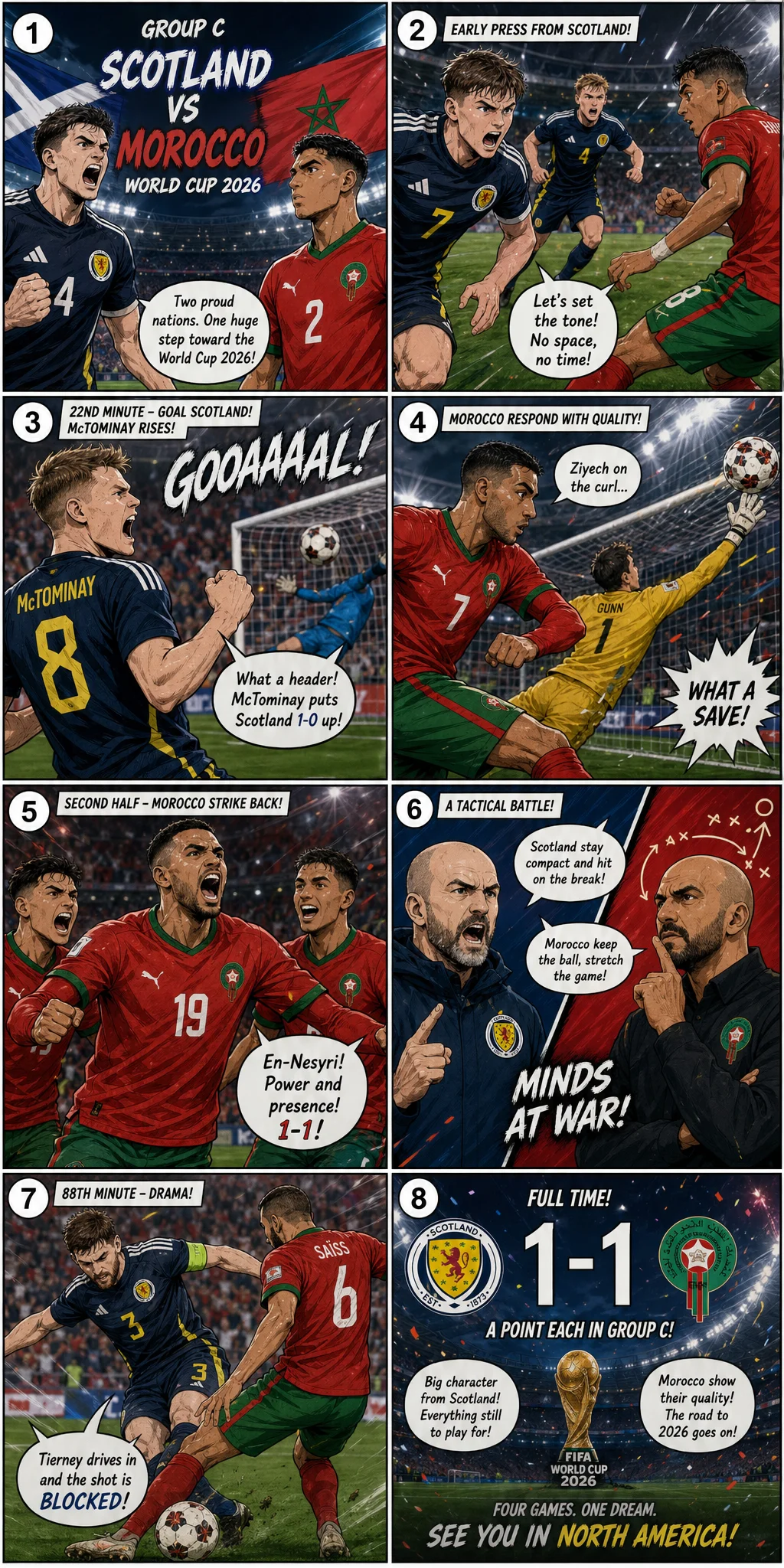
Scotland vs Morocco - Group C Preview
2026 World Cup Group C: Scotland vs Morocco at Gillette Stadium
Published: June 6, 2026
# Scotland vs Morocco: A Clash of Two Football Civilisations
On the world map of football, Scotland and Morocco occupy entirely different coordinates. One is the nation that invented the basic act of "passing" — Scottish footballers in the late 19th century were the first to recognise that passing the ball to a teammate was more efficient than individual dribbling, a realisation that ultimately changed the entire trajectory of the sport. The other is the new beacon of African football — Morocco's 2022 World Cup semi-final run was not just their achievement, but a collective source of pride for the entire Arab world and the African continent. When these two histories meet at Gillette Stadium, the match itself is merely the tip of the iceberg.
## Clarke's Pragmatism and Its Limitations
Steve Clarke's coaching philosophy can be traced back to the fundamental soil of Scottish football. Scotland has never been the most talent-rich football nation — but it possesses a deep tradition of tactical discipline and collective will, a tradition rooted in the working-class football culture of the Industrial Revolution era: the collective above the individual, discipline above improvisation. Clarke's 4-2-3-1 is not designed to entertain the crowd, but to maximise limited resources — this in itself is an ancient piece of Scottish wisdom.
Scott McTominay (Napoli) is the heart of this system. His transformation at Napoli is a textbook case of career reinvention — evolving from a functional midfielder at Manchester United into Serie A's Player of the Year. His late runs into the box are Scotland's primary source of goals; qualifying data shows that 40% of Scotland's goals involve McTominay's involvement in the final third. Without him, this Scotland side's attacking threat would be halved.
But he needs more support around him. John McGinn (Aston Villa) didn't score in qualifying — but his off-the-ball movement creating space for teammates (xG assisted 1.42, highest in the squad) illustrates his invisible value within the system. McGinn is the kind of player that data cannot fully capture — his true worth lies in how his presence alters the opponent's defensive shape. Captain Andy Robertson's (Liverpool) left-wing crosses represent Scotland's second attacking channel — he delivered 11 key passes in qualifying, and nine years of top-level experience at Liverpool make him an irreplaceable leader in the dressing room.
Scotland's weaknesses are equally clear and concerning. The goalkeeper position — Craig Gordon is 43, and the three keepers have made a combined seven appearances this season — is a ticking time bomb. In modern football, the goalkeeper is not just the last line of defence but the starting point of the build-up; if this position is unreliable, the entire system suffers. The forward line — Che Adams (just 5 goals in Serie A) and Lyndon Dykes (only 3 goals in 36 Championship games) are both in deep goal droughts — forcing Clarke to seriously consider starting Ross Stewart (Southampton) or Lawrence Shankland (Hearts). The pace of 20-year-old Ben Gannon-Doak (Bournemouth) on the wing could be the biggest unknown.
## Morocco: The Difficult Transition from Miracle to New Normal
Morocco in 2022 was a phenomenon: seven matches, only two goals conceded (one an own goal), eliminating Spain and Portugal, pushing defending champions France to the final moments. But football history repeatedly tells us that miracles are hard to replicate — Hungary in 1954, Netherlands in 1974, Croatia in 2018 — all failed to reach the same heights at the next major tournament. This is the deeper reason why the Moroccan federation took the risk of promoting U-20 World Cup-winning coach Mohamed Ouahbi: they understand that for success to be sustained, evolution is necessary.
Ouahbi's Morocco is no longer content with pure counter-attacking football. His 4-2-3-1 incorporates elements of high pressing while retaining the defensive skeleton of the Walid Regragui era — a cautious evolution rather than a revolution. Achraf Hakimi (PSG) remains the tactical axis of the entire right flank — his timing of forward runs and crossing quality directly define Morocco's attacking output. Brahmin Diaz's (Real Madrid) creativity in the number 10 role is the key to Morocco's transition from midfield to attack — his 5 goals at AFCON prove his big-game ability.
Bilal El Khannouss (Stuttgart), 21, is a symbol of Morocco's midfield future. His progressive carries data in the Bundesliga makes him one of Europe's most-watched young midfielders. His decision to move from Leicester City to Stuttgart — choosing a club that offers consistent playing time over a bench role at a giant — reflects mature career planning. Sofyan Amrabat's (Real Betis) defensive coverage remains the system's foundation — his success rate in 1v1 duels allows Morocco to quickly regain defensive shape after losing possession. Yassine Bounou's (Al Hilal) stability in goal provides confidence for the entire backline.
## The Stakes of History
For Scotland, this match carries almost greater importance than a game against Brazil — because it represents their most realistic chance of taking all three points, and a crucial battle in breaking the curse of "never advancing past the group stage." For Morocco, this is a match that must prove something: that 2022 was not a flash in the pan, but the maturation of a system, the birth of a new order in African football.
Predicted score: Scotland 1-2 Morocco. Morocco's individual quality and counter-attacking efficiency slightly edge out Scotland's defensive resilience — but this will be an extremely tight match, likely decided by a single fine detail.