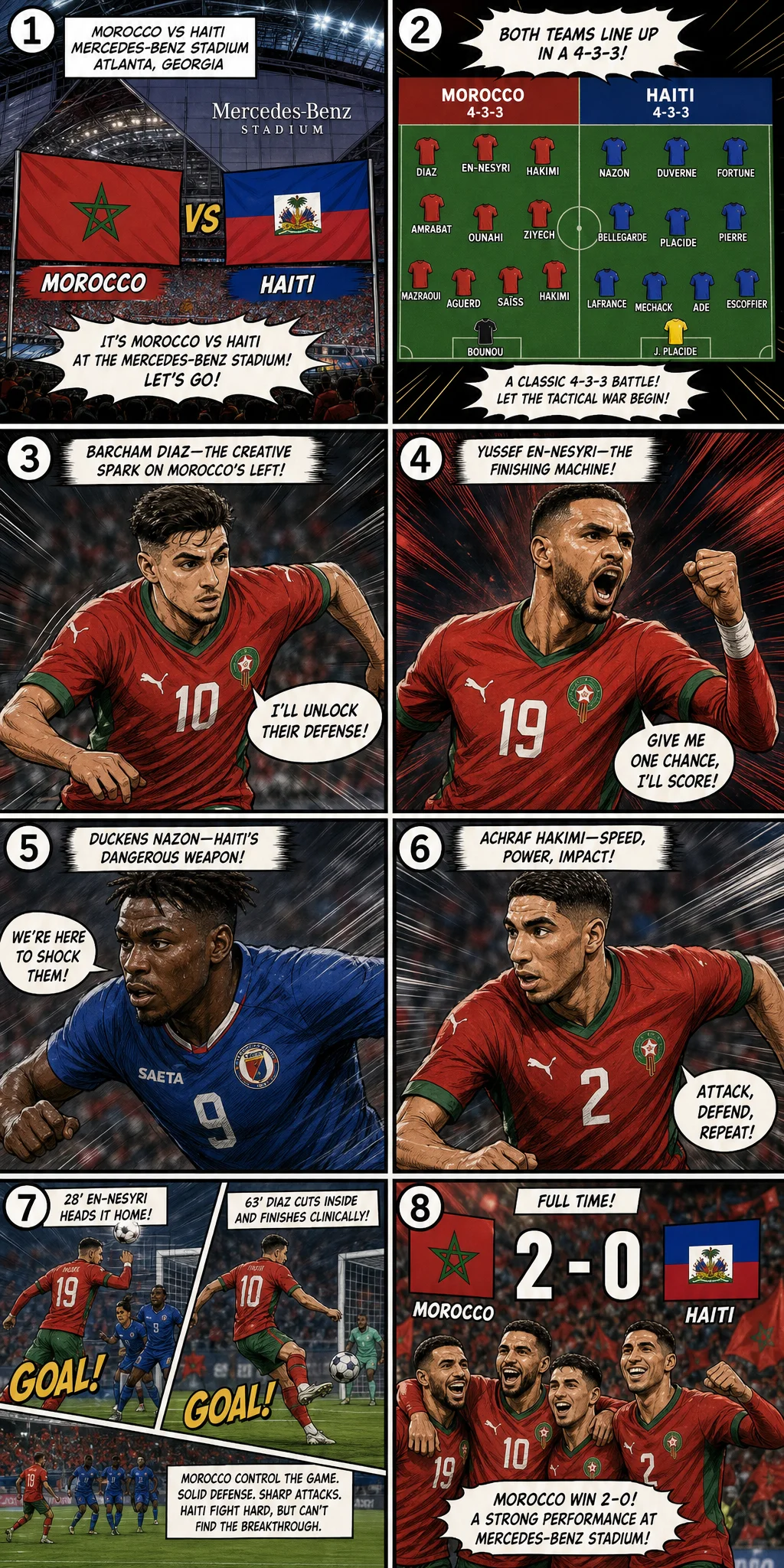
Morocco vs Haiti - Group C Preview
2026 World Cup Group C: Morocco vs Haiti at Mercedes-Benz Stadium
Published: June 6, 2026
# Morocco vs Haiti: The Ultimate Bet on Qualification and a Dialogue Between Two Footballing Faiths
The third round of group stage matches at the World Cup possesses a unique typological beauty: all pretence is stripped away, leaving only the naked mathematical reality. Morocco against Haiti – this Group C finale, staged at the Mercedes-Benz Stadium in Atlanta – will likely determine who joins Brazil in advancing to the knockout stages. For both teams and their fans, these 90 minutes carry not just qualification status – they carry the self-identity of an entire footballing civilisation.
## Morocco: A System's Coming of Age
Mohamed Ouahbi had only a few months to prepare when he succeeded Walid Regragui. He inherited not a team in need of rebuilding, but an already formed system – like a new CEO taking over a mature enterprise, the question is not whether to change direction, but how to inject new energy while maintaining core competitiveness. Football history is filled with cases of "failed succession" – think of Spain's coaching chaos after the 2014 World Cup, or Italy's prolonged迷失 after 2010. Ouahbi's task is to ensure Morocco does not join this list.
His experience winning the U-20 World Cup has given him a unique tactical calling card – he knows how to make young players shine on the biggest stage. 21-year-old Bilal El Khannouss (Stuttgart) has grown under his guidance into a top European midfield prospect – his performances in his second Bundesliga season (averaging 1.9 progressive carries per game, 86% pass completion) show he is ready for greater responsibility. Neil El Aynaoui (Roma) – son of tennis legend Younes El Aynaoui – represents the perfect embodiment of Morocco's diaspora strategy: a Moroccan-heritage youth born in Italy, choosing to play for his parents' country.
Morocco's 4-2-3-1 should be in optimal condition after the first two group matches. Achraf Hakimi's (PSG) right flank remains the attacking core – his crossing accuracy (32%, ranking in the top five among Europe's elite full-backs) is Morocco's most reliable attacking weapon. Brahim Diaz's (Real Madrid) creativity in the number 10 position provides the key to unlocking defences – his ability to turn and distribute in tight spaces allows Morocco to maintain possession on the edge of the opponent's box. Yassine Bounou's (Al Hilal) shot-stopping is the final insurance – the 34-year-old's performances in Saudi Arabia prove his reflexes have not diminished. Striker Youssef En-Nesyri's (Al Ittihad) aerial threat and Abde Ezzalzouli's (Real Betis) speed provide Ouahbi with diverse attacking options.
## Haiti: Existence is Victory – But Not Only That
Haiti's football story extends far beyond the pitch boundaries. A nation unable to play home matches amidst political turmoil, a team whose coach has never set foot in the country, a footballing civilisation returning to the world stage for the first time in 52 years – these facts alone are legendary. But football's charm lies in this: for 90 minutes, all external factors are temporarily set aside, leaving only the contest between 22 men on the field.
Sebastien Migne is not satisfied with a participation award – there is a hunger in his eyes, the hunger of the underestimated. His 4-3-3 proved its efficiency in the qualifiers – defeating Costa Rica without home advantage was a minor miracle in itself. Duckens Nazon's (Esteghlal) 6 qualifying goals (including a hat-trick against Costa Rica) demonstrate his big-game pedigree – 44 international goals are no accident. Jean-Ricner Bellegarde (Wolverhampton Wanderers) is the only player in the squad with consistent Premier League minutes; his creativity and set-piece ability will be key to Haiti breaking through – in the qualifiers, he was directly involved in 40% of Haiti's goals.
Wilson Isidor's (Sunderland) speed and directness are counter-attacking weapons – his sprint data in the Championship (top speed 35.1 km/h) means the Moroccan defence cannot relax for a single second. Ruben Providence's (Almere City) dribbling penetration is another card – his background in the PSG and Roma youth academies has given him a confidence born of surviving in top European environments. Danley Jean Jacques's (Philadelphia Union) interceptions and duels in midfield will be crucial to Haiti's resistance against Moroccan possession pressure.
## Qualification Arithmetic and Psychological Pressure: The Unique Dynamics of Matchday 3
The most subtle aspect of the third group matchday is the psychological dimension. If Morocco need a victory to secure qualification, the pressure is on them – the side expected to win is often more nervous than the challenger, a phenomenon repeatedly verified in sports psychology. If Haiti have already shown sufficient competitiveness in the first two rounds (even without winning), they can take the pitch with a "nothing to lose" mentality – that is the most dangerous kind of opponent.
The in-game decisions of both coaches will be crucial. Will Ouahbi dare to let young players shoulder responsibility under pressure? His experience at the U-20 World Cup tells us his trust in youth is not blind – but based on a deep understanding of their psychological resilience. Will Migne alter his cautious strategy when trailing? His experience at the Africa Cup of Nations shows he is a pragmatic coach, but one willing to take risks when necessary.
Viewed through the long lens of history, regardless of this match's outcome, it marks the continued rise of two non-traditional footballing powers on the world stage. Morocco must prove their 2022 run was no fluke; Haiti must prove their return is not an end, but a beginning.
Predicted score: Morocco 2-0 Haiti. Morocco's overall quality and World Cup experience will ultimately show the difference – but Haiti will make every minute a battle. For a team returning to the World Cup after 52 years, that in itself is victory.