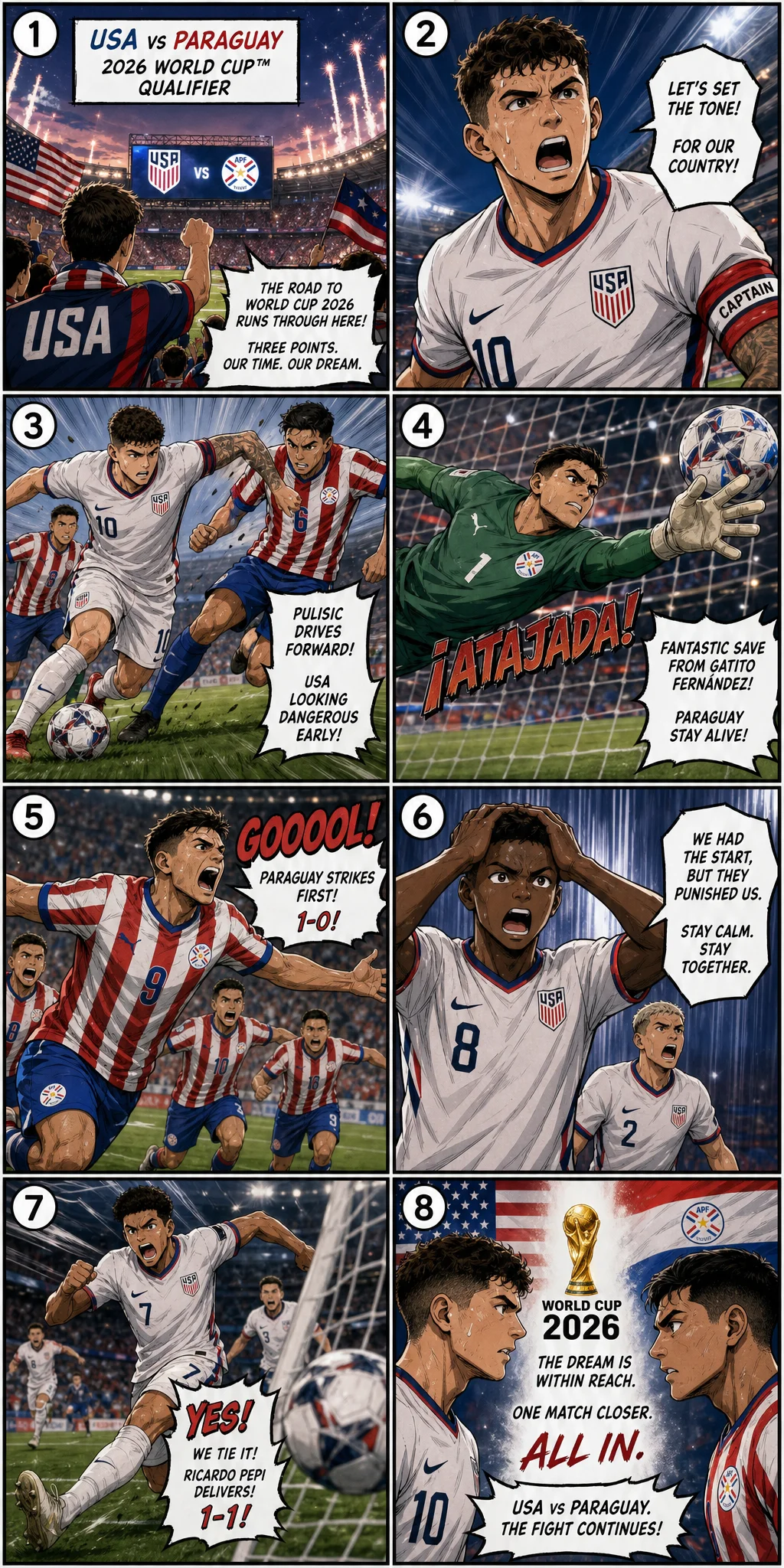
USA vs Paraguay: The Host's Pressure Test
Group D opener at SoFi Stadium. Pochettino's USMNT faces Alfaro's defensive Paraguay in a tactical chess match. Can the hosts break down CONMEBOL's most stubborn block?
Published: June 6, 2026
# USA vs Paraguay: The Host's First Pressure Test
When the World Cup hosts step onto the SoFi Stadium pitch for their opening match, they will not face an opponent that wants to play football — they will face a precisely engineered disruption machine. Gustavo Alfaro's Paraguay have not travelled to Los Angeles to entertain. They have come to drag this match into their tempo and wait for one counter-attacking moment.
This is the tactical problem that most troubles Mauricio Pochettino's United States.
Reviewing the USMNT's warm-up performances, a clear pattern emerges: when they play as the counter-attacking side — witness the 5-1 dismantling of Uruguay — this team looks like a high-speed pressing machine. But when they must dominate possession and dismantle a deep defensive block, the 2-5 loss to Belgium exposed structural vulnerabilities. Paraguay's tactical manual was written specifically to exploit this weakness.
From a formation-geometry perspective, the key battleground unfolds in two dimensions. First: Christian Pulisic's radius of operation in the left half-space. Paraguay's 4-2-3-1 contracts into a compact 4-4-2 block without the ball. Andres Cubas and Diego Gomez form the first barrier centrally; Juan Jose Caceres seals the outside channel. Pulisic is accustomed to receiving in crowded zones at AC Milan — but there he typically has Theo Hernandez's overlapping run as an outside option. With the national team, Antonee Robinson's timing must be precise to the second, or Pulisic gets isolated in a double-team.
The second — and more concerning — dimension: Tyler Adams' coverage responsibility as the lone defensive midfielder. Adams is this US squad's only true holding midfielder. No Johnny Cardoso, no Tanner Tessmann — Pochettino opted for attacking depth over defensive midfield backup. This means when Adams gets drawn out of position by Almiron or Enciso — and both are capable of doing exactly that — Chris Richards must decide whether to step out and fill the space or maintain the defensive line's integrity. Any hesitation gets punished by Paraguay's rapid transitions. Gustavo Gomez's 50-yard diagonal passing from the back is among the best in South America, and Antonio Sanabria's ability to run the channel on the counter should not be underestimated.
The US tactical advantages, however, are equally clear — and they are concentrated on one line. The Dest-Robinson wing-back pairing has few equals at the group stage level. Paraguay's full-backs habitually tuck inside to protect their center-backs, which means the American wing-backs will enjoy remarkable time and space in the opposition half. If McKennie can move the ball wide quickly and accurately — something he has proven capable of at Juventus — the US should generate enough crossing opportunities in the first half to break the deadlock.
The match's tempo will be defined by the opening 20 minutes. If the US scores early, Paraguay's passive strategy collapses — and that is precisely the scenario Pochettino's high-press system is built to exploit. But if it remains 0-0 after 60 minutes, Alfaro's side will squeeze tighter and tighter, and every stoppage, every throw-in, every foul becomes part of their time-management game. At that point, SoFi Stadium's 70,000 fans will shift from cheering to anxiety — and that anxiety transmits to the eleven players on the pitch.
This is not a match about talent — the United States are clearly superior in that department. It is a test of patience, of systemic discipline, of tactical maturity. Can Pochettino's system maintain structural integrity with 65% possession? The answer will define the hosts' trajectory at this World Cup.