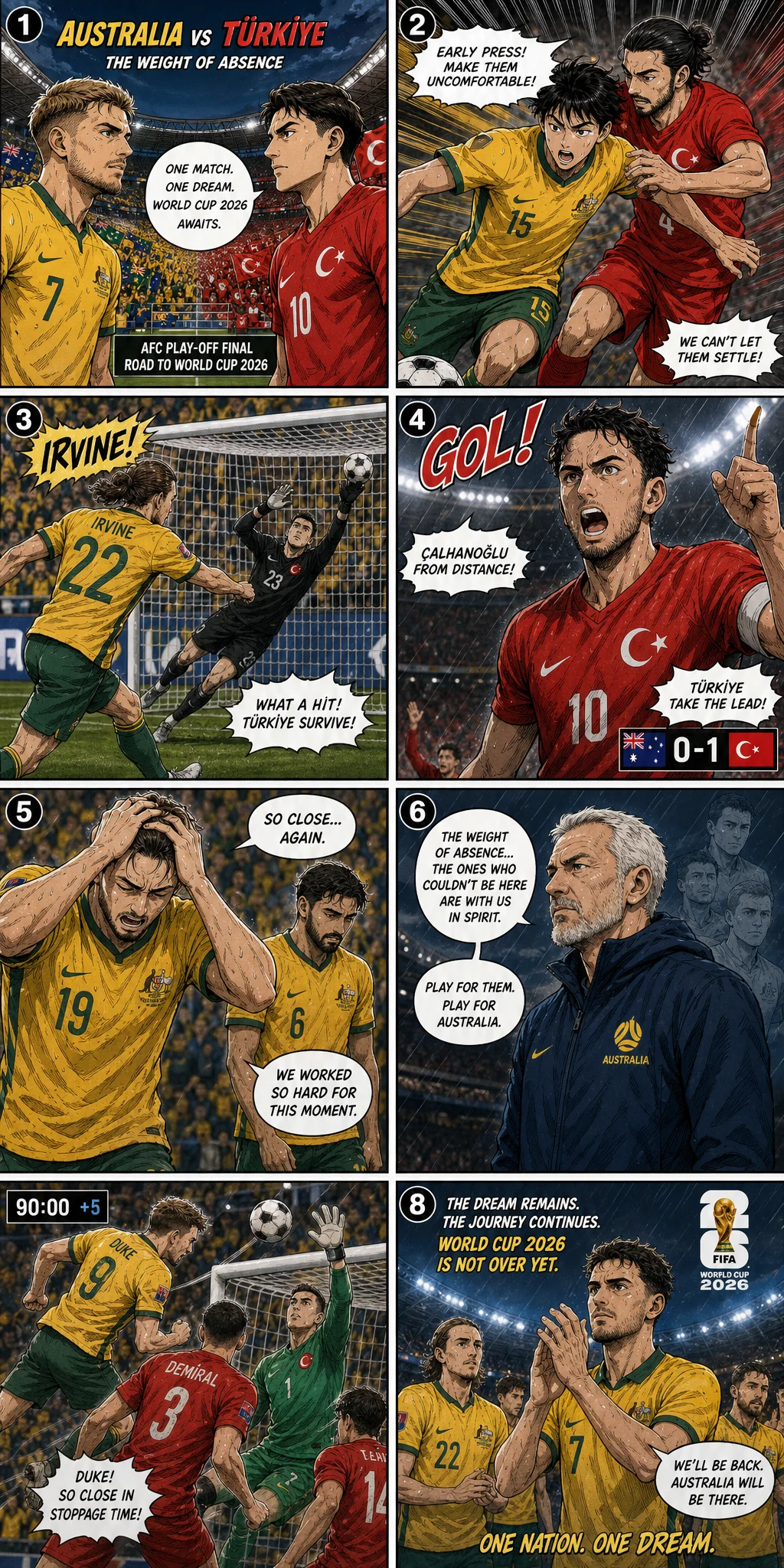
Australia vs Turkiye: The Weight of Absence
Two nations returning from long World Cup absences meet at BC Place. Australia's iron discipline under Popovic faces Montella's Turkish golden generation led by Arda Guler.
Published: June 6, 2026
# Australia vs Turkiye: The Weight of Absence
Twenty-four years. That is not merely a number — it is a generation. When Turkiye last appeared at a World Cup finals, Arda Guler had not been born; Hakan Sukur's 11-second goal against South Korea in the third-place match was still looping on television; Vincenzo Montella was a striker in flight for Roma, his aeroplanino celebration only just becoming an iconic fixture at the Stadio Olimpico. Twenty-four years later, Turkiye have returned, and they bring with them what is widely considered the most talented squad in the nation's history.
It is a story about waiting — and Australia have their own version to tell, even if their absence has been of a different kind.
The Socceroos' story is distinct. They have never missed a World Cup in this century — 2006, 2010, 2014, 2018, 2022, five consecutive appearances — but their record contains a paradoxical void: they have never won a knockout match. The Round of 16 has become a glass ceiling, visible but impenetrable. When Tony Popovic took over from Graham Arnold in September 2024, his mandate was not to get Australia to the World Cup — Arnold's system had proven it could do that — it was to get them through that first knockout match.
These two different types of absence — the complete twenty-four-year disappearance versus the continuous presence without breakthrough — have forged two distinct team psychologies.
Tracing the historical arc, Turkish football's essence has always been a tension: between European discipline and Anatolian passion, between Ottoman tradition and modern republican identity, between individual genius and collective system. Montella — an Italian raised in Naples — understands this tension in ways his Turkish predecessors perhaps could not. He has spoken of the cultural similarities between Naples and Turkiye: the centrality of family, the intensity of emotion, the meaning of football as collective release. This is not a foreign coach managing an exotic team; it is a Mediterranean man guiding another Mediterranean people.
Popovic's Australia represents a different proposition: a team built on discipline, physicality, and system, in search of a creative spark. The 3-4-3 formation reflects this philosophy — three center-backs providing a secure foundation, two wing-backs offering width, and the front three featuring Irankunda and Volpato supplying that element of unpredictability. It is a precisely calibrated system in which Harry Souttar's aerial dominance and Alessandro Circati's composed organization serve as both defensive bedrock and set-piece offensive weapons.
The tactical heart of this match is the duel between two young men: Arda Guler, 21, and Nestory Irankunda, 20. Both are their nations' X-factors — players with the talent to bend a match to their will through a single action. Guler is the more refined product, his left foot capable of conjuring passing lanes that geometry suggests should not exist; Irankunda is the more raw force, his pace and directness recalling the great African forwards of an earlier era.
But the match will likely be decided not by these two prodigies but by the midfield generals: Hakan Calhanoglu and Jackson Irvine. Whoever controls the tempo — Calhanoglu's long-range distribution and shooting threat, or Irvine's covering range and physical presence — will create the platform for their young forwards to shine. In a match likely to be settled by one or two key moments, control of the middle third is everything.