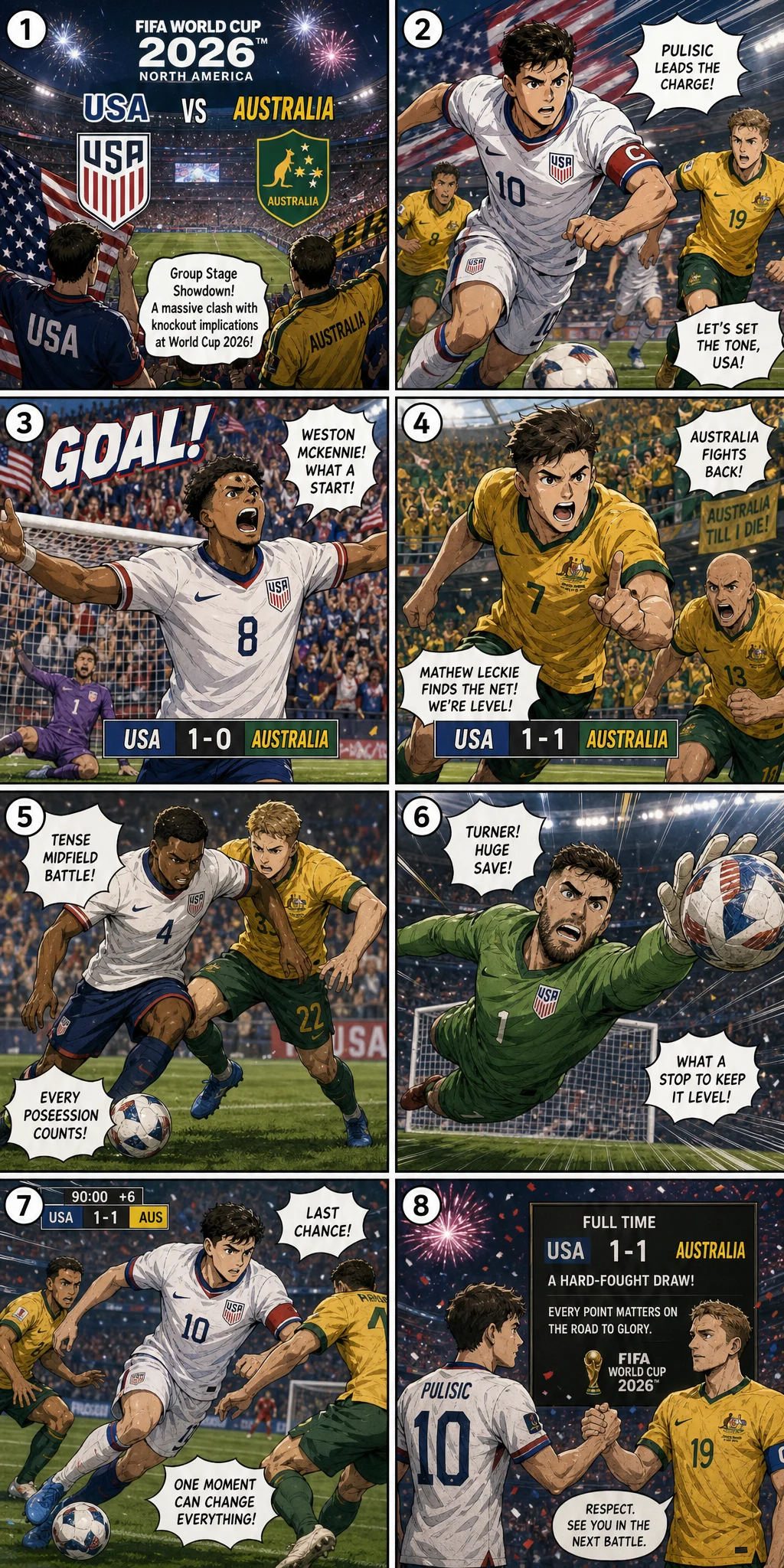
USA vs Australia: The Host's Identity on Trial
At Lumen Field, Seattle. The co-hosts face the Socceroos in what could be a qualification decider. American expectation meets Australian resilience in front of 68,000.
Published: June 6, 2026
# USA vs Australia: Home Advantage or Home Burden?
Home. In football, the word carries two meanings, and the relationship between them has never been as straightforward as it appears. It can be a fortress — a place that makes opponents feel small, a place that makes you feel invincible. It can also be a courtroom — where every misplaced pass is entered into evidence, where every missed chance is a violation of national honour. On June 19, 2026, at Lumen Field in Seattle, the United States will find itself standing at the center of both the fortress and the courtroom simultaneously.
This is the hosts' second group match, and its psychological weight far exceeds the first. The opener against Paraguay — that match carried the thrill of the opening, the freshness, the new grass of SoFi Stadium and new hope. But the second match is something different. The second match is the arrival of reality. It arrives in the middle of the fixture list, at the moment when group dynamics begin to crystallize — a misstep can mean suddenly having to fight for survival in the final round.
And Australia, as ever, are more than happy to play the role of disruptor.
There is a curious historical relationship between Australian football and the host-nation narrative. They do not need home advantage to prove themselves — they have produced their best football far from their own shores. In Germany in 2006, they came within a penalty of eliminating the eventual champions Italy. In Qatar in 2022, they pushed Argentina to the limit in the Round of 16. Tony Popovic's side will not be intimidated by the narrative of beating the United States on American soil — they will treat it as fuel.
The tactical configurations of this match reveal two distinct football philosophies. The United States under Pochettino is pursuing a hybrid approach — part European elite-club possession structure, part American athletic directness. The 3-4-2-1 offers everything in theory: three-center-back security, wing-back attacking width, dual number-ten creativity. But in practice, this system depends on two players to a worrying degree: Tyler Adams' coverage ability in defensive transition, and Christian Pulisic's creativity to unlock defenses in crowded spaces.
Australia has no such internal contradictions. Their 3-4-3 system knows exactly what it wants: stay compact, limit the opponent's space, threaten on set pieces, let Irankunda run on the counter. This system is not beautiful, but it is honest — it acknowledges its own limitations and maximizes its strengths within those constraints. In a match where the hosts must win and the challenger merely needs not to lose, that honesty might be the most dangerous weapon.
Harry Souttar will be the most important non-American player in this match. On corners and free kicks, his aerial threat poses a specific kind of problem for the US backline: neither Richards nor Ream are center-backs known for their physical dominance. The US will need a plan — not just man-marking Souttar, but a counter to Australia's carefully designed screening tactics to create space for their giant defender.
But in the end, the true protagonist of this match is not any individual player — it is the collective psychology of American soccer. In past World Cups, the United States has performed best as the underdog — against Portugal in 2002, against England in 2010, against England in 2022. Being the expected winner, at home, in front of your own fans, carrying the weight of a nation's expectations — this is a challenge they have never truly faced. Lumen Field's 68,740 spectators will be both their greatest asset and their heaviest burden.