Brazil: Journey to 2026
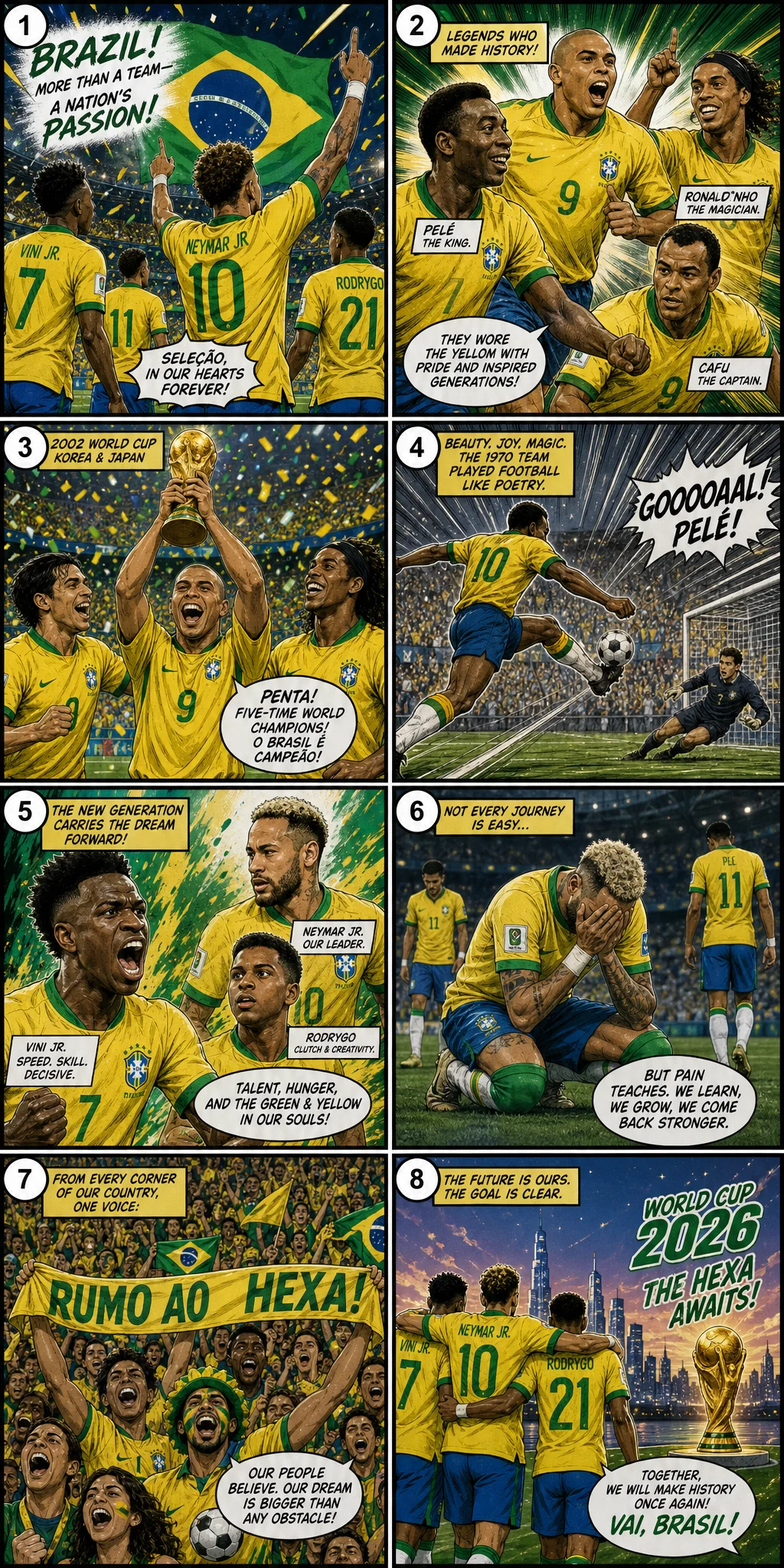
8-panel comic about Brazil national football team and their journey to the 2026 FIFA World Cup.
Published: June 5, 2026
Brazil National Football Team: The Eternal Search for the Sixth Star
The Brazil national football team, known as "Seleção" — The Selection — and "Canarinho" — Little Canary — for their iconic yellow jerseys, represents the most successful and romanticized football culture in human history. Five World Cup titles, a pantheon of legends that defines the sport's highest possibilities, and a playing philosophy known as "jogo bonito" — the beautiful game — have made Brazil synonymous with football itself. Entering the 2026 FIFA World Cup, the Seleção carries its eternal burden: nothing less than the championship is acceptable, and the quest for the sixth star, the "hexa," consumes the nation.
HISTORICAL FOUNDATIONS
Football arrived in Brazil in 1894, brought by Charles Miller, the São Paulo-born son of a Scottish railway engineer who returned from his studies in England carrying two footballs and a rulebook. The sport spread with astonishing speed, embraced by a racially diverse population that found in football a rare arena of social mobility and national expression. By the 1930s, Brazil had hosted and competed in its first World Cup, and the foundations of a football superpower were being laid.
The 1950 World Cup, hosted by Brazil, should have been the coronation. The Maracanã Stadium, built to hold 200,000 spectators, was the temple constructed for the anticipated celebration. In the final match — officially the deciding match of a final group stage — Uruguay defeated Brazil 2-1 before a crowd estimated at 199,854, a national trauma known as the "Maracanazo" that scarred the country's psyche. Goalkeeper Moacir Barbosa was scapegoated for decades, a reminder of the merciless pressure that accompanies Brazilian football.
Redemption came in Sweden in 1958 with Pelé, just 17 years old, announcing himself to the world. His goals in the final against the hosts — the first a breathtaking piece of close control and volleyed finish — introduced a new standard of footballing genius. Brazil retained the trophy in Chile 1962, with Garrincha, the "Joy of the People," mesmerizing defenders with his impossible dribbling. The 1970 team, widely considered the greatest club or international side ever assembled, won the World Cup in Mexico with a style of play that has never been surpassed for its fusion of individual brilliance and collective harmony. Pelé, Tostão, Jairzinho, Rivelino, and Carlos Alberto — their names ring through football history like a hymn. Carlos Alberto's goal in the final against Italy, the culmination of a team move involving almost every outfield player, remains football's most perfect expression.
A 24-year drought followed before the 1994 team, led by Romário and Bebeto, won the World Cup in the United States with a more pragmatic but undeniably effective approach. Ronaldo's redemption — from the mysterious seizure before the 1998 final to his eight-goal golden boot performance in 2002, leading Brazil to its fifth title — is one of sport's most compelling individual narratives.
LEGENDS OF THE SELECAO
Pelé transcends football. His 1,283 goals in 1,363 matches, three World Cup titles, and role as the sport's first global superstar make him the benchmark against which all greatness is measured. His athleticism — combining sprinter's speed, gymnast's agility, and a striker's instinct — was unprecedented. His legacy encompasses far more than sport: he is Brazil's most recognized global symbol, an ambassador for the country and for football itself.
Garrincha, the "Angel with Bent Legs," was Pelé's shadow and light — a man whose physical deformities (a twisted spine, one leg six centimeters shorter than the other) should have prevented him from walking, let alone producing the most devastating dribbling the game has seen. His performances in the 1962 World Cup, carrying Brazil to the title after Pelé's injury, remain one of sport's most remarkable individual achievements.
Zico, the "White Pelé," was the defining Brazilian player of the late 1970s and early 1980s, a midfield artist whose free-kicks, passing, and goalscoring made him the spiritual heir to the great number 10 tradition. Sócrates, the bearded philosopher-captain with the back-heel pass and the medical degree, led the 1982 team — a side that did not win the World Cup but won immortality for its breathtaking commitment to attacking beauty.
Romário was the penalty-box genius, a man who once informed his coach that he would not participate in a training session because "God didn't give me the gift of running, God gave me the gift of scoring goals." Ronaldo Nazário, "O Fenômeno" — The Phenomenon — redefined what a striker could be before knee injuries that would have ended lesser careers. His comeback to win the 2002 World Cup is football's ultimate story of resilience. Ronaldinho Gaúcho brought joy — pure, infectious, improvised joy — to the game, his elastic dribbling and no-look passes making football feel like a playground game elevated to art.
Neymar, the heir to this impossible legacy, has carried the weight of a nation's expectations with mixed results. His skill is undeniable — only Pelé has scored more goals for Brazil — but World Cup injuries in 2014 and 2018, combined with the perception that his club career at Paris Saint-Germain stalled rather than flourished, have left his legacy incomplete. The 2026 tournament represents, perhaps, his last chance to join the immortals.
THE MODERN ERA
Brazil enters the 2026 World Cup with its traditional attacking riches and a more balanced tactical approach than in previous generations. Vinícius Júnior, the electric Real Madrid winger, has developed into one of the world's most devastating attackers — his pace, dribbling, and improving end product making him a Ballon d'Or contender. Rodrygo, his club teammate, provides technical excellence and tactical intelligence from multiple attacking positions.
The emergence of Endrick, the Palmeiras prodigy who joined Real Madrid before his 18th birthday and has already scored for the senior national team, represents the latest chapter in Brazil's endless production of attacking talent. His low-center-of-gravity power, clinical finishing, and precocious composure have drawn comparisons to Romário — the highest praise in Brazilian football's vocabulary.
The midfield features Bruno Guimarães, the Newcastle United conductor whose passing range and tactical intelligence provide the team's rhythm, and Lucas Paquetá, whose creativity and goal threat from central areas add a different dimension. The defensive unit, anchored by Marquinhos and Éder Militão, combines experience with athletic quality. Alisson Becker and Ederson, two of the world's finest goalkeepers, provide elite-level security at the position that was historically Brazil's vulnerability.
FOOTBALL AND BRAZILIAN CULTURE
Football in Brazil is not a pastime or an entertainment product — it is a fundamental element of national identity, a religion with more devoted adherents than Catholicism. The sport serves as a metaphor for Brazilian society: the creative genius emerging from poverty, the tension between individual expression and collective discipline, the pursuit of joy amid difficulty.
The Brazilian domestic game, anchored by historic clubs like Flamengo, Corinthians, São Paulo, Santos, and Palmeiras, remains one of the world's most passionate and productive football environments. The Campeonato Brasileiro produces a constant stream of talent exported to Europe's wealthiest leagues, and the state championships that precede the national season provide a unique calendar rhythm — small-town clubs facing giants, dreams being born on dusty pitches across the continent-sized nation.
Football and politics have always been intertwined in Brazil. The military dictatorship's embrace of the 1970 team, the democratic movements associated with the "Democracia Corinthiana" of the 1980s, the massive protests surrounding the 2014 World Cup's costs — the sport has never been separate from the nation's broader struggles over resources, identity, and justice.
THE PATH FORWARD
Brazil enters every World Cup as a favorite, and 2026 is no different. The expanded 48-team format introduces new variables — more matches to win, more opportunities for something to go wrong — but the Seleção's depth of talent should be an advantage over the tournament's duration. The 2022 quarter-final exit to Croatia on penalties remains a scar, a reminder that talent alone does not guarantee triumph.
The tactical evolution under the current coaching staff has incorporated European organizational principles without sacrificing the Brazilian attacking identity. The team presses high, transitions rapidly, and possesses the individual quality to unlock even the most organized defenses. The wide attacking options — Vinícius, Rodrygo, and emerging talents — provide the one-on-one dominance that has always been Brazil's greatest weapon against packed defenses.
The quest for the hexa consumes Brazil. Every four years, the same question is asked: will this be the team that brings home the sixth star? The answer, as always, will be written on the pitch. For Brazil, anything less than the championship is failure — the eternal condition of football's most demanding nation.