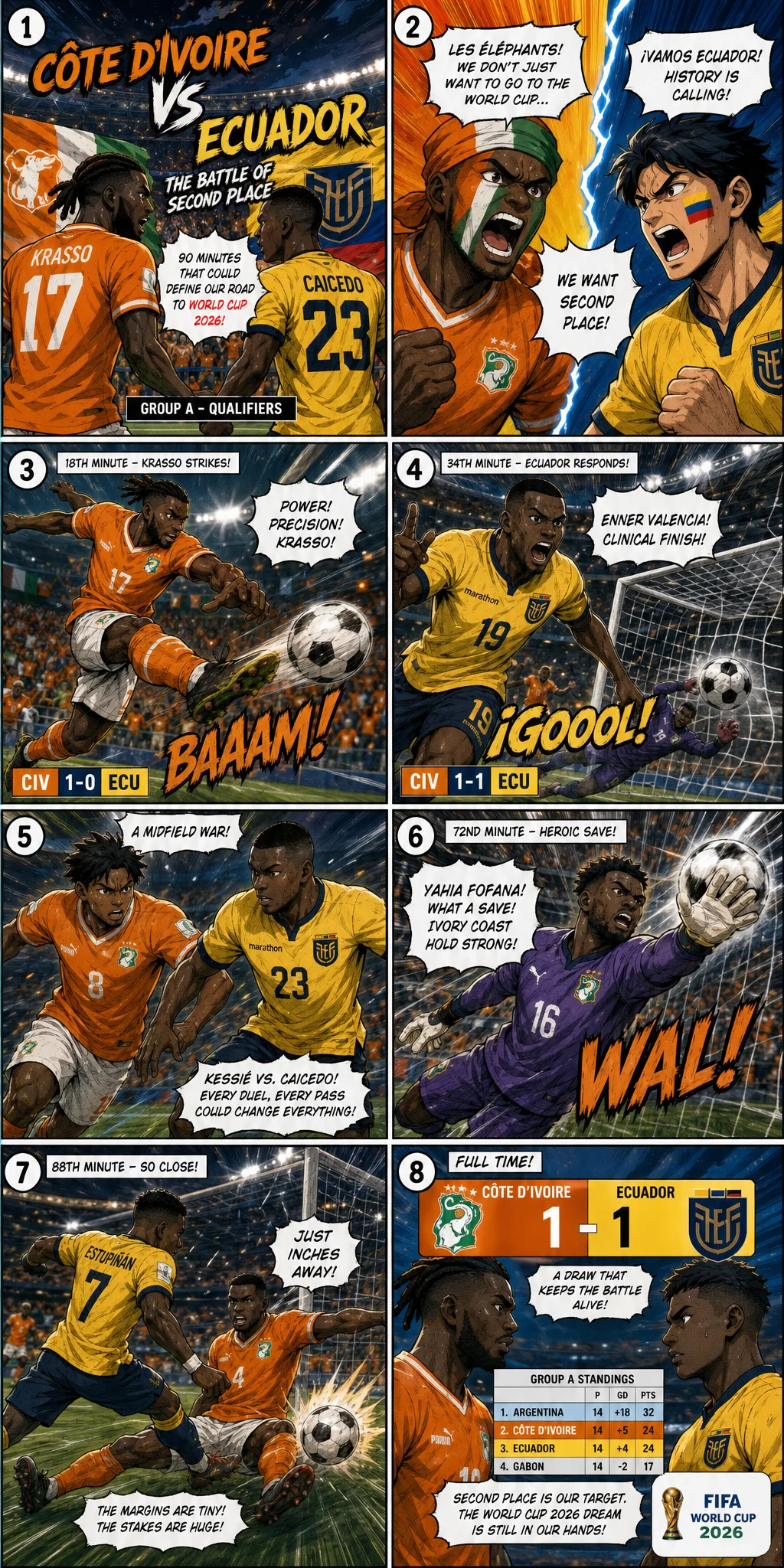
Côte d'Ivoire vs Ecuador: The Battle of Second Place
8-panel match preview comic for Côte d'Ivoire vs Ecuador, Group E Matchday 1. Panel 1: Lincoln Financial Field Philadelphia at dusk, Ivorian orange and Ecuadorian yellow in the stands. Panel 2: Emerse Faé holding the AFCON 2023 trophy, transition to coaching board showing 4-3-3. Panel 3: Yan Diomandé dribbling at speed, RB Leipzig kit visible in flashback, defenders trailing. Panel 4: Moisés Caicedo in Chelsea blue making a crunching tackle, ball flying away. Panel 5: Kendry Páez, 19, doing step-overs, Ecuador yellow kit, creative intensity. Panel 6: Amad Diallo cutting inside from the right wing, Man United red flashback. Panel 7: Hincapié and Pacho standing like a wall, Ecuador's defensive line. Panel 8: Split panel — both teams in huddles before kickoff, tension visible.
Published: June 6, 2026
Côte d'Ivoire vs Ecuador: The Battle of Second Place
The logic of Group E is simple: Germany finishes first, the other three fight for second. This makes Côte d'Ivoire vs Ecuador, effectively, a knockout match within the group stage — the loser almost certainly does not advance.
This presents a fascinating tactical symmetry: both teams are built on defensive solidity, both use midfield work-rate and physicality to close spaces, both lack a reliable finisher up front. Yet they achieve these objectives through diametrically opposite means — one through African chaotic creativity, the other through South American systemic discipline.
Côte d'Ivoire: Faé's Art of Chaos
Emerse Faé authored an impossible miracle at the 2023 Africa Cup of Nations: he took over the team mid-tournament and won the title. Since then, he has lost only five of twenty-five matches in permanent charge. Côte d'Ivoire conceded zero goals in ten qualifiers — a statistic that borders on absurd for any continent.
But those clean sheets in qualifying conceal a structural problem: this Ivorian defense is not stable. At AFCON 2025, against stronger opposition, the backline repeatedly exposed its chaotic tendencies — even as they sliced opponents apart going forward. This team is a supercar engine mounted on a chassis without a roll cage: it might explode at any moment, but nobody can catch it when it accelerates.
Midfield is Côte d'Ivoire's strongest zone. Franck Kessié — captain, over one hundred caps — has his competitive sharpness questioned by his Saudi Arabian club spell, but he remains a "big game player": in the 2023 AFCON semi-final, he came off the bench to change the match against Senegal, then scored in the final. Alongside him, Christ Inao Oulaï is one of the most exciting young midfielders on the African continent — low centre of gravity, physically robust, capable of receiving under pressure and threading passes through opposition lines. He was described as "arguably the best midfielder at AFCON 2025."
The attacking focus rests on two players: Yan Diomandé, the nineteen-year-old RB Leipzig left winger who was at a Florida football academy barely eighteen months ago — now valued at over eighty million pounds, fresh off winning Bundesliga Rookie of the Year. Amad Diallo, the twenty-three-year-old Manchester United attacker, is Côte d'Ivoire's creative hub — three goals at AFCON 2025 and the winner in a pre-tournament friendly against France.
But Côte d'Ivoire's biggest problem — the one that has haunted them for two decades — is the absence of a reliable number nine. Sébastien Haller was not selected. Elye Wahi has talent but has never delivered consistently for the national team. Côte d'Ivoire had fifteen different goalscorers in qualifying — which sounds positive but actually means no single player can be relied upon.
Ecuador: South America's Steel Wall
If Côte d'Ivoire is the art of chaos, Ecuador is the science of discipline. Sebastián Beccacece — an Argentine from the Bielsa school — has transformed this Ecuador into a moving wall. Five goals conceded in eighteen qualifiers. Five. Across the entire Americas — including Argentina, Brazil, and Uruguay — no team posted a better defensive record.
The system's core is Moisés Caicedo. The twenty-four-year-old Chelsea midfielder is a perpetual motion machine — tackle, interception, short pass, long pass, tackle again. He is one of the Premier League's highest-intensity midfielders, and Beccacece's entire system depends on his covering capacity in midfield. Ahead of him, nineteen-year-old Kendry Páez — also Chelsea-bound — is Ecuador's creative spark. His left-footed dribbling and penetrating passes are Ecuador's only reliable means of breaking down compact defenses.
The back four all play in Europe's top leagues: Willian Pacho (Paris Saint-Germain) and Piero Hincapié (Arsenal) form a centre-back partnership that may be among the best at the entire World Cup. Hincapié's passing range — his ability to find wingers directly from the back — is the launch point for Ecuador's rapid transitions. Left-back Pervis Estupiñán has enjoyed an excellent season at AC Milan.
But Ecuador's problem mirrors Côte d'Ivoire's exactly: the attacking end. Fourteen goals in eighteen qualifiers — fewer than Bolivia. Enner Valencia, Ecuador's all-time leading scorer, is thirty-six, and his fitness is the biggest question mark. If he cannot last ninety minutes, Beccacece must rely on Gonzalo Plata's individual wing play or Caicedo's long-range efforts — neither a reliable source of goals.
Tactical Matchup: Caicedo vs Kessié-Oulaï
This match will be decided in midfield. Can Caicedo's range simultaneously neutralize Kessié's physicality and Oulaï's line-breaking passes? If Caicedo is forced into excessive lateral movement, Páez loses his supply line further forward — and Ecuador's attack devolves into Plata trying to beat defenders one-on-one on the right flank.
Conversely, Côte d'Ivoire needs Amad Diallo to find receiving space in the channel between Ecuador's centre-backs and full-backs. The Hincapié-Pacho partnership concedes almost nothing with backs to goal — but if Diallo can cut inside from the wing toward central areas, he can bypass the face-to-face defending that makes Ecuador so formidable.
Prediction
This is an enormously difficult match to call. Both teams defend better than they attack — but Côte d'Ivoire's attacking ceiling (the individual talent of Diomandé, Diallo, and Oulaï) is visibly higher than Ecuador's. Ecuador may execute Beccacece's pressing system perfectly for seventy minutes, then concede to a moment of Ivorian individual brilliance.
The rational prediction: Côte d'Ivoire 1-0. Diomandé or Diallo will find the one chance that matters in the match's latter stages. But a 0-0 draw is equally logical — neither team's attacking efficiency guarantees a goal.
A Philadelphia night at Lincoln Financial Field. Two defensive juggernauts. A match where a goal may come only from a mistake.