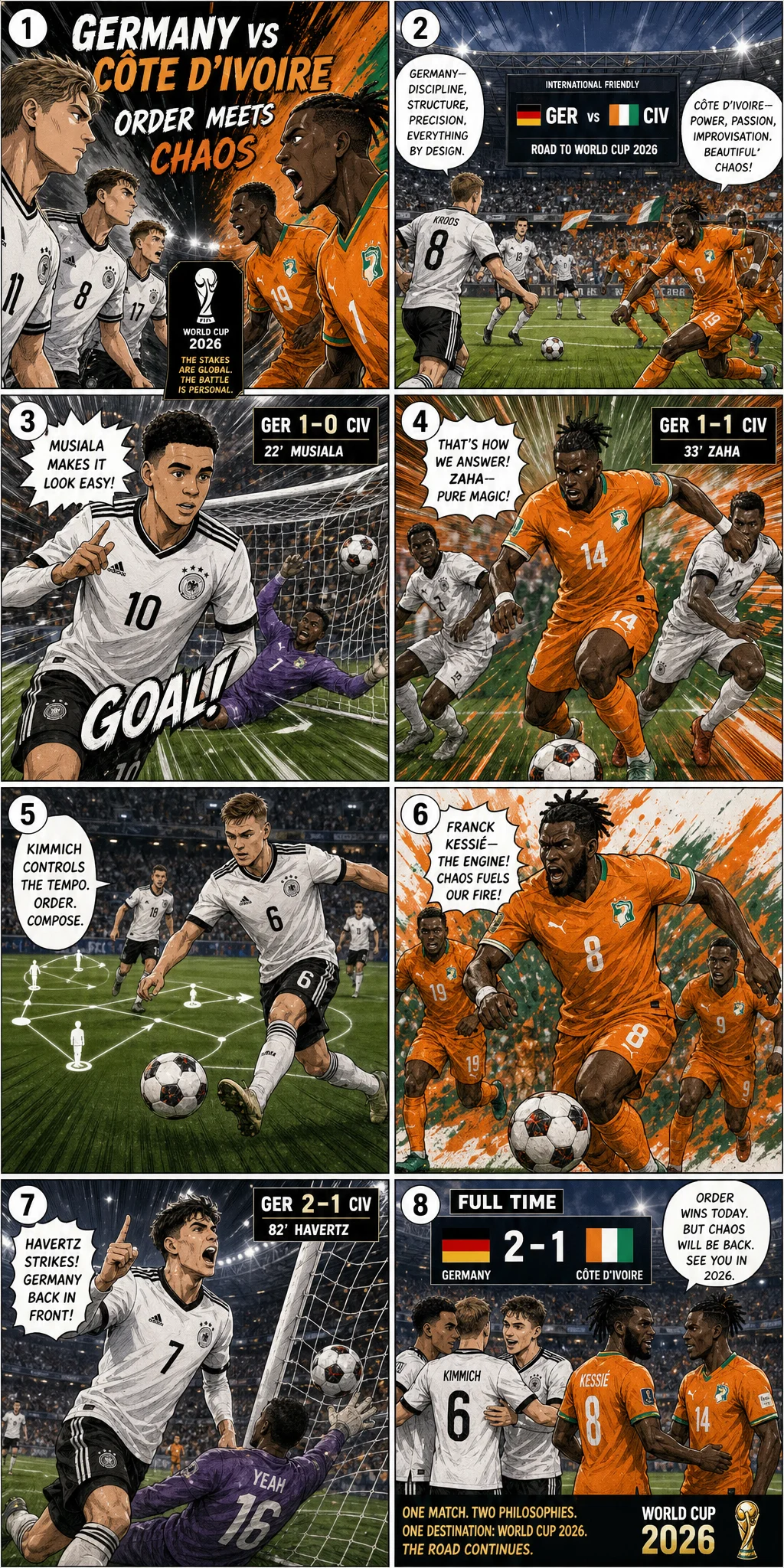
Germany vs Côte d'Ivoire: Order Meets Chaos
8-panel match preview comic for Germany vs Côte d'Ivoire, Group E Matchday 2. Panel 1: BMO Field Toronto, CN Tower visible, cool evening atmosphere. Panel 2: Wirtz receiving ball in half-space, German passing triangles overlaid. Panel 3: Oulaï turning away from pressure, threading a through-ball, Trabzonspor flashback. Panel 4: Kimmich and Kessié in midfield shoulder-to-shoulder duel. Panel 5: Diomandé sprinting past a defender on counter-attack, speed lines. Panel 6: Musiala dribbling through three Ivorian defenders. Panel 7: Ndicka and Ousmane Diomandé communicating, organizing defensive line. Panel 8: Tactical chess board metaphor — Nagelsmann and Faé as chess players, pieces representing their formations.
Published: June 6, 2026
Germany vs Côte d'Ivoire: When Order Meets Chaos — Round 2 Pressure Test
Second matchday. Germany enters Toronto's BMO Field carrying three points and a goal-difference cushion. Côte d'Ivoire — assuming they navigated past Ecuador in their opener — arrive with three points of their own. This makes the match, in all likelihood, the Group E decider for top spot.
Tactically, this is one of the most anticipated matchups of the group stage: a precision-calibrated German machine against an Ivorian side powered by chaos and genius.
Germany's Tactical Evolution: From Curaçao to Côte d'Ivoire
Matchday one against Curaçao was an "expected victory" — Germany likely held over seventy percent possession against an opponent in full retreat, the match becoming a test of patience and penetration. What Nagelsmann truly tested in that match was not his players — it was his system's capacity to break down an extreme low block.
Against Côte d'Ivoire, the problem is entirely different. Faé's team will not retreat en masse. Their 4-3-3 midfield trio — Kessié, Oulaï, Sangaré (or Seko Fofana) — will press high in midfield, attempting to force errors in Germany's build-up phase. Oulaï is key: his entire season at Trabzonspor has been an exercise in receiving in midfield, turning, and threading passes through lines. If he can evade Pavlović's marking and find Diomandé or Diallo in wide areas, Germany's defensive line will be forced backward — and Côte d'Ivoire's dual wingers will get the one-on-one situations they crave.
But Germany's counter is equally clear. Kimmich's defensive work against Oulaï will define the match's structure. If Kimmich, inverting into midfield, can limit Oulaï's turning radius — an instinct from his own background as a central midfielder — Côte d'Ivoire's progression chain breaks at the first link. Pavlović can then focus on long switches of play, releasing Wirtz and Musiala into the space behind Côte d'Ivoire's midfield — the nightmare zone for any African opponent.
The Wirtz Proposition
A telling data point: Wirtz averages 3.7 key passes per match for Germany, far exceeding his 1.9 at Liverpool. The national team's tactical framework grants him greater freedom — at Liverpool, he is part of the system; for Germany, he is the system.
Against Côte d'Ivoire, Wirtz's touch locations will define Germany's attacking geometry. If he primarily receives in the left half-space, right-back Wilfried Singo (Galatasaray) will be pulled into uncomfortable positions — Singo excels at physical duels, not spatial defending. If Wirtz drifts centrally, the Ousmane Diomandé-Evan Ndicka centre-back pairing faces the classic "who steps out" dilemma: who leaves the defensive line to engage Wirtz in the pocket between defence and midfield?
Côte d'Ivoire's Transition: The Diomandé Moment
Yan Diomandé is the most exciting nineteen-year-old at this World Cup. His breakthrough Bundesliga season — including a hat-trick against Eintracht Frankfurt — is built on one simple, lethal skill: acceleration after cutting inside from the left. His first-step explosiveness makes him impossible for full-backs to stay tight to, and his shooting selection — far post, near post, chip — exceeds his years.
Kimmich's defensive vulnerability — if one must be found — is recovery against pure pace on the wing. Kimmich reads the game brilliantly, but physical speed is not his asset. If Diomandé receives on the counter, isolated against Kimmich one-on-one, Nagelsmann may need Jonathan Tah or Schlotterbeck to slide across in cover — opening central space for Diallo or Kessié's late arrivals to become lethal.
Prediction
Germany should still win. They hold individual quality advantages in almost every position, and Nagelsmann's system tends to be more effective against opponents who also try to attack — because the spaces for Wirtz and Musiala become larger. But Côte d'Ivoire's match plan is not difficult to imagine: disrupt Germany's rhythm in the first half through physicality and midfield destruction, drag the match into chaos, then wait for Diomandé's magic on the counter.
The rational prediction: Germany 2-1. Côte d'Ivoire will score — they are too talented to be shut out — but Germany's collective quality will tell after seventy minutes. But if Côte d'Ivoire actually wins, it will be one of the biggest group-stage upsets of this World Cup.