
독일 vs 퀴라소 — NRG의 다윗과 골리앗
Germany faces Curacao in an extraordinary David-and-Goliath encounter pitting the four-time champion against a Caribbean island of 150,000 making its 월드컵
게시일: June 6, 2026
독일 vs 퀴라소: 패배가 허용된 팀 — 2026 월드컵 E조 전술 프리뷰
[KO] This article is an English-language tactical preview. A full translation to ko will be provided before match day.
Germany vs Curaçao: The Team Allowed to Lose, and the Team That Isn't
This is not a match. It is a tactical proposition.
When a team with four World Cup titles, seven Bayern Munich players, and a collective market value exceeding one billion euros faces an island nation of fewer than 190,000 people whose entire squad is worth less than a single German substitute — this is not a contest of strength, it is two different ways of existing in the football world colliding.
Germany's System: Nagelsmann's Four-Dimensional Chessboard
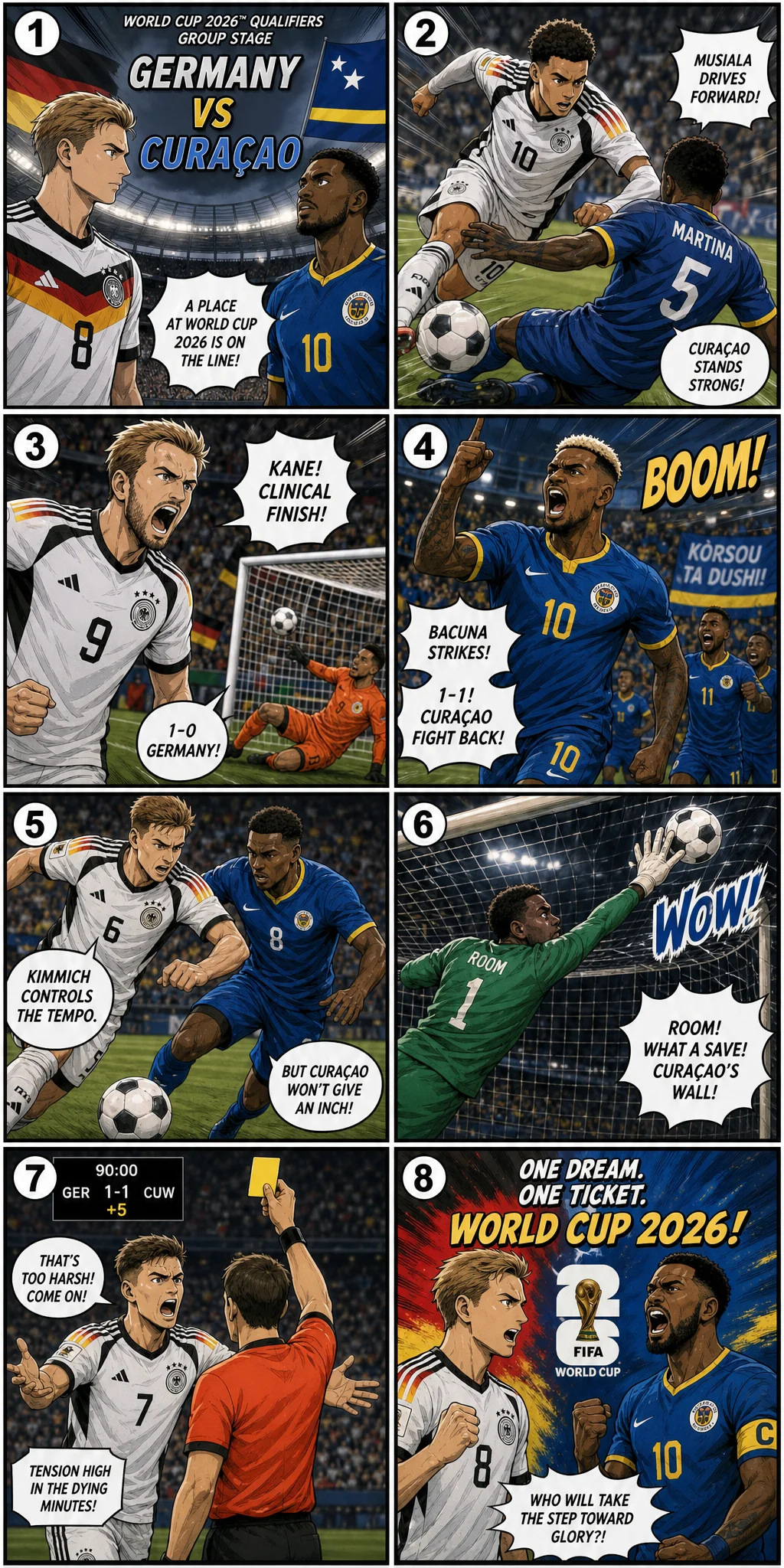
Julian Nagelsmann arrives in North America at age 38 with a clear mandate: make Germany function like a complete machine again. His base 4-2-3-1 is merely the starting point — the real story lies in the shape-shifting that occurs during the match. When Germany holds possession, Kimmich inverts from right-back into a double-pivot alongside Pavlović, both fullbacks push to attacking-line height, and the formation morphs into a 2-3-5 — a revival of the Viennese school from over a century ago.
The key is Florian Wirtz. Twenty-two years old, already a full Premier League season at Liverpool under his belt (seven goals, ten assists), but he transforms when wearing the Germany shirt — an 8.1 national team rating that far exceeds his club output. Wirtz's touch frequency in the half-spaces creates Germany's attacking structure: when he receives in the left half-space, Musiala automatically drifts inside to become a second striker, and Undav drops into the "pocket" between the opponent's centre-back and holding midfielder. These are not three independent movements — this is an interconnected system.
But the system has two structural cracks. The first is the centre-back pairing. Jonathan Tah and Nico Schlotterbeck both excel at high defensive lines — and both have committed costly errors in them. Curaçao may only get three or four opportunities to play the ball behind Germany's back line, but if one succeeds, recovery pace is not Tah's strength. The second crack is subtler: Wirtz and Musiala's creative output is overly concentrated. If Curaçao deploys a compact 5-4-1 low block that clogs the central corridors, Germany's breakthrough may arrive later than expected.
Curaçao's Proposition: Finding Dignity in Asymmetry
Dick Advocaat is seventy-eight years old. The oldest manager in World Cup history. He has coached the Netherlands, South Korea, and now he sits on Curaçao's bench — that alone is a story.
Curaçao's squad is drawn almost entirely from the Dutch league system. Leandro Bacuna, the captain, is the most experienced player — Premier League appearances for Aston Villa and Cardiff City. His younger brother Juninho Bacuna is the most creative presence in midfield — formerly of Huddersfield Town and Birmingham City, with a long-range shot in his arsenal. Tahith Chong — yes, that Chong from Manchester United's academy — operates on the right wing, where his pace and dribbling may provide Curaçao's only counter-attacking outlet. At the back, Armando Obispo plays for PSV Eindhoven, the most important piece of the defensive line; Riechedly Bazoer is a former Ajax academy product.
But honestly, listing these names feels almost cruel — their club minutes, competitive level, and the caliber of opponents they face belong to a different sport than Germany's.
Advocaat's tactical options are narrow but crystal clear: a 5-4-1 low block, turning the central channel into a no-go zone, forcing Germany to solve the problem with crosses. Germany's attacking height is not especially formidable — Undav is 178cm, not 190, and Havertz's heading is not a primary weapon. If Curaçao can drag the match to the sixtieth minute still at 0-0, Nagelsmann will start substituting, start adjusting, start — as his critics say — "over-engineering." That may be Curaçao's only window.
Prediction
Germany should win. The gap in quality is not one level — it spans at least four or five. But football possesses a curious phenomenon: when a team is "allowed" to lose, they sometimes play beyond their own capability. Curaçao has nothing to lose. They did not come to Houston to advance from the group — they came to prove that existence itself is a victory.
The rational prediction: Germany 3-0. Wirtz will find a goal, Undav will find one, and Musiala will score a third late with a solo run. But rational predictions in football are frequently unreliable. Of the 72,000 spectators in NRG Stadium, no one is truly here to watch how Germany wins — everyone is waiting to see how Curaçao does not lose.
That, in itself, is the greatest victory a small nation can claim at a World Cup.