

England 0-0 Ghana: Stalemate Leaves Both Sides Frustrated
FOXBOROUGH, Mass. — The 2026 FIFA World Cup arrived at Gillette Stadium on Tuesday night with a fixture that promised the vibrancy of two cultures colliding under the New England lights.
Veröffentlicht: June 23, 2026
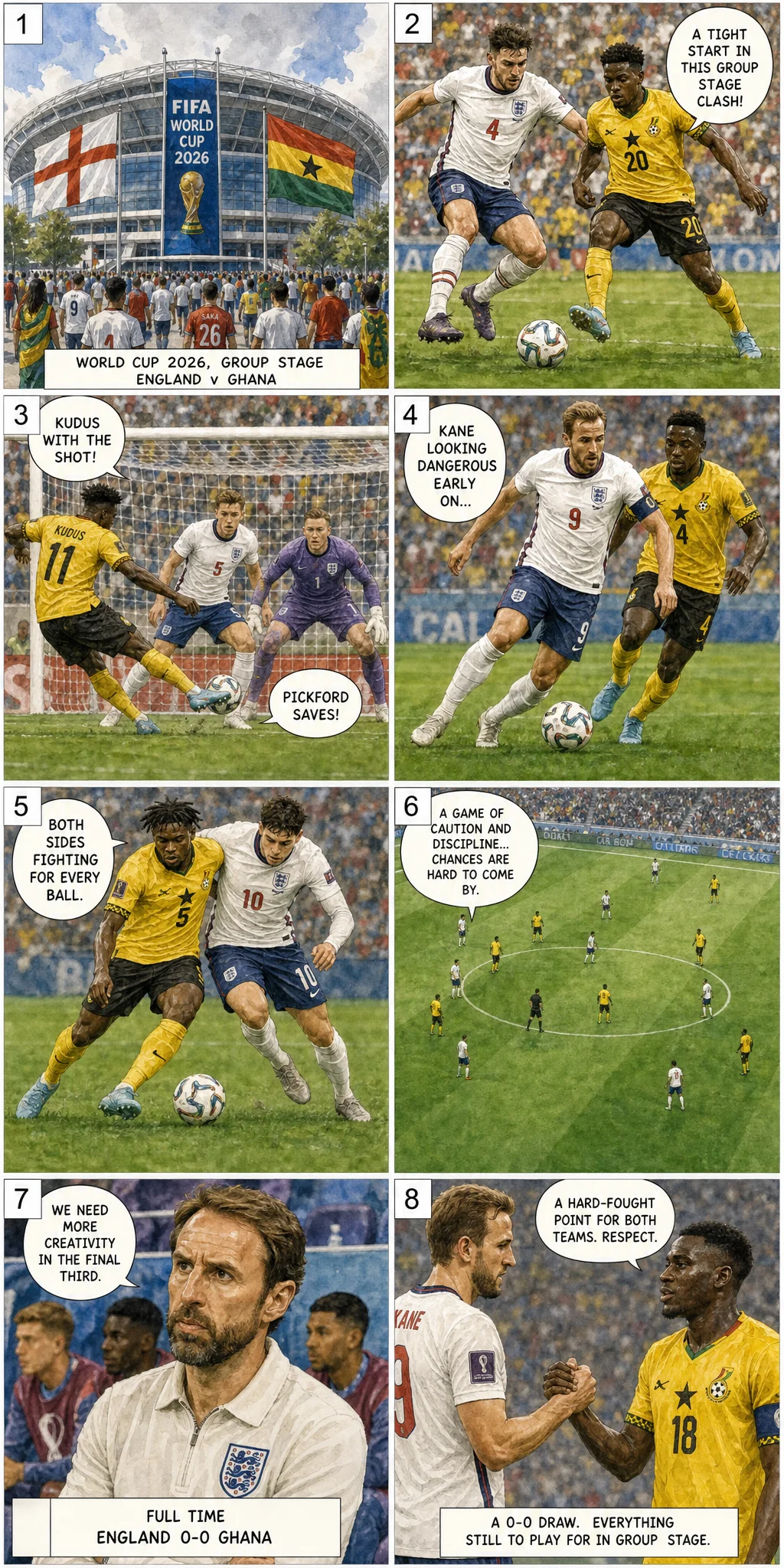
Comic-Inhalte und Spielstatistiken dienen nur Unterhaltungszwecken und können Ungenauigkeiten enthalten. Für genaue Daten besuchen Sie bitte die offizielle Website der Referenz.
# England 0-0 Ghana: Stalemate Leaves Both Sides Frustrated
FOXBOROUGH, Mass. — The 2026 FIFA World Cup arrived at Gillette Stadium on Tuesday night with a fixture that promised the vibrancy of two cultures colliding under the New England lights. What transpired instead was a 90-minute exercise in frustration for England and a masterclass in containment for Ghana, as Group L’s second round of matches concluded with a goalless draw that left both sides with mixed emotions. For England, it was a familiar feeling of stagnation in their second group game—the fourth successive tournament in which they have been held to a draw in that exact fixture. For Ghana, coached by the veteran pragmatist Carlos Queiroz, a point was a significant step toward a knockout stage appearance they have not experienced since their quarterfinal defeat to Uruguay in 2010.
From the opening whistle, the shape of the contest was dictated by Ghana’s defensive discipline. Queiroz, a man whose tactical philosophy was forged in the fires of Portugal’s golden generation and refined during his stints with Real Madrid and the Iran national team, deployed a system that prioritized structure over adventure. The Black Stars kept most men behind the ball, forming a compact block that invited England to probe but offered little space in the final third. For the first 45 minutes, England enjoyed the lion’s share of possession, circulating the ball patiently across the midfield and full-back areas, but found themselves repeatedly repelled by a well-drilled Ghanaian backline that showed no interest in committing numbers forward. The first half passed without a single shot on target from either side—a testament to Ghana’s defensive resolve and England’s lack of incision.
The pattern held firmly into the second half. Ghana, content to absorb pressure and break only when the opportunity presented itself, did not record their first shot of the match until the 50th minute. That moment, a speculative effort from distance that sailed harmlessly wide, was less a sign of attacking intent and more a statistical anomaly in a game defined by England’s dominance of the ball. The Three Lions, managed by Gareth Southgate, continued to probe down the flanks and through the half-spaces, but Ghana’s back five—and the midfield shield in front of them—remained resolute. The atmosphere at Gillette Stadium, which had been buzzing with anticipation before kickoff, began to take on an edge of anxiety as the clock ticked past the hour mark.
England’s best chance of the night arrived in the 87th minute, and it came from an unlikely source of creativity. A delivery into the box found Nico O’Reilly, whose header crashed against the crossbar. The ball rebounded invitingly into the path of Harry Kane, positioned just a few yards from goal with the net gaping. Kane, England’s all-time leading scorer and a man who has made a career out of finishing such chances, leaned back as he attempted to guide the ball home. The shot soared over the bar, a miss that drew a collective groan from the English supporters and a sigh of relief from the Ghanaian bench. It was a moment of uncharacteristic wastefulness from a player who has built his reputation on clinical composure, and it would prove to be the defining incident of the match.
In the frantic closing stages, England pushed with increasing desperation. Bukayo Saka, who had been a persistent threat on the right flank despite the crowded defensive landscape, forced a smart save from Ghana goalkeeper Benjamin Asare. The shot was well-struck, but Asare was equal to it, diving low to his left to parry the ball away. Moments later, central defender Marc Guehi rose highest from a set piece and directed a header toward goal. The ball seemed destined for the back of the net, only for a Ghanaian defender to clear it off the line—a moment of last-ditch heroism that preserved the clean sheet and the point. The sequence summed up England’s evening: close, but not close enough.
Southgate had already turned to his bench by that point, making a double substitution in the 73rd minute that signaled a desire for fresh legs and a different attacking dynamic. Jude Bellingham, who had been a focal point of England’s buildup play but struggled to find the decisive pass against Ghana’s low block, was replaced by Morgan Rogers. Elliot Anderson, another midfielder tasked with breaking the lines, made way for Eberechi Eze. The changes injected a degree of unpredictability into England’s approach, with Eze’s dribbling and Rogers’ direct running offering a contrast to the more structured patterns that had preceded them. Yet even with these alterations, the final product remained elusive. Ghana, having absorbed everything England could throw at them, saw out the remaining minutes with a composure that belied their underdog status.
The historical context of the result will not be lost on the English camp. For the fourth successive tournament, England have been held to a draw in their second group match. In 2018, it was a 1-1 stalemate with the United States in the group stage, followed by a 0-0 draw with Scotland at Euro 2020, and a 1-1 result against Denmark at Euro 2024. The pattern has become a curious hallmark of Southgate’s tenure—a tendency to underwhelm in the middle game of the group phase before regrouping for the decisive final fixture. Whether this pattern will hold true in 2026 remains to be seen, but the immediate takeaway is that England have left themselves work to do. The point keeps them in control of their own destiny, but it also opens the door for the rest of Group L to close the gap.
For Ghana, the draw was a result to savor. Queiroz’s game plan was executed with near-flawless discipline, and the defensive organization that frustrated England throughout the night was the product of meticulous preparation. The Black Stars, who have not graced the knockout rounds of a World Cup since their dramatic quarterfinal run in 2010—a campaign that ended in heartbreak against Uruguay—now find themselves on the brink of ending that drought. A point in this match all but ensured Ghana a place in the knockout stage, a significant achievement for a team that entered the tournament with modest expectations but has shown an ability to grind out results against higher-profile opposition. The defensive solidity on display at Gillette Stadium was a testament to Queiroz’s ability to instill a clear tactical identity, even when the team does not possess the attacking firepower of some of its rivals.
The match itself was not one for the neutrals. It was a game of structure over spontaneity, of defensive organization over attacking flair. England had 68% possession and registered 14 shots, but only three of those were on target. Ghana, by contrast, managed just two shots in the entire match, neither of which truly tested England goalkeeper Jordan Pickford. The xG (expected goals) numbers will likely reflect England’s dominance in terms of territory and chances created, but football is not a sport that awards points for statistical superiority. The 0-0 scoreline was a fair reflection of a contest in which one team refused to concede ground and the other could not find the key to unlock the door.
As the final whistle blew, the Ghanaian players celebrated with the kind of restrained joy that comes from knowing a job has been well done. They had come to Foxborough with a plan, and they had executed it to perfection. England’s players, meanwhile, trudged off the pitch with the look of a side that knows it let an opportunity slip. Kane’s late miss will dominate the post-match analysis, but the broader issue for Southgate is one of tactical adaptability. When faced with a deep block, England struggled to generate the kind of quick, incisive movement that breaks down organized defenses. The introduction of Rogers and Eze offered a glimpse of a different approach, but the sample size was too small to draw firm conclusions.
The group stage now moves toward its conclusion, with England needing to secure a positive result in their final match to guarantee progression. Ghana, buoyed by this result, will approach their own decisive fixture with the confidence that comes from having stifled one of the tournament favorites. For the 2026 World Cup, the memory of this night at Gillette Stadium will be one of defensive resilience and attacking frustration—a 0-0 draw that told a story of two teams with very different ambitions, both of whom left the field with reasons to believe their tournament was still alive.