

Dieci a Uno: Il giorno in cui il tabellone si ruppe
15 giugno 1982. Elche, Spagna. Fase a gironi dei Mondiali. Ungheria contro El Salvador. Prima del calcio d’inizio, a nessuno importava di questa partita — l’Ungheria era una squadra dell’Est Europa in declino, i un tempo "Magnifici Magiari" ridotti a nient’altro che un nome e qualche foto in bianco
Pubblicato: June 6, 2026
I contenuti dei fumetti e le statistiche delle partite sono solo a scopo di intrattenimento e possono contenere inesattezze. Per i dati precisi, consultare il sito ufficiale di riferimento.
# 10-1: The Only Time in World Cup History the Scoreboard Broke
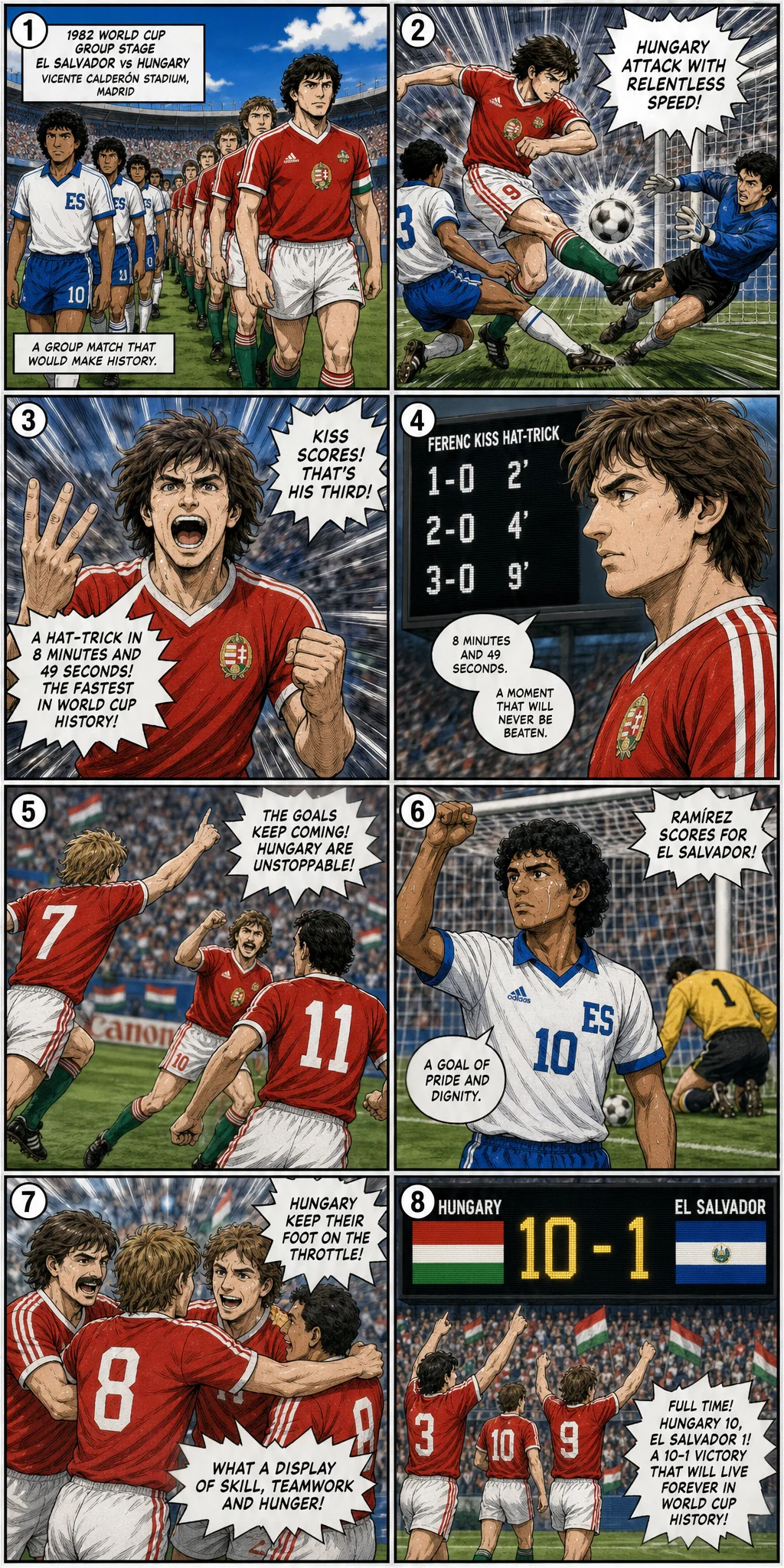
15 June 1982. Elche, Spain. World Cup group stage. Hungary vs El Salvador. Nobody cared about this match before kick-off – Hungary were an Eastern European team on the decline, the once "Mighty Magyars" reduced to a name and a few black-and-white photos. El Salvador were a tiny Central American nation torn apart by civil war, with a population of 4.5 million, and their qualification alone was a miracle that should never have happened. Nobody expected this game to become the only double-digit massacre in World Cup history.
The scoreboard read: 10-1.
I once found the full footage of this match on YouTube. Ninety minutes, the quality so blurry it felt like watching history through yellowed cling film. Hungary's first goal came in the 4th minute – a corner, defender Nyilasi jumped, headed it, and the ball sailed over the Salvadoran goalkeeper's head. 1-0. Second goal: 10th minute. Third goal: 37th minute. At half-time, the score was 3-0. To be honest – 3-0 isn't that outrageous in a World Cup. Salvadoran fans were probably thinking, "Alright, losing by three, not too shameful. We're World Cup rookies. We're learning."
Then the second half arrived.
50th minute. 4-0. 55th minute. 5-0. By this point in the match, Hungary's coach Kálmán Mészöly made a decision – he brought on substitute striker László Kiss. Kiss sat on the bench, chewing gum, probably wondering where he'd grab dinner later. He had no idea the next seven minutes would etch his name into World Cup history forever. 69th minute. Kiss scored. 6-0. 72nd minute. Kiss scored again. 7-0. 76th minute. Kiss scored once more. 8-0. In seven minutes, a substitute striker had completed the fastest hat-trick in World Cup history. He jogged to the sideline – no special celebration, just raised his hands and got a pat on the head from teammates. Nobody realised what had just happened. It wasn't until after the match, when the statisticians crunched the numbers, that they discovered Kiss's three goals were separated by just seven minutes. The fastest hat-trick in World Cup history. Not Ronaldo. Not Mbappé. Not Pelé. Not any star whose name you'd iron onto a jersey. A Hungarian substitute you've probably never heard of. That record has stood for over forty years, and nobody has broken it yet.
89th minute. Hungary scored their 10th goal. Salvadoran goalkeeper Luis Guevara Mora knelt on the goal line. He wasn't praying. He was too exhausted to stand. His white jersey was covered in grass stains and mud. His gloves – the ones his mother had washed clean for him before the match – were worn through. He knelt there, head down, like a fisherman waiting for a storm to pass.
Then – the most memorable moment of the entire match.
90th minute. El Salvador got a chance. Luis Ramírez – a young man who played in El Salvador's domestic league and had never been abroad for a match before the World Cup – poked the ball into Hungary's net amid the chaos. 1-10. He didn't celebrate. Didn't run to the corner flag. Didn't dance. He just picked the ball out of the net – from a goal that had been breached 10 times – ran back to the centre circle, and placed it on the kick-off spot. The match wasn't over yet. He had to keep playing.
The crowd in Elche – those neutral Spaniards – all stood up and applauded Ramírez's goal. Not sarcastically. Not out of pity. Genuinely, as a tribute to someone still fighting with everything he had despite being 10-0 down. El Salvador's commentator shouted in Spanish over the radio: "¡Gol! ¡Gol de El Salvador! ¡Gol de la dignidad!" – "Goal of dignity!"
That goal didn't change the result of the match. But it changed how the match would be remembered. 10-1 isn't a joke. 10-1 is a country struggling through civil war, using football as its only solace, then being treated most cruelly by history on the World Cup stage – before scoring a goal, picking up the ball, running back to the centre circle, and placing it on the kick-off spot. Because the match wasn't over. Because as long as the referee hadn't blown the whistle – you keep playing. Because that's the simplest, and hardest, thing football teaches us.