

Twaalf groepen, acht nummers drie en een wereldwijde Excel-crash
Het WK-formaat met achtenveertig teams introduceert een kwalificatiemechanisme dat ongekend is in de toernooigeschiedenis: de acht beste nummers drie uit zestien groepen van drie teams gaan door naar de knock-outfase, samen met alle groepswinnaars en...
Gepubliceerd: June 6, 2026
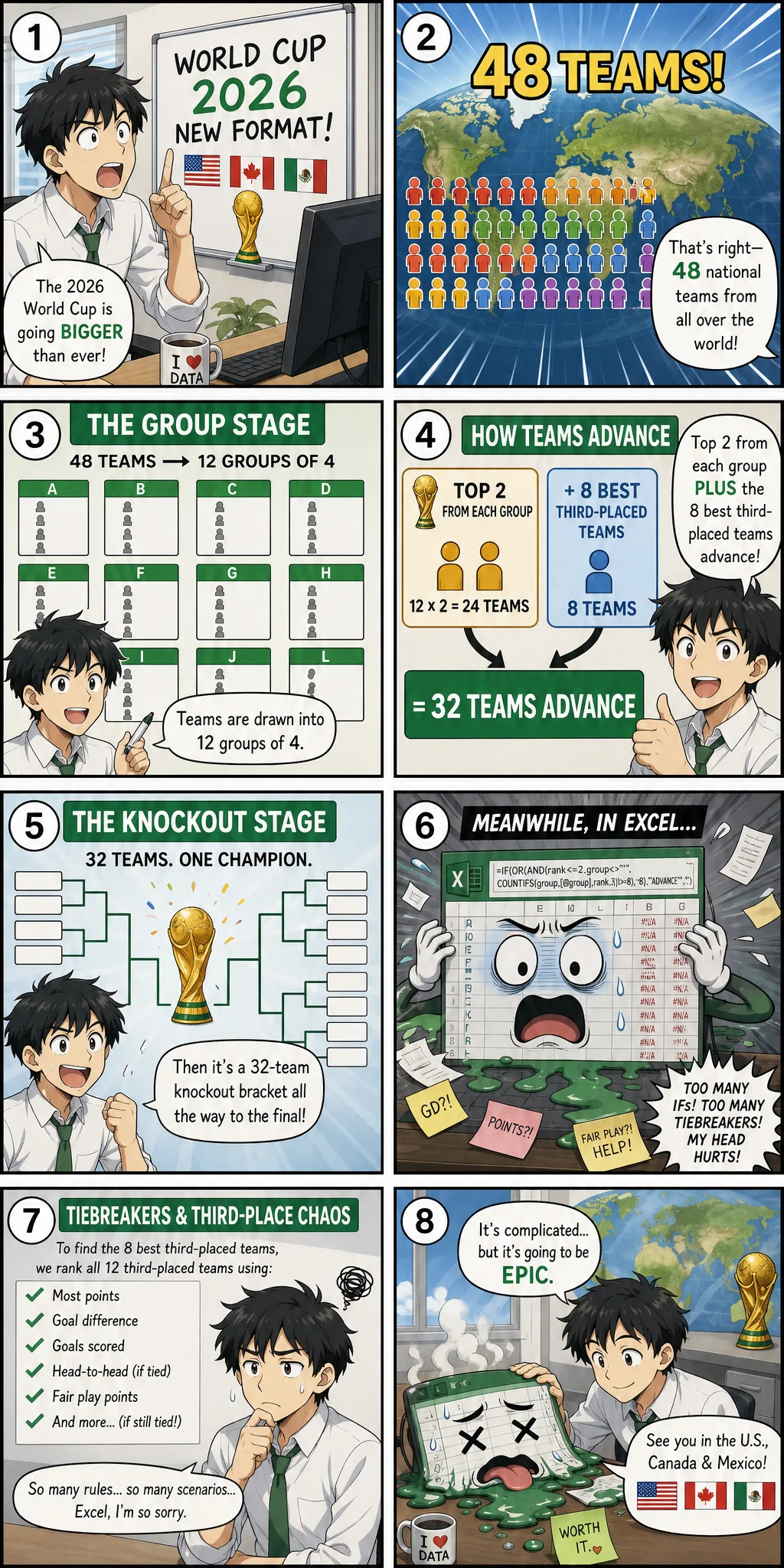
Stripinhoud en wedstrijdstatistieken zijn uitsluitend voor entertainmentdoeleinden en kunnen onnauwkeurigheden bevatten. Raadpleeg de officiële website van de referentie voor nauwkeurige gegevens.
Het achtenveertig-landenformat introduceert een kwalificatiemechanisme dat ongekend is in de toernooigeschiedenis: de acht beste nummers drie uit zestien groepen van drie teams plaatsen zich samen met alle groepswinnaars en nummers twee voor de knock-outfase. Deze schaduwcompetitie — die parallel loopt aan de groepsfase zelf — creëert wiskundige dynamieken die de beslissende momenten van het toernooi zullen bepalen en mogelijk zullen beslissen welke landen doorgaan en welke naar huis gaan.
De vergelijking tussen groepen van teams die nooit tegen elkaar of tegen gemeenschappelijke tegenstanders hebben gespeeld, introduceert een onherleidbaar element van willekeur. Een team dat vier punten behaalt tegen sterke tegenstanders in een moeilijke groep kan worden uitgeschakeld, terwijl een team dat drie punten haalt tegen zwakkere tegenstanders doorgaat. De tiebreakcriteria — achtereenvolgens toegepast: punten, doelsaldo, doelpunten voor, fairplaypunten en uiteindelijk loting — zijn logisch coherent en praktisch absurd. FIFA's toernooiplanners vrezen in stilte een scenario dat zich nog nooit in de geschiedenis van het mannen-WK heeft voorgedaan: twee nummers drie die op alle criteria identiek eindigen, waardoor een letterlijke loting moet bepalen welke natie verder gaat.
Het mechanisme creëert ook strategische prikkels die de symmetrische structuur van het tweeëndertig-landenformat specifiek ontworpen was om te voorkomen. Een team dat weet dat een bepaald resultaat kwalificatie als een van de acht beste nummers drie garandeert, kan zijn laatste groepswedstrijd met fundamenteel andere doelstellingen benaderen dan een team dat voor de groepswinst speelt. Gelijktijdige programmering van groepsfinales minimaliseert expliciete samenzwering, maar kan het stilzwijgende begrip niet uitschakelen dat ontstaat wanneer beide teams beseffen dat een bepaalde score wederzijdse belangen dient. De angst die elk driegroepsformaat achtervolgt, blijft de "Schande van Gijón" uit 1982, toen West-Duitsland en Oostenrijk precies het resultaat produceerden dat beide nodig hadden om door te gaan ten koste van Algerije. FIFA's waarborgen zijn verbeterd. De onderliggende structurele prikkel naar wederzijds voordelige uitkomsten blijft bestaan.
Om de wiskundige dynamiek van het nummer-drie-kwalificatiesysteem te begrijpen, is het nuttig om de structuur in detail te bekijken. Zestien groepen van drie teams betekent dat elke groep een nummer drie oplevert. Van deze zestien nummers drie gaan er precies acht door. De overige acht — samen met alle zestien nummers vier, die automatisch zijn uitgeschakeld — gaan naar huis. Dit betekent dat derde worden in je groep, wat in elk voorgaand WK-formaat automatische uitschakeling betekende, nu een reële weg naar de knock-outfase biedt. Het psychologische effect op teams die hun openingswedstrijd verliezen, wordt getransformeerd. In plaats van virtuele uitschakeling kan een team dat zijn eerste groepswedstrijd verliest nog steeds doorgaan door de tweede te winnen — of mogelijk zelfs door gelijk te spelen, afhankelijk van de doelsaldoberekening en de prestaties van nummers drie in andere groepen. Het formaat injecteert hoop in situaties waar eerdere WK's alleen wanhoop boden, en de competitieve consequenties van die hoop zullen zich bij elke groepswedstrijd ontvouwen.
De tiebreakhiërarchie voor nummer-drie-kwalificatie is een meesterwerk van bureaucratische precisie dat vrijwel zeker momenten van oprechte sportieve onrechtvaardigheid zal opleveren. De criteria, in volgorde toegepast totdat de teams gescheiden zijn, luiden: punten behaald in de groepsfase; doelsaldo over alle groepswedstrijden; doelpunten voor over alle groepswedstrijden; fairplaypunten, berekend volgens de FIFA-disciplinaire code; en ten slotte loting door het FIFA-organisatiecomité. De sprong van fairplaypunten — een maatstaf van sportief gedrag — naar loting — een maatstaf van puur toeval — is zo scherp dat het onder toernooiorganisatoren tot galgenhumor heeft geleid. Het scenario dat zij het meest vrezen: twee nummers drie eindigen met identieke punten, identiek doelsaldo, identieke doelpunten voor en identieke fairplay-records. In dat geval eindigt een WK-campagne niet op het veld maar in een vergaderzaal, beslist door de mechanische willekeur van een getrokken balletje of een opgeworpen munt. De waarschijnlijkheid is laag; de gevolgen, mocht het gebeuren, zijn enorm.
Het historische precedent dat het driegroepsformaat achtervolgt, is het WK 1982 in Spanje. Dat toernooi kende een tweede groepsfase met drie teams per groep, en in Groep 2 nam West-Duitsland het in de laatste wedstrijd op tegen Oostenrijk, wetende dat een Duitse overwinning met één of twee doelpunten verschil beide Germaanse naties zou laten doorgaan ten koste van Algerije. West-Duitsland scoorde in de tiende minuut. De resterende tachtig minuten speelden beide teams wat alleen als een gearrangeerd bestand kan worden omschreven — balletjes zachtjes rondgerold tussen verdedigers, geen tackle met overtuiging ingezet, een wederzijds begrip dat de uitslag op het scorebord precies was wat beide partijen nodig hadden. De "Schande van Gijón" bracht FIFA ertoe gelijktijdige aftrappen voor alle laatste groepswedstrijden te verplichten, een hervorming die in 2026 van kracht blijft. Maar gelijktijdige aftrappen voorkomen alleen de meest expliciete vorm van samenzwering — die waarbij één team vroeg scoort en beide teams ophouden met proberen. Ze kunnen een subtielere vorm van strategische berekening niet voorkomen, waarbij een team zijn laatste groepswedstrijd ingaat met exacte kennis van het vereiste resultaat uit andere groepen en zijn aanpak daarop afstemt. Het nummer-drie-kwalificatiemechanisme versterkt deze strategische dimensie: teams zullen vóór de aftrap van hun laatste groepswedstrijd weten welk resultaat ze nodig hebben om bij de acht beste nummers drie te eindigen. De informatie-asymmetrie tussen groepen die op verschillende tijdstippen spelen, is geen fout in het format; het is een inherent kenmerk van elk format waarin kwalificatie deels afhangt van resultaten in andere groepen.
Het debat onder voetbaltheoretici over de optimale benadering van een driegroep heeft concurrerende denkscholen opgeleverd die in 2026 voor het eerst empirisch getest zullen worden. De agressieve school betoogt dat in een groep waarin slechts twee wedstrijden worden gespeeld — elk team speelt precies twee groepswedstrijden — een overwinning in de openingswedstrijd kwalificatie effectief garandeert, en de optimale strategie is om die eerste wedstrijd als koste-wat-het-kost te moeten winnen. De conservatieve school stelt daar tegenover dat in een format waarin de derde plaats een reële kwalificatieweg biedt, het risico van verlies in de openingswedstrijd wordt gemitigeerd, en teams deze met tactische voorzichtigheid in plaats van wanhopige agressie moeten benaderen. De analytische school — bevoordeeld door het groeiende kader van datagedreven technische staven — betoogt dat het format een probabilistisch optimalisatieprobleem creëert waarin de optimale strategie afhangt van de specifieke tegenstanders, het verwachte doelsaldo van concurrenten in andere groepen, en het evoluerende beeld van nummer-drie-kwalificatie naarmate de groepsfase vordert. Het toernooi zal dienen als een gigantisch praktijkexperiment om te bepalen welke van deze scholen het effectiefst blijkt, en de resultaten zullen de tactische orthodoxie voor elk volgend achtenveertig-landentoernooi vormgeven.
De acht nummers drie die doorgaan, zullen per definitie tot de zwakkere teams in de knock-outfase behoren. Zij betreden de laatste tweeëndertigronde nadat ze in hun groep achter twee andere teams zijn geëindigd. Historisch gezien hebben nummers drie die in vierentwintig-landenformats doorgingen — toen vier beste nummers drie uit zes groepen zich plaatsten — af en toe diepe toernooiruns neergezet. Argentinië werd in 1990 derde in zijn groep en bereikte de finale. Italië werd in 1994 derde in zijn groep en bereikte de finale. De aanwezigheid van acht in plaats van vier nummers drie in de knock-outfase van 2026 schept de wiskundige mogelijkheid dat een echte titelkandidaat — een team dat in een moeilijke groep onderpresteerde maar de kwaliteit bezit om met iedereen te concurreren — door de achterdeur kan binnenglippen en ravage kan aanrichten in de knock-outrondes. Het format produceert niet simpelweg meer wedstrijden. Het produceert meer mogelijkheden, en tot die mogelijkheden behoort het scenario dat toernooitraditionalisten het meest vrezen en romantici het meest verwachten: een team dat de groepsfase ternauwernood overleefde, voortgestuwd door het momentum van zijn onwaarschijnlijke overleving, zich een weg banend door de knock-outrondes die geen expert had voorspeld en geen algoritme had kunnen voorzien.