

Trois pays, une table, et une fête sans précédent
La Coupe du monde 2026 est la première de l’histoire à être organisée par trois nations — les États-Unis, le Canada et le Mexique — sous une même bannière organisationnelle unifiée. L’architecture logistique nécessaire pour mener à bien un tournoi à travers trois pays souverains,
Publié : June 6, 2026
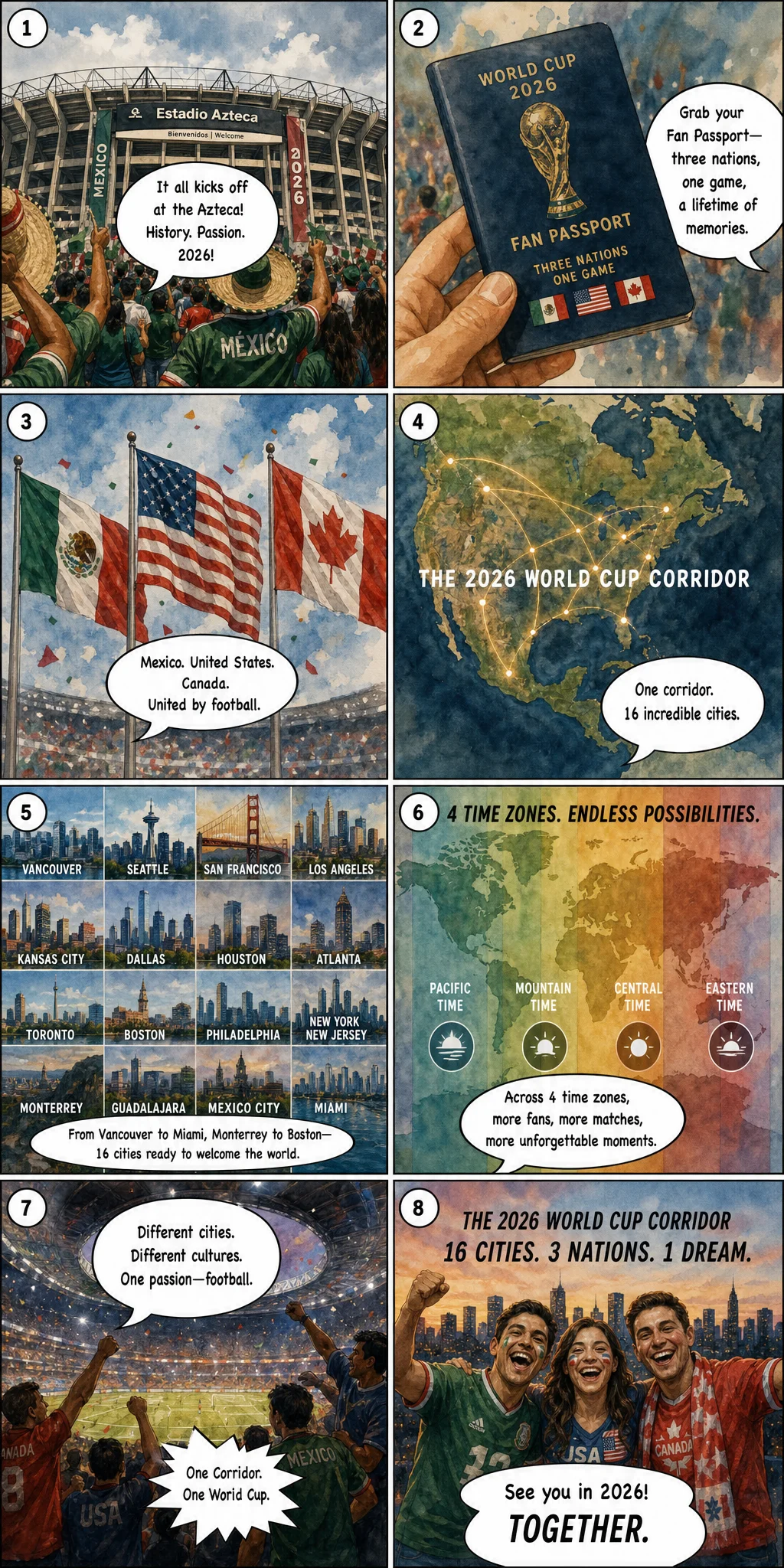
Le contenu de la bande dessinée et les statistiques des matchs sont uniquement à des fins de divertissement et peuvent contenir des inexactitudes. Pour les données précises, veuillez consulter le site officiel de la référence.
# Trois nations, un tournoi : l'architecture inédite de la co-organisation
La Coupe du monde 2026 est la première de l'histoire à être organisée par trois nations — les États-Unis, le Canada et le Mexique — sous un même parapluie organisationnel unifié. L'architecture logistique nécessaire pour déployer un tournoi à travers trois pays souverains, avec trois systèmes d'immigration distincts, trois ensembles de lois du travail, trois écosystèmes de diffusion nationaux et seize stades répartis sur un continent, est sans précédent dans l'histoire du sport. Que cette architecture représente l'avenir de l'organisation de méga-événements ou une accommodation ponctuelle aux circonstances géographiques et politiques uniques de l'Amérique du Nord est l'une des questions centrales auxquelles le tournoi devra répondre.
La candidature unifiée, officiellement présentée à la FIFA en mars 2018 sous la bannière « United 2026 », reposait sur un postulat simple : l'Amérique du Nord possède les infrastructures existantes pour accueillir une Coupe du monde à quarante-huit équipes sans les projets de construction de stades de plusieurs milliards de dollars qui ont pesé sur les précédents hôtes. Le dossier de candidature, long de 534 pages, couvrait les spécifications des stades, les infrastructures de transport, les protocoles de sécurité, la capacité d'hébergement et les projections d'impact économique. Il soutenait que la combinaison inégalée du continent — vastes enceintes à grande capacité (la plupart des seize stades sélectionnés étaient des installations existantes de la NFL ou de grands stades universitaires de football américain, ne nécessitant qu'une rénovation modeste pour le football), sophistication des marchés de diffusion, écosystèmes de parrainage d'entreprise et capacité démontrée à organiser d'immenses événements sportifs — en faisait le seul candidat capable de livrer un tournoi élargi commercialement viable. Le comité d'évaluation de la FIFA a attribué à la candidature unifiée une note de 4,0 sur 5,0, la plus élevée jamais accordée. Le Maroc, seul autre candidat, a obtenu 2,7. Le Congrès de la FIFA a voté à 134 voix contre 65 en faveur de l'Amérique du Nord le 13 juin 2018, la veille de l'ouverture de la Coupe du monde 2018 en Russie.
La répartition des matchs au sein du partenariat reflète les dynamiques de pouvoir entre les trois hôtes avec une précision mathématique. Soixante des quatre-vingts matchs de phase de groupes et des premiers tours à élimination directe se joueront aux États-Unis. Dix chacun au Canada et au Mexique. Tous les matchs à partir des quarts de finale se dérouleront dans des stades américains, une décision qui reflète à la fois l'inventaire inégalé de stades à grande capacité des États-Unis et la logique commerciale qui place les rencontres les plus précieuses du tournoi dans le pays hôte disposant du plus grand marché de diffusion national. L'Estadio Azteca à Mexico accueillera le match d'ouverture — un geste symbolique envers le seul stade du football mondial à avoir accueilli deux finales de Coupe du monde, le lieu sacré où Pelé a remporté son troisième titre en 1970 et où Maradona a inscrit le But du Siècle en 1986. La finale se jouera au MetLife Stadium dans le New Jersey, une décision dictée par les mathématiques de planification des diffusions, les considérations de fuseau horaire pour les téléspectateurs européens et la proximité du stade avec le marché médiatique new-yorkais, plutôt que par une quelconque distinction architecturale ou historique particulière.
La structure de gouvernance nécessaire pour organiser un tournoi à trois nations constitue en soi une étude de cas en matière de complexité institutionnelle. Chaque pays hôte maintient son propre comité d'organisation local, son agent de liaison gouvernemental et sa structure de coordination sécuritaire, tous opérant sous l'égide d'un comité central de la FIFA basé à Miami. Trois systèmes d'immigration distincts traiteront des millions de visiteurs internationaux — un fan détenant des billets pour des matchs dans les trois pays devra naviguer à travers trois régimes de visa distincts, trois systèmes d'autorisation de voyage électronique distincts et trois bureaucraties de contrôle frontalier distinctes. La FIFA a négocié des arrangements spéciaux de visa de tournoi avec chaque gouvernement hôte, mais l'expérience pratique de traverser de San Diego à Tijuana pour un match de phase de groupes, ou de Détroit à Toronto, implique des protocoles de sécurité et des formalités frontalières qu'aucune Coupe du monde précédente n'a imposés aux spectateurs.
La structure à trois nations crée également des complexités en matière de travail et d'emploi que les tournois à nation unique évitent. Les travailleurs des stades de Dallas opèrent sous le droit du travail du Texas ; les travailleurs des stades de Vancouver sont soumis aux normes d'emploi de la Colombie-Britannique ; les travailleurs des stades de Mexico opèrent sous la réglementation fédérale du travail mexicaine. Les bénévoles — les dizaines de milliers de travailleurs non rémunérés qui forment l'épine dorsale opérationnelle de chaque Coupe du monde — sont soumis à différentes définitions juridiques du statut de bénévole dans chaque pays, avec des règles différentes régissant ce que l'on peut demander aux bénévoles, le nombre d'heures qu'ils peuvent travailler et les protections auxquelles ils ont droit. Le service juridique de la FIFA a passé des années à harmoniser ces arrangements entre les juridictions, et cet effort d'harmonisation constitue en soi une réalisation institutionnelle significative, mais les tensions résiduelles et les incohérences ne deviendront visibles que lorsque les exigences opérationnelles du tournoi entreront en collision simultanément avec trois cadres juridiques différents.
La question que pose la Coupe du monde 2026 — à savoir si l'organisation à trois nations est un modèle reproductible pour les tournois futurs ou une accommodation ponctuelle aux circonstances uniques de l'Amérique du Nord — dépend du succès opérationnel du tournoi. Si les frontières fonctionnent, si les vols sont connectés, si les infrastructures tiennent, le modèle à trois nations devient un modèle que les futures candidatures pourront citer. Si la logistique se fragmente — si les retards aux frontières bloquent les spectateurs, si les transitions entre sites échouent, si la distance entre les villes hôtes produit des distorsions concurrentielles que les tournois à nation unique évitent — le tournoi de 2026 sera rappelé comme une expérience ambitieuse dont l'ambition a dépassé l'exécution. La candidature unifiée reposait sur la capacité de l'Amérique du Nord à livrer. Que cette capacité se traduise par une livraison effective sera déterminé non par les dossiers de candidature mais par l'été 2026 lui-même.
La géographie de la Coupe du monde 2026 est d'une ampleur vertigineuse et pose des défis opérationnels qu'aucun tournoi précédent n'a affrontés. Les seize stades hôtes s'étendent sur environ 4 500 kilomètres, de l'Estadio Azteca au sud jusqu'au BC Place à Vancouver au nord, et près de 4 000 kilomètres d'est en ouest à travers les États-Unis continentaux. Ce n'est pas un tournoi confiné à une seule région métropolitaine, comme le Qatar 2022, ni même à une seule nation européenne de taille moyenne. C'est un tournoi joué à travers un continent, et les distances entre les sites créent des exigences logistiques que les organisateurs du tournoi ont passées des années à modéliser et à préparer. Un fan tentant de suivre son équipe nationale à travers la phase de groupes pourrait se retrouver à voyager de Mexico à Seattle puis à Toronto en l'espace de dix jours — un périple couvrant plus de 7 000 kilomètres par voie aérienne, traversant deux frontières internationales et passant par trois postes de douane et d'immigration distincts. L'empreinte carbone de tels déplacements, multipliée par des millions de spectateurs, représente un calcul environnemental que la FIFA a publiquement reconnu et qu'elle a eu du mal à concilier en privé avec ses engagements déclarés en matière de durabilité. L'évaluation d'impact environnemental du tournoi, commandée par la FIFA et publiée en 2024, projetait que les voyages aériens des spectateurs représenteraient plus de quatre-vingts pour cent des émissions totales de carbone du tournoi — un chiffre qui met en lumière la tension entre l'empreinte géographique élargie du tournoi et son discours environnemental.
Le processus de sélection des stades lui-même a révélé les économies politiques en jeu au sein du partenariat à trois nations. Les États-Unis ont fourni onze des seize sites, une domination qui reflète à la fois leur inventaire inégalé de stades à grande capacité et la logique commerciale qui sous-tend les projections de revenus de la FIFA. Les stades de la NFL tels que l'AT&T Stadium à Arlington, le SoFi Stadium à Los Angeles et le Mercedes-Benz Stadium à Atlanta offrent des capacités dépassant 70 000 places, des loges de luxe générant des revenus d'hospitalité premium, et le type d'infrastructures — parkings, connexions de transport en commun, quartiers de divertissement adjacents — dont les partenaires commerciaux de la FIFA ont besoin. Les coûts de rénovation de ces sites sont minimes comparés aux milliards dépensés pour construire de nouveaux stades pour le Qatar 2022 ou le Brésil 2014, un fait qui était central dans l'argument économique de la candidature unifiée. Le tournoi peut être organisé sans l'héritage de stades éléphants blancs parce que les stades ont déjà des locataires permanents, des sources de revenus permanentes et des rôles permanents dans leurs communautés. C'est à la fois la plus grande force de la candidature — l'évitement de dépenses de construction inutiles — et la source de sa critique la plus acerbe : le tournoi est organisé dans des sites conçus pour le football américain, adaptés pour le football, et le caractère spécifique de ces espaces diffère fondamentalement des stades dédiés au football qui ont accueilli les tournois précédents.
La contribution hôte du Canada représente quelque chose de qualitativement différent de celle des États-Unis. Le pays a accueilli exactement un match de Coupe du monde masculine — une rencontre de phase de groupes lors du Mexique 1986 — et ses infrastructures footballistiques reflètent une nation où le sport a historiquement occupé une position culturelle secondaire derrière le hockey sur glace. Le BMO Field de Toronto a nécessité une expansion significative pour atteindre le minimum de 45 000 places exigé par la FIFA pour les sites de Coupe du monde, et le BC Place de Vancouver, bien qu'architecturalement distingué, est un stade à dôme conçu principalement pour le football canadien. L'inclusion du Canada dans le partenariat hôte ne concerne pas principalement les infrastructures de stades. Il s'agit de partenariat politique, de solidarité continentale et de la valeur symbolique d'étendre l'empreinte géographique de la Coupe du monde à une nation du G7 où la présence culturelle du football croît plus rapidement que partout ailleurs dans le monde développé. Le public canadien du football — multiculturel, jeune et de plus en plus engagé dans le jeu mondial — représente exactement la démographie que la stratégie commerciale de la FIFA cible pour une croissance à long terme.
La contribution du Mexique porte un poids historique qu'aucun tableur de spécifications de stades ne peut capturer. L'Estadio Azteca — rénové et agrandi pour le tournoi 2026 — est un lieu sacré dans l'histoire du football. C'est le stade où Pelé a remporté sa troisième et dernière Coupe du monde en 1970, le stade où Diego Maradona a inscrit le « But du Siècle » et la « Main de Dieu » lors du même quart de finale en 1986, le seul stade sur terre à avoir été témoin de deux finales de Coupe du monde. La décision d'attribuer le match d'ouverture à Mexico plutôt qu'à Los Angeles ou New York était un geste envers cette histoire — une reconnaissance que le retour de la Coupe du monde en Amérique du Nord est aussi un retour à son site le plus légendaire, et que la continuité historique du tournoi compte autant que ses ambitions commerciales. La résonance symbolique du match d'ouverture joué à l'Azteca, dans la nation qui a accueilli deux Coupes du monde précédentes et qui est le marché du football le plus passionné d'Amérique du Nord depuis des générations, transcende tout calcul économique.