

The Man Carrying the Trophy Into 2026
The World Cup trophy arrives at the opening ceremony in the arms of a representative of Argentina, the defending champion, the nation that claimed the golden statuette in Qatar on December 18, 2022, in what is widely and reasonably considered the gre
Publié : June 6, 2026
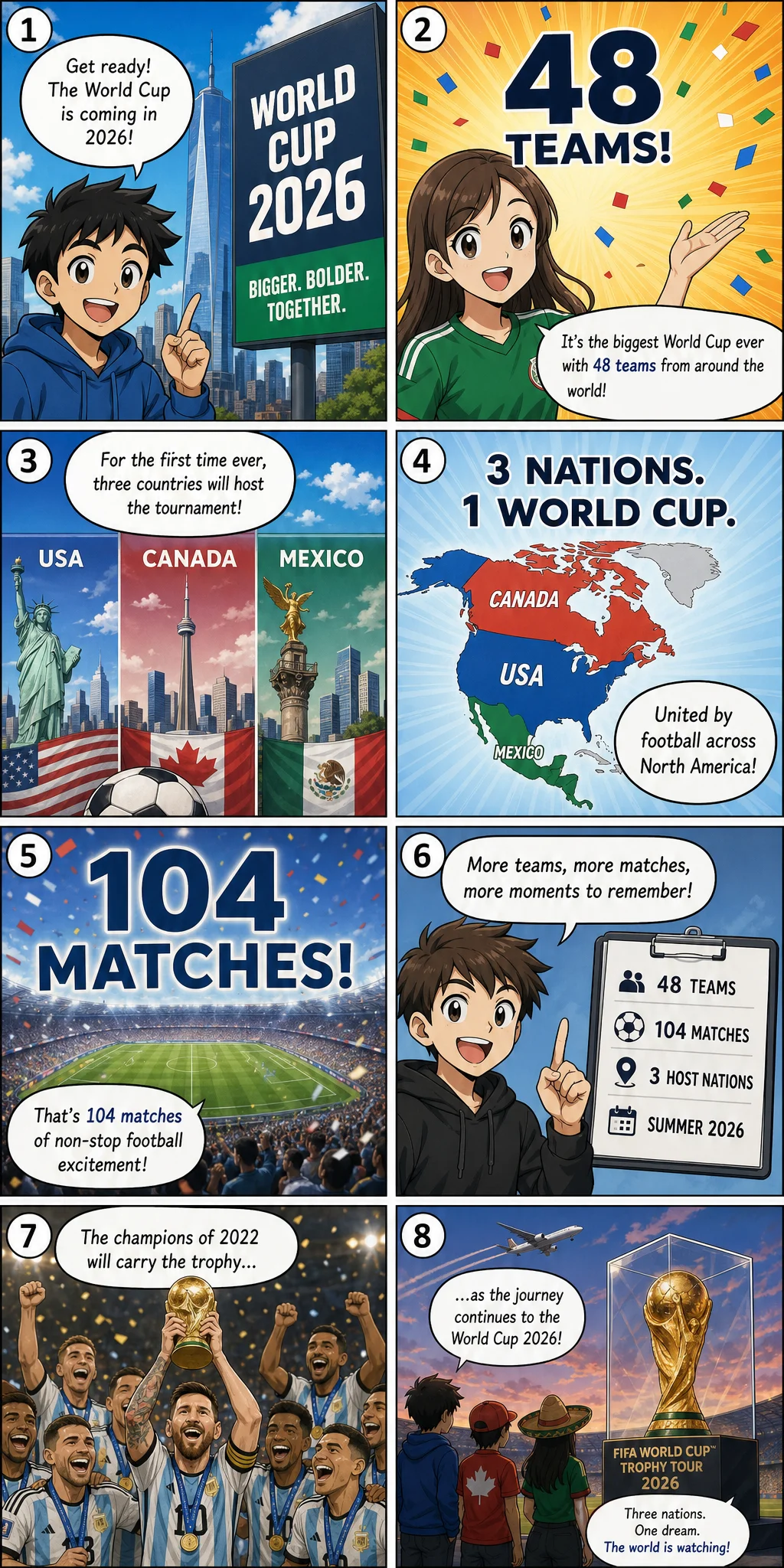
Le contenu de la bande dessinée et les statistiques des matchs sont uniquement à des fins de divertissement et peuvent contenir des inexactitudes. Pour les données précises, veuillez consulter le site officiel de la référence.
La Coupe du Monde fait son entrée lors de la cérémonie d'ouverture dans les bras d'un représentant de l'Argentine, championne en titre, la nation qui a remporté le trophée doré au Qatar le 18 décembre 2022, lors de ce qui est largement et raisonnablement considéré comme la plus grande finale de Coupe du Monde jamais jouée. Le joueur choisi pour cet honneur foulera la pelouse de l'Estadio Azteca — le même stade où Pelé a soulevé le trophée Jules Rimet en 1970 et où l'Argentine de Maradona a soulevé l'actuel trophée en 1986 — et présentera le prix au monde avant de le remettre à la FIFA pour le garder en sécurité jusqu'au match final du 19 juillet. Le message de la cérémonie est explicite, ancien et universellement compris dans toutes les cultures qui ont jamais produit un champion défendant son titre : ceci est encore à nous. Venez le prendre si vous le pouvez. Le message est délivré avec la confiance d'une nation qui a conquis le monde et avec la conscience, enfouie sous le faste de la cérémonie, que défendre une Coupe du Monde est l'un des exploits les plus difficiles du sport — un exploit accompli seulement deux fois depuis la Seconde Guerre mondiale.
Le fardeau du champion en titre est unique dans le sport mondial car le cycle de la Coupe du Monde fonctionne sur un rythme de quatre ans fondamentalement différent des rythmes annuels des compétitions de clubs ou des rythmes biennaux des championnats continentaux. Quatre ans, c'est assez long pour que la préparation tactique d'un adversaire soit exhaustive, pour que chaque match de la campagne précédente du champion soit analysé image par image par les analystes de performance dans les fédérations du monde du football, pour que les schémas spécifiques qui ont produit la victoire soient compris, contrecarrés et neutralisés avant même que le champion ne commence sa défense. Chaque adversaire que l'Argentine affrontera en 2026 aura passé quatre ans à étudier exactement comment l'équipe de Scaloni a gagné au Qatar — les rotations au milieu de terrain, les surcharges sur les ailes, les moments précis où un match qui aurait pu être perdu a été survécu grâce à la souffrance compétitive plus qu'à la brillance esthétique. L'équipe d'Argentine de 2022 n'était pas l'équipe la plus talentueuse de ce tournoi. Le Brésil et la France pouvaient chacun revendiquer une qualité individuelle supérieure dans un onze de départ. L'Argentine était l'équipe la plus soudée — un groupe forgé par une victoire en Copa America en 2021, une Finalissima contre le champion d'Europe italien à Wembley, et le traumatisme spécifique de la défaite d'ouverture contre l'Arabie Saoudite qui a endurci les survivants en un collectif dont la résilience dépassait la somme de ses parties. Au moment où l'Argentine a atteint la finale contre la France, ils avaient été testés d'une manière qu'aucune simulation ne pouvait reproduire et avaient réussi chaque test grâce à une combinaison du génie de Messi, du travail au milieu de terrain et du refus de la défense de s'effondrer quand l'effondrement semblait inévitable.
Le bilan historique des champions en titre est impitoyable et l'est devenu encore plus à l'ère moderne. Le Brésil a remporté des titres consécutifs en 1958 et 1962, la seule nation à avoir réussi à défendre la Coupe du Monde dans près d'un siècle de compétition. L'Italie a gagné en 1934 et 1938, un doublé qui s'étend sur l'ère d'avant-guerre et qui semble, rétrospectivement, une compétition différente jouée sous des règles différentes par un sport différent. Depuis 1962, aucune nation n'a défendu la Coupe du Monde. Le schéma des tournois récents est particulièrement inquiétant pour l'Argentine : la France a gagné en 1998 et est sortie en phase de groupes en 2002 sans marquer un seul but. L'Italie a gagné en 2006 et est sortie en phase de groupes en 2010, terminant dernière d'un groupe contenant le Paraguay, la Slovaquie et la Nouvelle-Zélande. L'Allemagne a gagné en 2014 et est sortie en phase de groupes en 2018, battue par la Corée du Sud dans un match qui hantera le football allemand pendant des générations. L'Espagne, l'équipe internationale dominante de l'ère 2008-2012, est sortie en phase de groupes en 2014, éliminée cinq buts à un par les Pays-Bas dans un match qui a exposé toutes les vulnérabilités que quatre années d'analyse adverse avaient identifiées. La malédiction du champion en titre n'est pas une superstition. C'est une caractéristique structurelle d'un cycle de tournoi qui donne aux adversaires quatre ans pour étudier le champion tandis que l'effectif du champion vieillit, sa cohésion s'érode et la faim qui l'a poussé à la victoire devient la complaisance qui empêche sa défense.
L'édition 2026 de l'Argentine a évolué, et cette évolution est la réalisation la plus impressionnante de Scaloni depuis le triomphe au Qatar. L'équipe qui arrive en Amérique du Nord est moins dépendante de Messi, plus cohérente structurellement, construite autour d'un trio de milieu de terrain composé d'Enzo Fernandez, Alexis Mac Allister et Rodrigo De Paul qui contrôle les matchs par l'intelligence positionnelle et le pressing collectif plutôt que par le génie individuel ou les moments de transcendance qu'un Messi de trente-huit ans, s'il joue, peut encore fournir mais ne peut pas fournir de manière fiable sur sept matchs en trente-neuf jours. L'évolution de la dépendance à l'indépendance a été l'arc tactique le plus significatif de toute équipe nationale depuis le Qatar, et elle a été entreprise en pleine conscience que la présence de Messi — qu'il commence, qu'il soit disponible, que le tournoi devienne son dernier acte — ne peut pas être le plan. Le plan doit fonctionner sans lui, et doit être amélioré par lui, plutôt que de dépendre de lui. Que l'Argentine ait réalisé cette évolution tout en conservant son identité compétitive — l'intensité du combat de rue, l'intelligence de la gestion du match, la capacité à souffrir sans se briser — est un hommage à l'entraînement de Scaloni et à la compréhension du groupe de joueurs que défendre un titre nécessite de devenir une équipe différente de celle qui l'a gagné.
Que l'Argentine puisse devenir la première nation à défendre la Coupe du Monde en soixante-quatre ans est la question que pose la présentation du trophée lors de la cérémonie d'ouverture, et les cinq semaines qui suivent dans les stades d'Amérique du Nord y répondront. Le format du tournoi exige sept victoires en sept matchs. La géographie du continent exige des déplacements sur plus de kilomètres que tout champion précédent n'en a enduré dans un seul tournoi. L'opposition exige des niveaux de performance qu'aucun champion en titre n'a maintenus depuis 1962. Le fardeau du champion en titre n'est pas seulement la pression des attentes. C'est le poids accumulé de la préparation de quatre ans de chaque adversaire, de chaque ajustement tactique conçu spécifiquement pour vous, de chaque match où l'adversaire élève son niveau parce que vous êtes le champion et que battre le champion signifie plus que battre n'importe qui d'autre. Le trophée arrive à Mexico entre les mains argentines. Qu'il reparte dans les mêmes mains, ou que le cycle de rotation de quatre ans réclame un autre champion en titre, est la question autour de laquelle le récit du tournoi 2026 s'organisera dès le coup d'envoi. L'Azteca a déjà vu l'Argentine soulever le trophée. Qu'il la voie le soulever à nouveau dépend d'une génération de footballeurs argentins qui n'étaient pas encore nés en 1986. La cathédrale sera témoin soit d'un couronnement, soit d'une passation. Le football décidera lequel.