

The Ball With Canada's Maple Leaf, Mexico's Eagle, and America's Stars
The official 2026 World Cup match ball carries three national emblems arranged across its surface, a design challenge that no previous tournament ball has faced. Since the modern era of named, branded, and meticulously marketed match balls began with
Publié : June 6, 2026
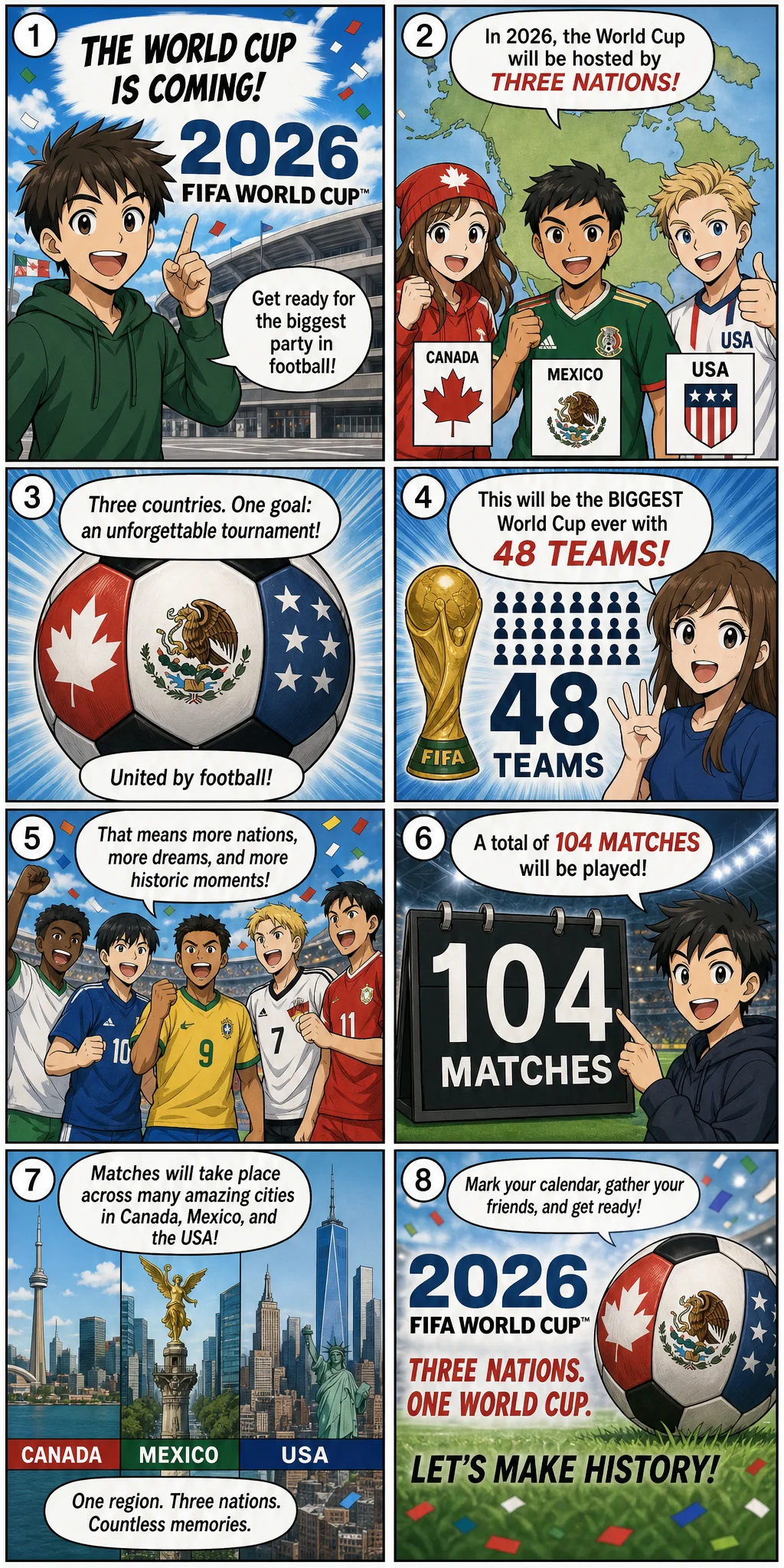
Le contenu de la bande dessinée et les statistiques des matchs sont uniquement à des fins de divertissement et peuvent contenir des inexactitudes. Pour les données précises, veuillez consulter le site officiel de la référence.
Le ballon officiel de la Coupe du Monde 2026 arbore trois emblèmes nationaux répartis sur sa surface, un défi de conception qu'aucun ballon de tournoi précédent n'a jamais rencontré. Depuis l'ère moderne des ballons nommés, marqués et méticuleusement commercialisés, inaugurée avec l'Adidas Telstar en 1970 — le célèbre design à panneaux noirs et blancs créé spécifiquement pour améliorer la visibilité sur les téléviseurs en noir et blanc qui atteignaient encore la majorité du public mondial — chaque ballon de Coupe du Monde a représenté une seule nation hôte, traduisant ses couleurs, son iconographie et son identité visuelle sur une toile sphérique. Le ballon de 2026 doit représenter trois hôtes simultanément : la feuille d'érable du Canada, l'emblème de l'aigle et du serpent du Mexique, et les étoiles des États-Unis. Trois langages visuels nationaux distincts, trois palettes de couleurs distinctes, trois ensembles de significations symboliques distincts, exigeant tous un poids visuel et une présence symbolique égaux dans les contraintes d'un objet d'environ vingt-deux centimètres de diamètre et divisé en un nombre fini de panneaux.
La solution de conception est subtilement intelligente, récompensant un examen attentif. Les trois symboles ne se disputent pas la domination sur la surface du ballon ni ne luttent pour leur position comme pourraient le faire des emblèmes nationaux disposés sur un objet partagé si le designer avait tenté un placement symétrique ou une surface visuelle égale. Au lieu de cela, ils sont disposés le long des coutures structurelles du ballon — les rainures aérodynamiques qui définissent la configuration moderne des panneaux — chacun occupant son propre panneau, chacun bénéficiant de son propre espace, reliés par une ligne fluide qui suggère, selon l'interprétation et la disposition du spectateur, soit des frontières continentales partagées, soit un parcours footballistique commun, soit simplement la logique de conception d'un objet sphérique dont la surface doit accommoder le mouvement et l'impact en plus du symbolisme. Les symboles sont rendus en or sur fond blanc traditionnel, un choix de couleur qui les relie visuellement au trophée lui-même et affirme leur équivalence dans l'entreprise commune d'accueil : trois partenaires égaux, aucun subordonné aux autres, aucun bénéficiant d'une primauté visuelle sur le reste. La conception soutient implicitement ce que l'arrangement d'accueil à trois nations revendique explicitement : ce tournoi appartient aux trois nations, non à un partenaire dominant avec deux invités dont la participation est tolérée plutôt que célébrée.
Les caractéristiques techniques du ballon de match représentent la continuation de l'évolution décennale d'Adidas, passant des sphères en cuir cousu de l'ère pré-moderne aux constructions synthétiques thermocollées du jeu contemporain. Le Telstar de 1970 a introduit la configuration à trente-deux panneaux d'hexagones et de pentagones qui est devenue le vocabulaire de conception par défaut des ballons de football pendant les quatre décennies suivantes, un motif si universel qu'il est apparu sur les écussons des clubs de football et est devenu le raccourci visuel générique du sport lui-même. Le Teamgeist de 2006 a réduit le nombre de panneaux à quatorze et a introduit le thermocollage comme alternative à la couture, produisant un ballon dont la surface était plus lisse et le comportement aérodynamique plus prévisible. Le Jabulani de 2010 a réduit le nombre de panneaux à huit et est devenu le ballon de Coupe du Monde le plus controversé depuis les années 1960, sa trajectoire de vol imprévisible dans l'air raréfié des sites en altitude sud-africains provoquant des plaintes des gardiens de but selon lesquelles les tests aérodynamiques d'Adidas n'avaient pas réussi à reproduire les conditions réelles. Le Brazuca de 2014 est revenu à une configuration de panneaux plus conventionnelle et a largement restauré la confiance des gardiens. Le Telstar 18 de 2018 et l'Al Rihla de 2022 ont poursuivi la tendance vers une texturation de surface accrue et une optimisation aérodynamique, chaque itération produisant des améliorations marginales dans la constance du vol du ballon à différentes vitesses de frappe et taux de rotation.
Le ballon de 2026 intègre la technologie du ballon connecté — des systèmes de capteurs intégrés dans la structure du ballon qui transmettent en temps réel des données sur la position, la vélocité, l'accélération et l'impact aux officiels du match et aux systèmes de diffusion. Cette technologie, introduite expérimentalement dans l'Al Rihla du tournoi de 2022, a directement contribué aux décisions de hors-jeu et aux déterminations de ligne de but qui ont défini plusieurs matchs à élimination directe. L'itération de 2026 affine le pack de capteurs, améliore le taux de transmission des données et intègre la technologie de manière plus transparente dans la conception structurelle du ballon, réduisant les variations de poids et d'équilibre que les premiers prototypes présentaient. Les capteurs n'affectent pas les caractéristiques de vol du ballon. Ils suivent son mouvement avec une précision suffisante pour déterminer, au millimètre près, le moment exact du contact entre la chaussure et le ballon, une information que le système semi-automatisé de hors-jeu utilise pour déterminer si un attaquant était en position de hors-jeu au moment où la passe a été jouée. Cette technologie a éliminé une catégorie de controverses arbitrales qui a tourmenté la Coupe du Monde pendant des décennies. Elle a également introduit une catégorie de débat philosophique sur la question de savoir si un sport dont les lois ont été écrites pour le jugement humain devrait être arbitré par des systèmes dont la précision dépasse la perception humaine.
Le défi de conception du ballon tri-national s'étend au-delà de la disposition des emblèmes jusqu'à la palette de couleurs, la texture de surface et l'identité visuelle que le ballon projette lorsqu'il tourne à grande vitesse — la condition dans laquelle la plupart des spectateurs, regardant à la télévision depuis des angles de caméra qui privilégient le mouvement au détail, le percevront réellement. Un ballon recouvert de trois schémas de couleurs concurrents se lirait comme un bruit visuel en rotation, un flou chaotique de couleurs qui obscurcit plutôt qu'il ne communique l'identité du tournoi. La retenue du design — des emblèmes dorés sur fond blanc, reliés par une seule ligne fluide, évitant la tentation de remplir chaque panneau de symbolisme national — n'est pas simplement un choix esthétique. C'est une exigence fonctionnelle pour un objet dont l'identité doit être lisible en mouvement, à distance, à travers les caméras de télévision, les écrans de smartphone et les lignes de vue des stades, par des publics qui verront le ballon plus souvent comme un flou que comme un objet stationnaire. Le ballon ne peut pas parler. S'il le pouvait, il dirait ce que le design communique déjà à travers la disposition de ses symboles et la retenue de sa palette : tout le monde est le bienvenu ici, personne n'est secondaire, et le tournoi appartient également aux trois nations. Le football déterminera si cette promesse — trois partenaires égaux, accueillant ensemble, partageant la scène — survit à la pression compétitive d'un tournoi dans lequel les nations se disputent la primauté par définition. Le ballon fait la promesse. Les matchs testeront si elle peut être tenue.