
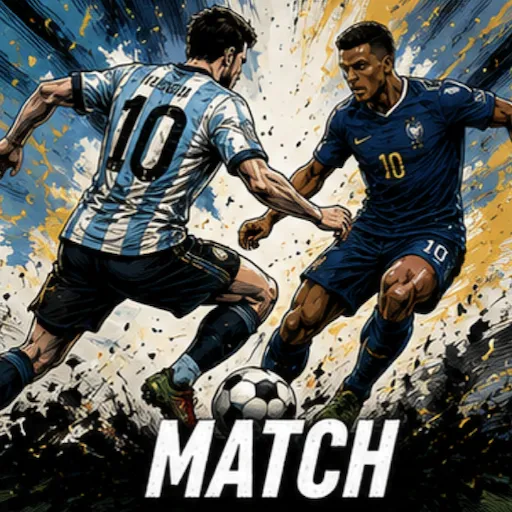
New Zealand vs Belgium
New Zealand versus Belgium confronts the All Whites with their group's seeded giant — a golden generation making its final stand against Oceania's hungry champion. This analysis explores the tactical chasm between the sides, New Zealand's set-piece disruption strategy, Belgium's creative genius attempting to unlock a deep defensive block, and the classic dynamic of established power meeting determined underdog.
Published: June 6, 2026

Comic content and match statistics are for entertainment purposes only and may contain inaccuracies. For Accurate Data, please refer to the reference's official website.
New Zealand vs Belgium: De Bruyne's Geometry Against the All-White Wall
Belgium's golden generation enters its final group match with the familiar burden of expectation now accompanied by the creeping sense of an era drawing to a close. Kevin De Bruyne, at 35, orchestrates a Belgian side that has evolved from the counter-attacking unit of 2018 into a possession-dominant team that builds through the half-spaces with a methodical patience that borders on vulnerability. New Zealand, already eliminated, presents not a tactical puzzle so much as a psychological one: how does a team that struggles to break down deep blocks maintain intensity when the outcome carries no jeopardy?
The Belgian system under Domenico Tedesco has settled into a 4-2-3-1 that becomes a 3-2-5 in sustained possession. De Bruyne operates from the right half-space with license to drift centrally, where his capacity to weight passes into the channel behind the full-back remains the most potent creative weapon in the tournament. The full-backs, Timothy Castagne and Maxim De Cuyper, advance to provide width while the double pivot of Amadou Onana and Youri Tielemans screens against transition. Romelu Lukaku, at 33, remains the reference point at center-forward — a player whose hold-up play and physical presence create the platform from which Belgium's creators can operate.
New Zealand's approach will be tactically identical to their approach against Egypt: a 5-3-2 defensive block that surrenders possession, compresses central space, and relies on the occasional counter-attack through Chris Wood's hold-up play and the pace of Ben Waine in the channel behind. The difference is the quality of the opponent. Belgium moves the ball faster than Egypt, with De Bruyne's passing range enabling diagonal switches that stretch a low block laterally at speeds that Egyptian midfielders could not generate. A compact shape that held against Egypt for 70 minutes may be stretched to breaking point within 20 against Belgian ball circulation.
The specific tactical problem for New Zealand is De Bruyne's positioning between the lines. In a 5-3-2 block, the three central midfielders are responsible for covering the space in front of the back five. Against a team that builds through the flanks, this is manageable. Against De Bruyne operating in the half-space — the zone between the center-back and the full-back, where a midfielder and a defender both feel responsible but neither fully commits — the structure fractures. De Bruyne receives the ball in these pockets, and in the half-second it takes for a New Zealand midfielder to close him down, he has already released a pass that breaks the defensive line. This is not a matter of effort; it is a matter of geometry. De Bruyne's passing angles are designed to exploit the spaces that exist in every defensive system, no matter how well drilled.
If New Zealand adjust — if they drop a forward into midfield to create a 5-4-1, or if the wing-backs tuck inside to congest the half-spaces more aggressively — Belgium's wide overloads become the alternative route. Castagne and De Cuyper delivering crosses toward Lukaku, whose aerial duel win rate places him among Europe's elite forwards in that category, creates a different but equally dangerous threat. The tactical choice for New Zealand is between defending the half-spaces and exposing the flanks, or defending the flanks and ceding the half-spaces to De Bruyne. Neither option is appealing.
Belgium's defensive vulnerability, however, remains the space behind their advanced full-backs. Tedesco's system demands that the full-backs push high to provide width, which leaves the two center-backs — likely Wout Faes and Zeno Debast — isolated against counter-attacks. This is the precise weakness that opponents have exploited in Belgium's tournament exits since 2018. New Zealand's route to goal is not through sustained possession, which they will not have, but through the single moment when Belgium's full-backs are caught ahead of the ball and Wood can hold up a clearance while a teammate breaks from midfield.
The pattern of the match will be established within the first 15 minutes. If Belgium scores early — if De Bruyne finds a pass that unlocks New Zealand's block before the defensive rhythm is set — the contest effectively ends, and the question becomes one of scoreline rather than outcome. If New Zealand reaches halftime without conceding, the dynamic shifts. Belgium's patience, tested by a resilient block, can give way to hurried decision-making in the final third — crosses from non-threatening positions, shots from distance, the gradual erosion of the structured approach that Tedesco has spent three years installing.
The deeper tactical narrative concerns Belgium's evolution. The 2018 side that finished third was built on rapid transitions and De Bruyne operating as a false nine. The 2026 version is a possession team, a control team, a team that wants to dictate terms rather than react to them. The transition from counter-attacking to controlling has been incomplete — Belgium dominate possession against weaker sides but struggle to create high-quality chances against organized defenses. This match against New Zealand is less a contest than a diagnostic: how effectively can Belgium's possession system generate goals against a block that is designed to concede nothing but time? If the answer is unconvincing, the evidence will be on display for Belgium's knockout-stage opponents, who will be watching closely and taking notes.