
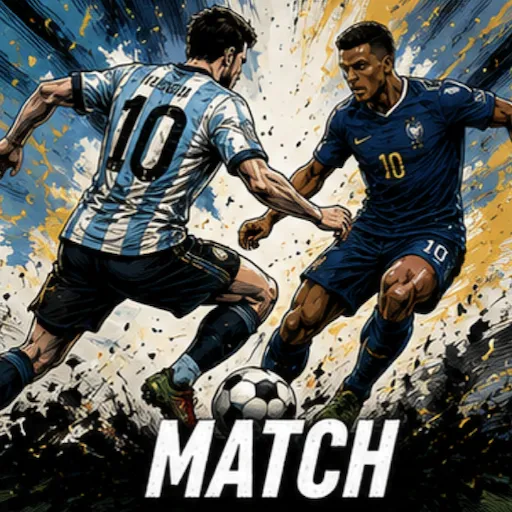
Portugal vs DR Congo: The Empire and the Return — Group K Tactical Preview
Portugal versus DR Congo carries colonial history onto the football pitch with a weight that no pre-match ceremony can acknowledge and no tactical preview can address. The Democratic Republic of the Congo was once, briefly and horrifically, the perso
Published: June 6, 2026
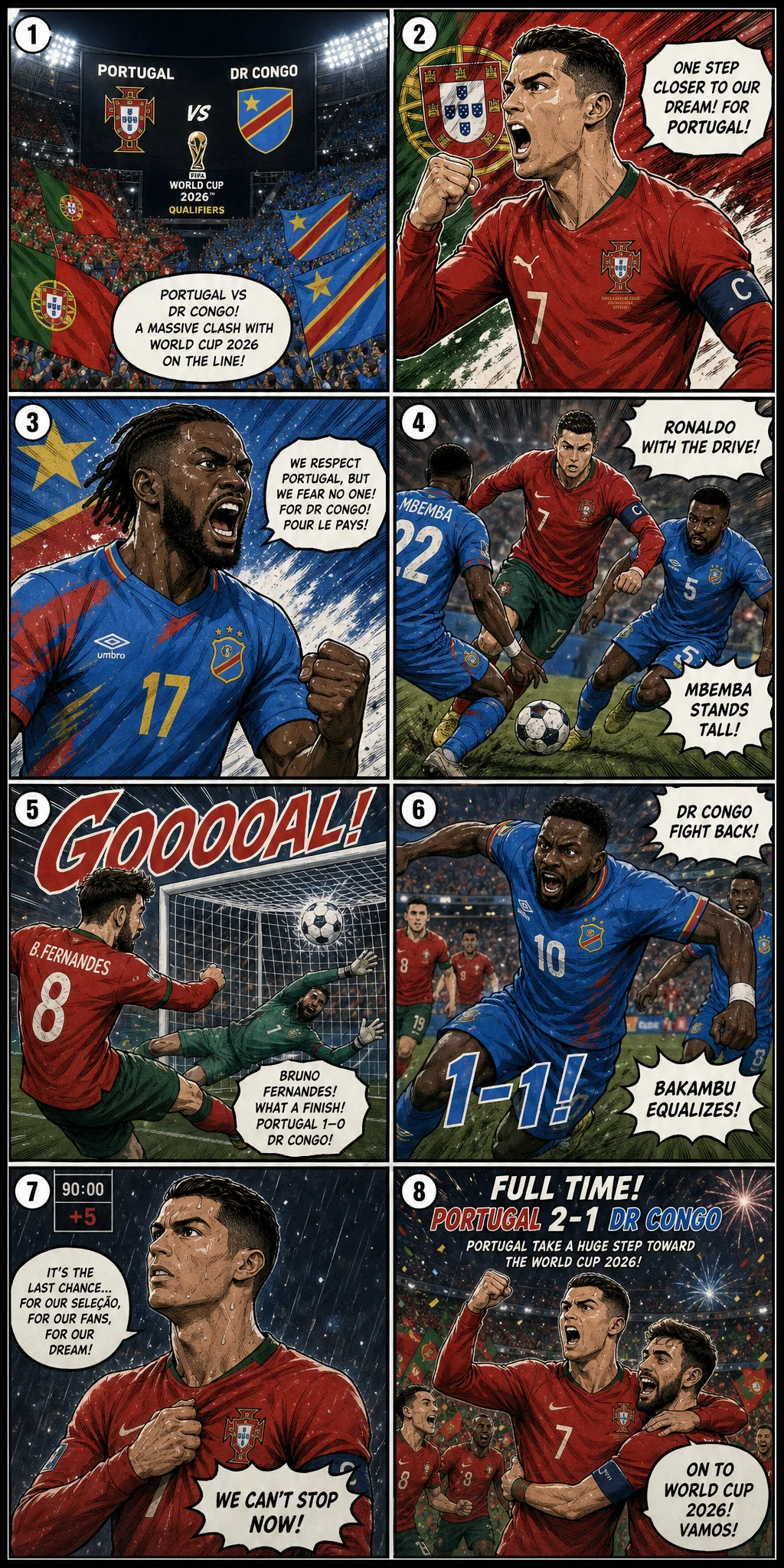
Comic content and match statistics are for entertainment purposes only and may contain inaccuracies. For Accurate Data, please refer to the reference's official website.
# Portugal vs DR Congo: The Empire and the Return — When Colonial History Meets the Pitch
Portugal versus DR Congo carries colonial history onto the football pitch with a weight that no pre-match ceremony can acknowledge and no tactical preview can address. The Democratic Republic of the Congo was once, briefly and horrifically, the personal property of King Leopold II of Belgium, but the Portuguese colonial presence in Central Africa predates even that — Angola borders the DRC, the linguistic and cultural connections run deep, and the players who take the field for both sides understand the resonance even if the broadcast commentary will studiously avoid it. This is not just a Group K opener. This is a collision of empires, past and present, played out on grass in front of a global audience.
Portugal's squad is the deepest in its history. Deeper than 2006, when Figo and Deco led the golden generation to a semi-final. Deeper than the Eusebio generation, when a single transcendent talent carried a nation's hopes. Deeper than any team that has worn the burgundy and green. Ruben Dias anchors a defense that has conceded fewer goals in qualifying than any European team. Bruno Fernandes creates from midfield with a controlled chaos that is entirely his own — passes arrive from angles the geometry textbooks have not documented. Bernardo Silva provides the metronomic precision that transforms possession into control. Rafael Leao offers the explosive unpredictability that turns half-chances into goals. The starting eleven is Champions League-level at every position. The bench — Joao Felix, Goncalo Ramos, Vitinha, Joao Palhinha — would start for most nations in this tournament.
And yet — the hesitation that follows every Portuguese footballing generation, the "and yet" that has haunted this nation since Eusebio's tears at Wembley in 1966 — Portugal has never quite delivered when it mattered most. The 2016 European Championship, won in Paris against a France team that dominated the final, was supposed to break the curse. It did not. The doubts resurface at every tournament, and they resurface with particular intensity against opponents who should, on paper, be overwhelmed. Portugal should beat DR Congo comfortably. Should. The word is doing an enormous amount of work.
DR Congo's Leopards arrive with nothing to lose and a football identity built on proving that "should" is a useless word in tournament football. The squad is built on physical dominance — the Congolese midfield is taller, faster, and more powerful than Portugal's — and transitional chaos, a style that disrupts organized opponents and exploits the spaces disruption creates. The plan is simple in conception and brutally difficult in execution: absorb Portuguese possession in a compact 4-5-1 block, break through the channels when Portugal's full-backs have committed forward, and trust that the specific chaos of a Congolese counter-attack can produce a moment that no tactical system can prevent.
Yoane Wissa, the Brentford forward, carries the attacking threat. His Premier League education has taught him to be clinical with limited service — a skill that will be tested to its limit against Portugal's possession dominance. Wissa will see the ball perhaps thirty times in the entire match, and perhaps five of those touches will come in positions where a goal becomes theoretically possible. Converting one of those five chances is the difference between a historic result and a respectable defeat.
The tactical question is whether Portugal can prevent the Congolese counter-attack from ever launching. The Portuguese press under Roberto Martinez is less frenetic than Rangnick's Austria, more positional, designed to trap opponents in wide areas rather than win the ball high. Against DR Congo, this approach carries risk — the touchline press invites the long diagonal to the opposite flank, and the Congolese wingers are fast enough to exploit the space that Portugal's shifted defensive block leaves behind. Martinez must decide whether to commit his full-backs forward and accept the transitional vulnerability, or hold them deeper and sacrifice the attacking width that makes Portugal's system work.
I met a Portuguese journalist in Lisbon last autumn, a man who has covered the selecao since Figo's debut. "We are the most pessimistic football nation in Europe," he told me over a pastel de nata in Belem. "We have the talent to win everything and the psychology to lose to anyone. Every tournament, we wonder which Portugal will show up. The answer is usually: both." Against DR Congo, both Portugals might be enough. Or the bad Portugal might meet the best Congo. That is the match nobody in Lisbon wants to talk about but everyone is quietly dreading. Group K begins with an empire and a question. The answer arrives at the final whistle.