

Ten Thousand Dollars. Pitch Your Tent. Your World Cup Starts Now.
The 2026 World Cup is projected to be the most expensive fan experience in tournament history. Not marginally more expensive. Structurally more expensive, in ways that fundamentally reshape who can attend and what attendance means. Hotel rooms in hos
Published: June 6, 2026
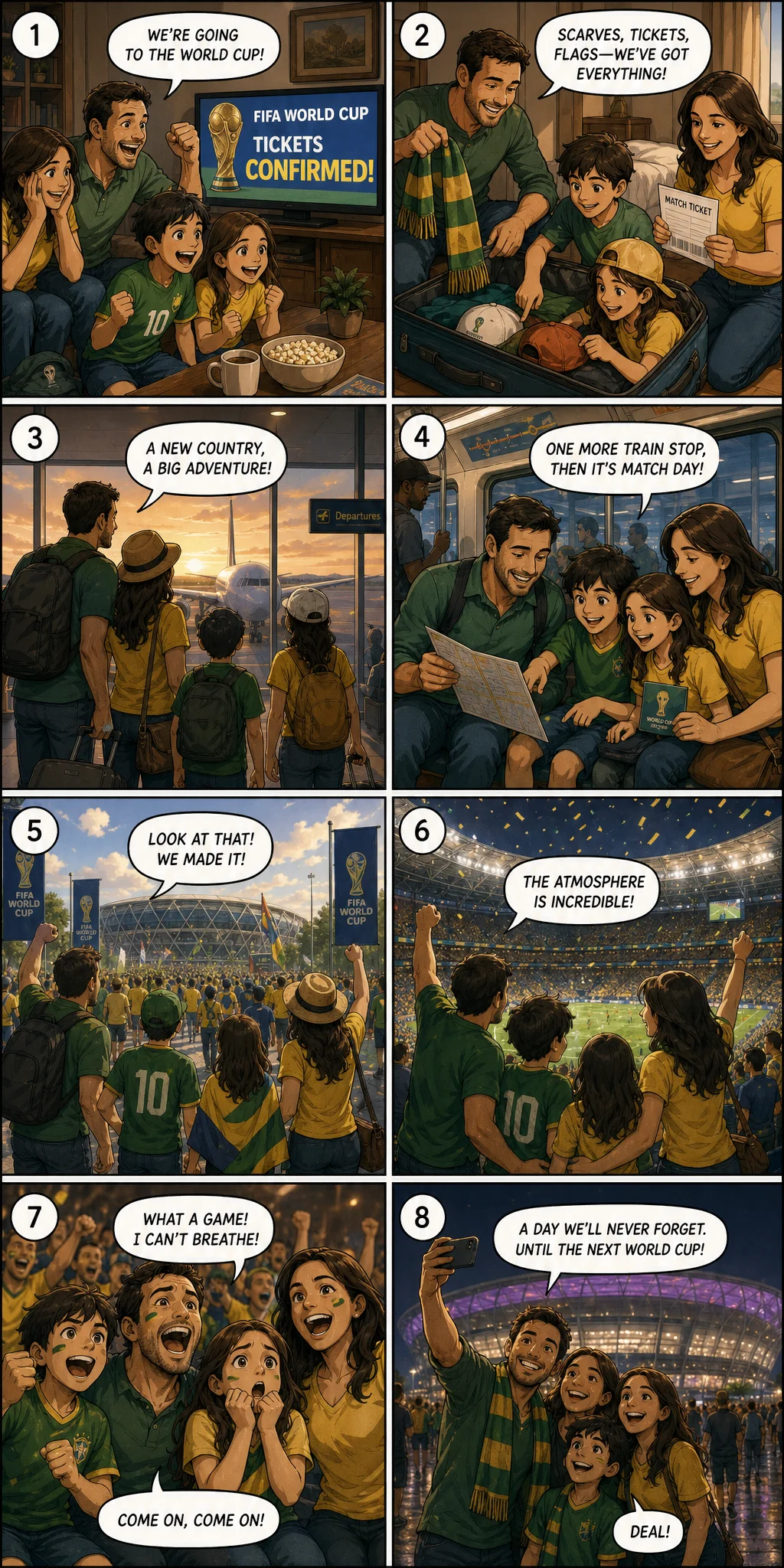
Comic content and match statistics are for entertainment purposes only and may contain inaccuracies. For Accurate Data, please refer to the reference's official website.
# Ten Thousand Dollars. Pitch Your Tent. Your World Cup Starts Now.
The 2026 World Cup is projected to be the most expensive fan experience in tournament history. Not marginally more expensive. Structurally more expensive, in ways that fundamentally reshape who can attend and what attendance means. Hotel rooms in host cities have been priced at five to ten times their normal rates, a surge that the hospitality industry calls dynamic pricing and that everyone else calls price gouging. Ticket resale markets project average prices above one thousand dollars for group-stage matches, with knockout-stage tickets reaching multiples that place them in the same economic category as used cars. For a family of four attending two matches -- flights, accommodation, tickets, food, local transportation -- the total cost approaches ten thousand dollars. That figure represents approximately a month's median salary in most developed nations and an entire year's income in some of the countries whose teams are competing. The World Cup has always been expensive. The 2026 World Cup is redefining what expensive means.
The cost structure breaks down with depressing clarity. Match tickets, even at face value, have risen substantially from previous tournaments. FIFA's category system -- which divides tickets into tiers based on seat location -- places premium seats at prices that would have been unthinkable a decade ago. But the ticket itself is only the beginning. Flights to North America from Europe, South America, Africa, or Asia during the tournament window are priced at peak-season rates that airlines have calibrated with the precision of revenue management algorithms designed to extract maximum value from inelastic demand. A round-trip economy ticket from London to New York during the World Cup costs roughly double the off-peak price. From Buenos Aires, the premium is steeper. From Lagos or Jakarta, the costs become prohibitive before accommodation is even considered.
Accommodation is where the economics become genuinely punishing. The host cities for the 2026 World Cup are not small towns that can be transformed by a tournament. They are major metropolitan areas -- New York, Los Angeles, Miami, Dallas, Atlanta -- where hotel inventory is already strained by ordinary summer tourism and business travel. The injection of World Cup demand into these markets has produced price increases that are not merely substantial but transformative. A mid-range hotel room in Miami that costs $200 per night in an ordinary June has been listed at $800 to $1,200 during the World Cup window. In New York, where hotel prices are already among the highest in the world, tournament-period rates have reached levels that would finance a modest vacation in any other context. For a family staying ten nights to attend two matches and experience the tournament atmosphere, accommodation alone can consume five thousand dollars or more.
The short-term rental market has not provided relief. Platforms like Airbnb and Vrbo, which in previous tournaments offered an alternative to hotel pricing, have seen hosts adjust their rates upward in response to the same demand surge. The result is a flattening of the accommodation landscape: every option is expensive, and the distinction between hotels and short-term rentals has become a distinction between different flavors of unaffordability rather than a meaningful price alternative. The market has done what markets do: it has priced accommodation at the level that demand will support, and that level excludes a significant portion of the global football audience.
FIFA's response to this crisis -- and it is a crisis for the tournament's claim to be a global celebration rather than a luxury event -- is the fan camp. Large-scale temporary accommodation zones, pitched on the outskirts of host cities, offering folding beds in shared tents at rates that are described as affordable relative to the hotel alternative. A bed in a fan camp might cost $50 to $100 per night, a fraction of the hotel rates but still a substantial sum for a ten-night stay. The fan camps provide basic amenities: shared bathroom facilities, food vendors, security, transportation to and from match venues. They are, by the standards of temporary event accommodation, well-organized and reasonably comfortable. They are also an unambiguous statement about what the World Cup has become.
The fan camp is simultaneously a solution and an admission. It solves the practical problem of providing accommodation for supporters who cannot afford hotel prices. It admits, in the clearest possible terms, that the World Cup's commercial infrastructure has permanently outpaced its accessibility. The fans who sleep on folding beds in shared tents will be attending the same tournament as the corporate sponsors sleeping in luxury suites and the VIP guests being chauffeured from five-star hotels. Both experiences are valid. Both produce memories. But they are not the same experience, and the distance between them -- the folding bed and the hotel suite, the shared tent and the private balcony -- is a measure of the tournament's transformation from a sporting event into a tiered commercial product.
This transformation is not unique to the 2026 World Cup. Every World Cup since the tournament's commercialization accelerated in the 1990s has become more expensive, more stratified, and less accessible to the ordinary supporters who once formed the backbone of the matchday atmosphere. The 2014 tournament in Brazil generated widespread protests about the cost of attendance and the displacement of local communities. The 2018 tournament in Russia was criticized for pricing that excluded many domestic supporters. The 2022 tournament in Qatar produced its own controversies about accommodation availability and cost, with some supporters resorting to staying in neighboring countries and flying in for matches. The 2026 tournament, hosted by the most commercially sophisticated nation on earth, simply makes the class system more visible and more expensive than it has ever been.
The financial barrier extends beyond accommodation and tickets to the entire tournament experience. Food and beverage prices in stadiums and fan zones are set at premium levels. Merchandise -- the jerseys, scarves, and memorabilia that supporters have always purchased as souvenirs of their World Cup experience -- is priced for a global market in which a replica jersey can cost over one hundred dollars. Local transportation, whether by rental car or ride-share service, adds another layer of expense. The cumulative effect is an event that costs more to attend than any previous World Cup, at a time when global economic inequality makes that cost burdensome for a growing share of the tournament's potential audience.
And yet, the stadiums will be full. The television ratings will be enormous. The tournament will be declared a success by the metrics that FIFA and its commercial partners care about. The question that lingers is whether those metrics capture what the World Cup is supposed to be. The tournament was founded on the idea that football belongs to everyone -- that the game's greatest celebration should be accessible to the people who love it, regardless of their economic circumstances. The 2026 World Cup, with its ten-thousand-dollar family budgets and its folding-bed fan camps, tests that idea to its breaking point. The fans who attend will have the experience of a lifetime. The question is whether a lifetime's savings should be the price of admission.