

One Visa, Three Countries, and a Rejected Dream
The 2026 World Cup spans three nations with three separate immigration systems. The United States, Canada, and Mexico share a continent but not a border policy, and for fans traveling from countries that require visas, the tournament involves three a
Published: June 6, 2026
Comic content and match statistics are for entertainment purposes only and may contain inaccuracies. For Accurate Data, please refer to the reference's official website.
# One Visa, Three Countries: The Bureaucracy of World Cup Dreams
The 2026 World Cup spans three nations with three separate immigration systems. The United States, Canada, and Mexico share a continent but not a border policy, and for fans traveling from countries that require visas, the tournament involves three applications, three sets of documentation, three separate bureaucratic processes, and three independent opportunities for rejection. The three-nation hosting arrangement was sold to the world as a celebration of partnership and continental inclusion. For millions of supporters from the Global South, it represents an obstacle course that will prevent some of them from attending -- not because they cannot afford tickets or accommodation, but because they cannot secure the paperwork that three separate governments require before they are permitted to enter.
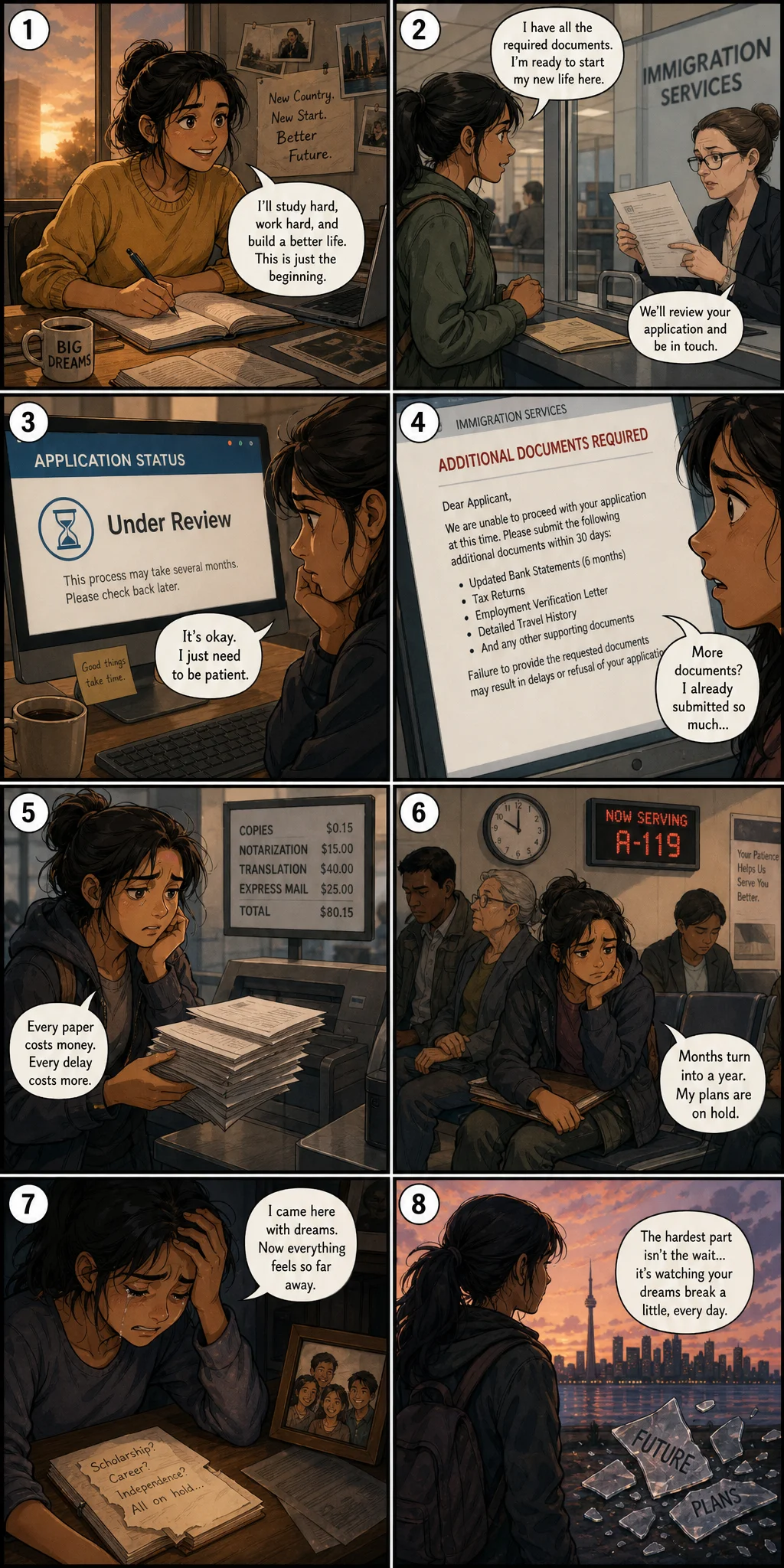
The American visa process is the primary bottleneck, and it is severe. The United States requires visitor visas -- officially B-1/B-2 visas -- from citizens of most African, many Asian, and several South American nations. The application process requires an in-person interview at a U.S. embassy or consulate, and the wait time for that interview varies dramatically by country. In some of the nations that have qualified for the 2026 World Cup, the wait time for a U.S. visa interview appointment exceeds six months. A Senegalese supporter who learns in December 2025 -- when the draw is held and match schedules are announced -- that their team will play in American host cities has approximately six months to secure a visa. If the wait time in Dakar is eight months, the mathematics are unforgiving. The supporter will not attend. Not because they did not want to. Not because they could not afford to. Because a bureaucracy designed for business travelers and tourists, not for football supporters on tournament schedules, lacked the capacity to process their application in time.
The numbers are stark. The U.S. State Department's own data shows that visa interview wait times in several World Cup-qualified nations regularly exceed 200 days. The countries affected include some of the most passionate football cultures on the planet -- nations whose supporters would transform the tournament atmosphere with their presence, whose absence will be felt in quieter stadiums and less colorful fan zones. The U.S. government has made commitments to expedite World Cup-related visa applications, establishing dedicated processing channels and promising to prioritize tournament attendees. But the commitments come from political appointees with limited control over the operational reality of understaffed consular sections in overburdened embassies. The gap between the promise and the processing capacity is measured in the disappointed faces of supporters who did everything right and still ran out of time.
Canada and Mexico add their own layers of complexity. A fan attending matches in all three host nations must navigate three separate visa regimes, each with its own documentation requirements, its own application timelines, and its own grounds for rejection. The Canadian visa process, while generally faster than the American equivalent, still requires detailed documentation of travel plans, financial resources, and ties to the applicant's home country. The Mexican visa process varies by nationality, with some World Cup-qualified nations enjoying visa-free access and others facing requirements that mirror the American system. A supporter who successfully navigates the U.S. visa process may discover, too late, that their itinerary requires a Canadian visa they have not applied for, or a Mexican visa with a processing timeline they have not accounted for. The three-nation tournament demands three-nation documentation literacy, and the cost of getting it wrong is not a fine or a delay -- it is exclusion from the tournament entirely.
The bureaucratic burden falls most heavily on supporters from the nations that FIFA's expansion to 48 teams was supposed to benefit. The 2026 tournament will feature more teams from Africa, Asia, and the Americas than any previous World Cup. The expansion was justified in part by the argument that a larger tournament would be more globally representative, more inclusive, more genuinely a world championship. But representation on the pitch does not translate into representation in the stands if the supporters of those newly included nations cannot physically reach the stadiums. The irony is sharp: FIFA has expanded the tournament to include more of the world, while the host nations' visa systems have constructed barriers that prevent those same parts of the world from attending.
The economic dimension of the visa problem compounds the injustice. Visa application fees for the United States currently stand at approximately $185, a non-refundable charge that is assessed regardless of whether the visa is ultimately granted. For a family of four, the application fees alone approach $750 before any other tournament expense is incurred. If the visa is denied -- and denial rates for certain nationalities are substantial -- that money is lost. The same family must then decide whether to apply for Canadian or Mexican visas to attend matches in those countries, incurring additional fees and additional uncertainty. The financial risk of the visa process falls disproportionately on supporters from lower-income nations, creating a de facto economic filter that screens out precisely the supporters whose presence would most enrich the tournament's atmosphere.
The teams themselves are affected. National federations from visa-required countries have spent significant resources navigating the immigration systems of the host nations, not just for players and staff -- who typically travel on special accreditation rather than standard visas -- but for the extended support networks of families, federation officials, and domestic media who accompany a World Cup campaign. The administrative burden of managing visa applications for dozens of individuals across three separate immigration systems consumes time and money that could be spent on tournament preparation. It is a tax on participation, invisible to the television audience but substantial to the federations that pay it.
The three-nation hosting model is unlikely to be repeated. The 2030 World Cup's six-nation spread is being treated as a centenary exception rather than a template, and the logistical lessons of 2026 -- including the visa complications -- will inform future hosting decisions. But for the supporters whose World Cup dreams will be decided not by a football match but by a consular officer's stamp, the lessons come too late. The World Cup belongs to the world. The visa offices, with their six-month wait times and their non-refundable fees and their sovereign discretion to say no, do not. The gap between those two realities is where the 2026 tournament's most profound exclusion will occur -- not on the pitch, where 48 teams will compete, but at the border, where some of the people who love those teams most will be turned away.