

A Letter from Europe: Dear FIFA, We've Had Enough
The relationship between FIFA and Europe's major clubs has never been warm, but as the 2026 World Cup approaches, the temperature has dropped to something approaching open hostility. The proximate cause is the tournament itself: a 48-team, 104-match
Published: June 6, 2026
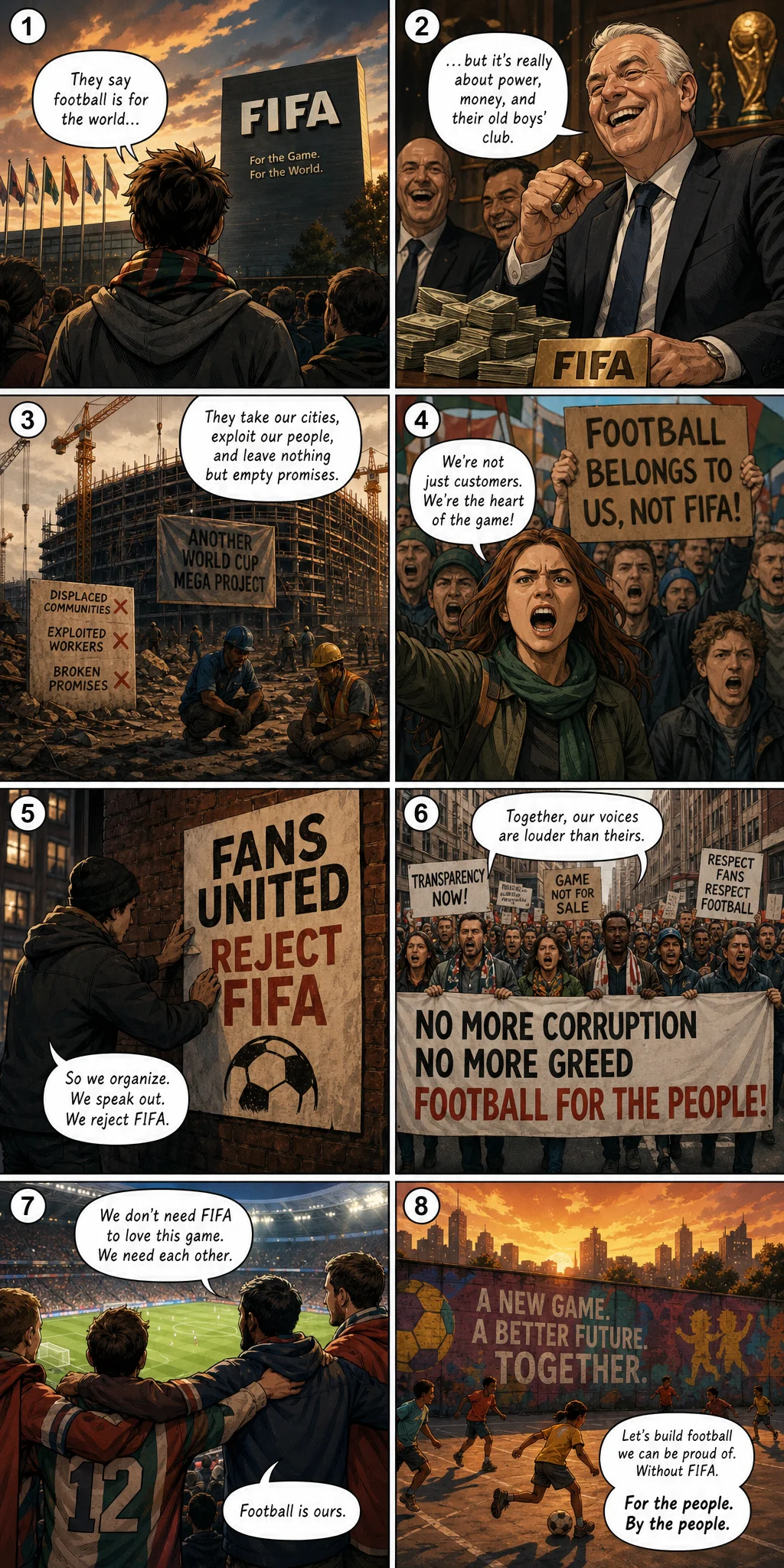
Comic content and match statistics are for entertainment purposes only and may contain inaccuracies. For Accurate Data, please refer to the reference's official website.
# The Club-Country Fault Line: European Football's War of Attrition with FIFA
The relationship between FIFA and Europe's major clubs has never been warm, but as the 2026 World Cup approaches, the temperature has dropped to something approaching open hostility. The proximate cause is the tournament itself: a 48-team, 104-match behemoth scheduled across 39 days in June and July, demanding the services of more than 800 players -- the vast majority of whom are employed by European clubs that receive no direct compensation, no meaningful consultation, and no relief from the fixture congestion that already threatens to consume the sport's calendar. But the underlying tension is older and deeper, a structural conflict between two visions of football's political economy that have been on a collision course for decades.
The clubs' argument, stripped of its diplomatic language, is straightforward and not unreasonable. They invest enormous sums -- hundreds of millions of euros annually in wages, medical care, training facilities, and youth development -- to build the squads that make the World Cup watchable. The Premier League alone pays its players approximately 2 billion pounds per season, a figure that dwarfs FIFA's total prize money for the 2026 tournament. When those players depart for a five-week international tournament at the end of an already-bloated club season, the clubs absorb the risk of injury and fatigue without receiving a share of the revenue their players help generate. They are, in effect, subsidizing FIFA's flagship product, and they have grown tired of it.
The 2026 World Cup intensifies this grievance because of its expanded scale. The 48-team format requires more players, more matches, and a longer tournament window -- 39 days from opening match to final, compared to 29 days for the 32-team format used from 1998 through 2022. The additional ten days may not sound catastrophic, but in the context of a football calendar that has already expanded to accommodate an enlarged Champions League, an expanded Club World Cup, and an ever-proliferating schedule of international breaks, the marginal cost of those ten days is substantial. A player who reaches the World Cup final with his national team in July 2026 will have roughly three weeks before his club's preseason begins, and perhaps four weeks before competitive fixtures resume.
The welfare implications of this compression are not theoretical. FIFPRO, the global players' union, has been sounding alarms about player workload for years, and its data is increasingly difficult to dismiss. A 2023 FIFPRO report found that elite players now routinely exceed 55 matches per season across club and international competitions, with some -- the most valuable, most watched, most demanded -- approaching 70. The physical toll of this schedule is measurable in injury rates, career longevity, and the quality of the product on the pitch; a player who has played 60 matches by June is not the same player who began the season in August, and the World Cup, which purports to showcase the game at its highest level, is increasingly populated by athletes running on empty.
The clubs have attempted to assert their interests through the European Club Association (ECA), which has evolved from a polite discussion forum into a genuine political force. The ECA's leadership, particularly under the chairmanship of Paris Saint-Germain president Nasser Al-Khelaifi, has pushed for a formalized revenue-sharing agreement that would compensate clubs for releasing players to the World Cup, similar to the model that already exists for the European Championship through UEFA's club benefits program. Under that program, clubs receive a portion of tournament revenue proportional to the number of players they supply and the duration of their involvement, a system that acknowledges the clubs' contribution without fundamentally challenging UEFA's authority. FIFA has resisted extending this model to the World Cup, arguing that the tournament's global development mandate requires distributing revenue to member associations rather than to clubs, and that the clubs' own commercial interests are already served by the exposure their players receive on the World Cup stage.
This argument has not aged well. The notion that "exposure" constitutes adequate compensation for the loan of a club's most valuable assets -- assets that are insured for tens of millions of euros and whose loss to a tournament injury can derail an entire season -- strikes club executives as a relic of an era when the balance of power between clubs and international federations was fundamentally different. In the 1970s and 1980s, when the World Cup was still the primary stage upon which players built their reputations, the exposure argument carried weight. In 2026, when the Champions League generates comparable global audiences and club football's commercial ecosystem is larger and more sophisticated than the international game's, the argument has lost whatever force it once possessed.
The tension between clubs and FIFA is not merely financial; it is philosophical. FIFA operates, at least in its public pronouncements, as the guardian of football's universal values -- development, solidarity, the global growth of the game. The major European clubs operate as businesses, and while many of them invest significantly in community programs and youth development, their primary fiduciary duty is to their shareholders or members, not to the global football community. When these two value systems collide -- when FIFA schedules a World Cup that extracts value from clubs without compensating them, or when clubs threaten to withhold players from international duty to protect their commercial interests -- the collision reveals the fundamental incoherence at the heart of football's governance: the sport's most important institutions are accountable to different constituencies with different interests, and there is no mechanism for resolving conflicts between them.
The 2026 World Cup will not, in all likelihood, produce a rupture. The clubs are not going to instruct their players to boycott the tournament, a move that would alienate fans, breach contracts, and invite legal challenges that no club wants to fight. The players themselves, whatever their fatigue, are not going to decline call-ups to the World Cup, the tournament that every footballer dreams of playing. But the underlying tensions will persist, and they will surface in the negotiations over the 2030 and 2034 tournaments, in the ongoing battles over the Club World Cup's format and scheduling, and in the slow, grinding institutional struggle that will determine who controls football's most valuable resource: the players' time.
In the meantime, the 2026 World Cup will proceed, and the clubs will watch with a mixture of pride and anxiety as their employees compete for the sport's greatest prize. Some of those employees will return injured. Some will return exhausted. Some will return diminished, the accumulated fatigue of a 60-match season compounded by the intensity of a World Cup run. And the clubs will add the cost of those injuries, that fatigue, that diminishment to the ledger of grievances they maintain against FIFA, waiting for the day when the balance of power shifts far enough for the ledger to be settled. That day is not yet here. But it is coming.