
If a New Name Lifts the Trophy
Seven nations arrive at 2026 with a credible case to become first-time champions in an expanded format that historically favors outsiders. This prediction feature evaluates Portugal, Netherlands, Belgium, Croatia, Morocco, the United States, and Japan across squad depth, tournament pedigree, and tactical identity, asking which country will join the exclusive club of World Cup winners.
Published: June 6, 2026
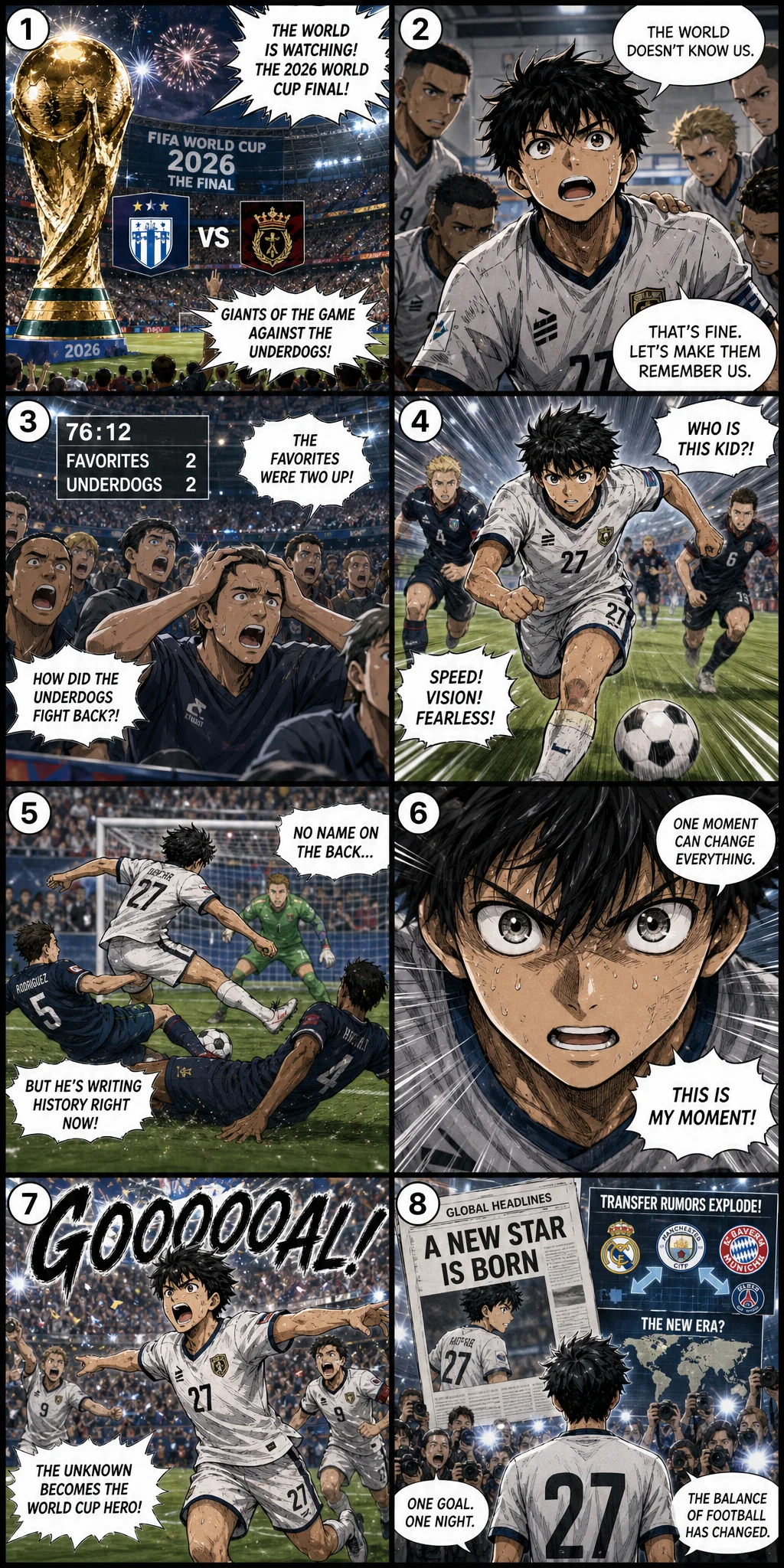
Comic content and match statistics are for entertainment purposes only and may contain inaccuracies. For Accurate Data, please refer to the reference's official website.
First-Time Champion Candidates: Portugal, Netherlands, Croatia, Morocco
Eight nations have ever won the men's World Cup. Uruguay, Italy, Germany, Brazil, England, Argentina, France, Spain. Eight names carved into a trophy that has been contested twenty-two times across ninety-six years, and the gates have been locked since Spain forced them open in 2010 after an eighty-year expansion that added roughly one new champion every decade. The 2026 tournament, with its forty-eight teams, its continental travel burden, its three-team groups that compress the margin for error, and its bracket asymmetries that reward the teams smart enough to identify them, offers the most plausible opportunity for a ninth name since the tournament's expansion era began.
I have thought about what it would mean -- not for the trophy's engraver, whose task is merely technical, but for the sport itself -- if a new nation lifted the World Cup on July 19, 2026. The last first-time champion was Spain, and the moment was not merely a football result but a cultural reckoning: the nation whose football identity had been defined by underachievement, by the specific capacity to arrive at tournaments as favourites and depart as disappointment, finally delivered the validation that its club football had been promising for decades. A new champion in 2026 would produce a similar reckoning for whichever nation achieves it, and the candidates are more varied, more credible, and more narratively compelling than any previous tournament's field of outsiders.
Portugal is the most credible candidate by every available measure. The squad depth in 2026 is the deepest outside the traditional superpowers: Ruben Dias anchoring the defence, Bruno Fernandes and Bernardo Silva providing the creative midfield axis, Rafael Leao offering the explosive athleticism that turns half-chances into knockout-stage goals, Joao Felix representing the wildcard talent that might finally bloom. The 2016 European Championship victory provides the specific psychological inoculation that first-time champions historically lack -- Portugal has won a major tournament, its players understand the emotional architecture of a knockout run, the scar tissue of near-misses has been replaced by the institutional memory of success. The question is whether the squad can avoid the collective underperformance that has accompanied every Portuguese generation except the 2016 European champions, and whether the specific pressure of being the favourite in matches Portugal is expected to win -- a different pressure from the underdog resilience that carried the 2016 team through extra time and penalties -- can be managed without the psychological collapse that has historically undone talented Portuguese teams.
Netherlands is the most romantic candidate, the eternal near-miss, the football culture that changed the sport and never received the ultimate validation. Three World Cup finals: 1974, the Cruyff team that redefined what football could be and lost to West Germany in a match that felt, to everyone who witnessed it, like a cosmic injustice. 1978, another final, another host nation, another defeat without Johan Cruyff, who had declined to travel to Argentina's military dictatorship. 2010, the ugly Dutch, the De Jong karate kick to Xabi Alonso's chest, the Iniesta goal in the hundred-and-sixteenth minute that felt like the universe finally settling accounts. The Netherlands has been the best team never to win the World Cup for so long that the description has become a cultural identity rather than a competitive status. The 2026 squad, built around Virgil van Dijk's defensive organisation, Frenkie de Jong's midfield control, and the emerging attacking generation of Xavi Simons and Cody Gakpo, has the structural quality to compete. The question is psychological: can a football nation that has defined itself through near-misses finally produce the result that rewrites its own narrative?
Croatia's case is the most narratively compelling in the entire tournament. Luka Modric is forty years old, playing his final World Cup, the last active link to the generation that reached the 2018 final and the 2022 semifinal. A nation of four million people has outperformed its population size by a factor that no other football country approaches: Croatia has won more World Cup knockout matches since 1998 than England, more than the Netherlands, more than any European nation outside the established powers. The Modric-Kovacic-Brozovic midfield is the most decorated central unit in international football, and the institutional knowledge of deep tournament runs -- the specific understanding of what a World Cup semifinal feels like, what the days between matches demand, what the moment before a decisive fixture requires -- cannot be purchased or simulated. Croatia has it because Croatia has lived it. The question is whether the legs can support the mind through eight matches rather than seven, whether the accumulated fatigue of a forty-year-old playing a tournament that is longer and more physically demanding than any previous edition can be managed without the specific drop-off that age eventually demands.
Morocco returns with something the 2022 semifinalists lacked: institutional belief rather than improbable hope. The 2022 run -- Belgium, Spain, Portugal, France, four consecutive knockout opponents from the sport's traditional elite, one goal conceded from open play -- established that Morocco belongs. The 2026 squad returns with Achraf Hakimi, the best right-back in the world, and the defensive structure that made Morocco the most difficult team to play through in Qatar. The question is whether the attack can generate goals against opponents who now respect Morocco's quality rather than underestimate it -- a different competitive dynamic that requires a different tactical approach. The 2026 World Cup will not be won by a dark horse in the traditional sense of a team that arrived without expectation and surged through the bracket on momentum and defensive organisation. The format's length, the travel burden, and the quality concentration among the tournament's top eight teams make a Cinderella run structurally more difficult than in any previous edition. But the 48-team field, the bracket asymmetries, and the specific chaos that an additional knockout round introduces create conditions where a new name could plausibly navigate to the final and produce the single-match upset that rewrites history. Could, not will. The difference between could and will is the space where the 2026 World Cup will be decided, and the team that bridges that gap -- whether Portugal, the Netherlands, Croatia, Morocco, or a candidate no one has identified -- will carve a ninth name into a trophy that has waited sixteen years for a new inscription.