

The Azteca Temple Opens Its Doors for the Third Time
The Estadio Azteca in Mexico City is the only stadium in world football to have hosted three men's World Cup tournaments — 1970, 1986, and 2026 — arriving at astonishingly regular sixteen-year intervals that feel less like coincidence and more like a
Published: June 6, 2026
Comic content and match statistics are for entertainment purposes only and may contain inaccuracies. For Accurate Data, please refer to the reference's official website.
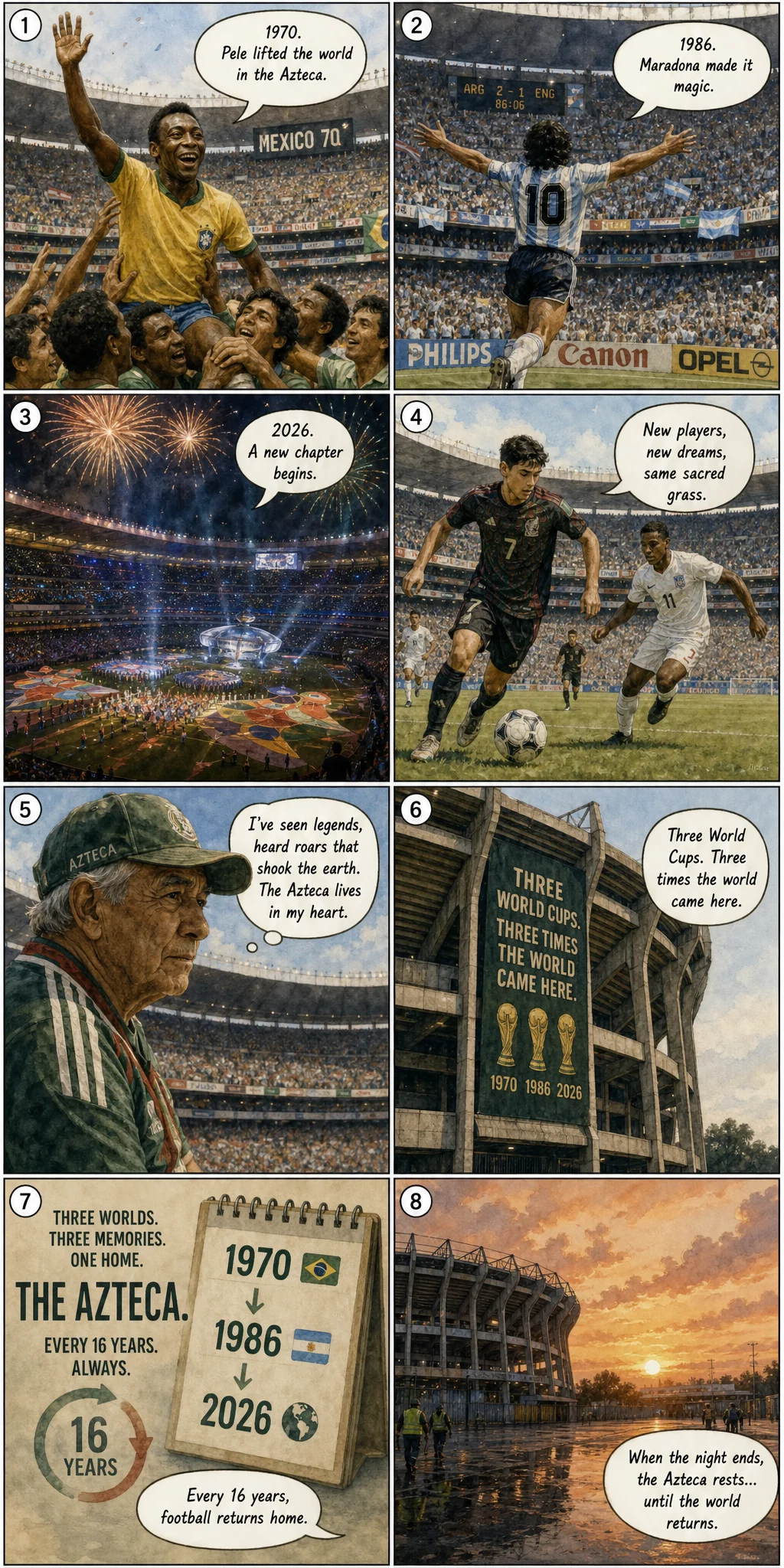
The Estadio Azteca in Mexico City is the only stadium in world football to have hosted three men's World Cup tournaments — 1970, 1986, and 2026 — arriving at astonishingly regular sixteen-year intervals that feel less like coincidence and more like a rhythm the football gods quietly inserted into the tournament schedule when nobody was paying attention. The Azteca's place in football history was established by the two tournaments it hosted in the twentieth century, each of which produced a defining moment in the sport's mythology, each of which is permanently associated with a single transcendent player whose relationship with the stadium became inseparable from his legend. No other building in sport can claim to have witnessed both Pelé's coronation and Maradona's transfiguration. The Azteca has, and in 2026 it will be asked to witness a third act in a story that has no precedent.
The 1970 tournament belonged to Pelé, whose Brazil team dismantled Italy four goals to one in the final in what remains the most aesthetically complete performance in World Cup history. The fourth goal, struck by right-back Carlos Alberto after a move involving eight of ten Brazilian outfield players — Tostão to Pelé, who held the ball with the patience of a predator before rolling it into the path of Alberto's late-arriving thunderbolt — is the gold standard for collective football intelligence, a goal so perfectly constructed that it is still taught in coaching courses as an example of what the sport can produce when eleven individuals dissolve into a single organism. That goal was struck at the Azteca and belongs to it forever. Pelé, shirt held aloft by the Italian defender Burgnich who had been assigned to mark him, raised the Jules Rimet trophy in the Azteca's thin mountain air, and the stadium absorbed the image into its concrete bones.
The 1986 tournament belonged to Diego Maradona, and specifically to the quarterfinal against England on June 22, a match that contained within ninety minutes both the Hand of God and the Goal of the Century — the sinner and the saint, the cheat and the genius, two goals scored by the same man in the same stadium within four minutes of each other, both permanently altering the way football understands individual brilliance. The first goal required Maradona to leap alongside England goalkeeper Peter Shilton and punch the ball into the net with his left fist, an act of deception that the Tunisian referee Ali Bin Nasser somehow failed to detect. The second goal required Maradona to collect the ball inside his own half, spin away from two England midfielders, and then embark on a sixty-meter slalom through five more English players before rounding Shilton and sliding the ball home from an angle that required him to contort his body past the point of balance. That both goals were scored in the same match, in the same stadium, by the same player, within the same four-minute span, is the kind of narrative density that fiction would reject as implausible. The Azteca was not simply a venue for Maradona's transcendence. It was a witness to the most concentrated expression of individual footballing greatness ever produced in a single competitive match, and the stadium's bowl — designed in 1966, modernized repeatedly, retaining its essential shape — absorbed both moments and neither has ever left.
The Azteca sits at two thousand two hundred and fifty meters above sea level in the Santa Ursula neighborhood of Mexico City, where the air contains approximately twenty-five percent less oxygen than at sea level. The altitude is not a curiosity or a talking point for broadcast commentary. It is an environmental weapon, a physiological stressor that visiting teams have struggled to adapt to across six decades of international football competition. The ball travels differently through thinner air, carrying further on long passes and swerving more dramatically on shots struck with power. Sprint recovery takes measurably longer as oxygen-depleted muscles struggle to clear lactic acid from fatigued tissue. Players acclimatized to sea level describe the first ten minutes at the Azteca as deceptively normal — the body has not yet registered the oxygen deficit — the next ten as running through water, and the remaining seventy as a gradual descent into physiological crisis from which full recovery within a single match is impossible. Mexico's national team, its players raised at altitude or extensively acclimatized through training camps, plays at a tempo that feels natural to them and increasingly unsustainable to opponents as the match progresses and oxygen debt accumulates. The Azteca does not guarantee Mexican victory — no stadium can guarantee anything — but it provides a competitive advantage that no visiting team can fully negate and that visiting coaches have described, off the record, as the hardest single-venue challenge in international football.
The stadium has been renovated for its third World Cup. Capacity has been expanded beyond eighty-seven thousand through modifications that respect the original bowl design while meeting FIFA's contemporary safety and accessibility requirements. Facilities have been modernized, media infrastructure upgraded, pitch drainage rebuilt. But the elements that make the Azteca the Azteca cannot be renovated into existence: the altitude that makes every breath an effort, the noise that traps inside the steep-sided bowl and ricochets until it becomes physical force pressing against eardrums, the accumulated weight of the moments the building has absorbed across sixty years of tournament history. The Azteca is not a stadium in the conventional sense. It is a cathedral, a building that houses something its architects could not have designed but that decades of collective experience have deposited into its walls and seats and tunnels and air. The worshippers who fill it for Mexico's group-stage matches in 2026 will add their voices to a choir that has been singing since Pelé's Brazil played the first World Cup match here in 1970. The current generation of Mexican footballers carries the opportunity — the burden, the privilege, the terrifying possibility — of producing a moment worthy of the building that contains so many. The Azteca is waiting. It has been waiting since 1986. Whether 2026 adds a third defining moment to its history, or whether Pelé and Maradona remain the only gods whose footprints the stadium holds, will be determined by players who were not yet born when Maradona's left fist reached toward the sky. The cathedral opens its doors regardless.