

Four Thousand Five Hundred Kilometres of Madness
The 2026 World Cup will be played across a geographic span exceeding four thousand five hundred kilometers — from Vancouver on the Pacific coast to Mexico City at altitude, from Los Angeles in the southwest to Foxborough in the northeast. This is not
Published: June 6, 2026
Comic content and match statistics are for entertainment purposes only and may contain inaccuracies. For Accurate Data, please refer to the reference's official website.
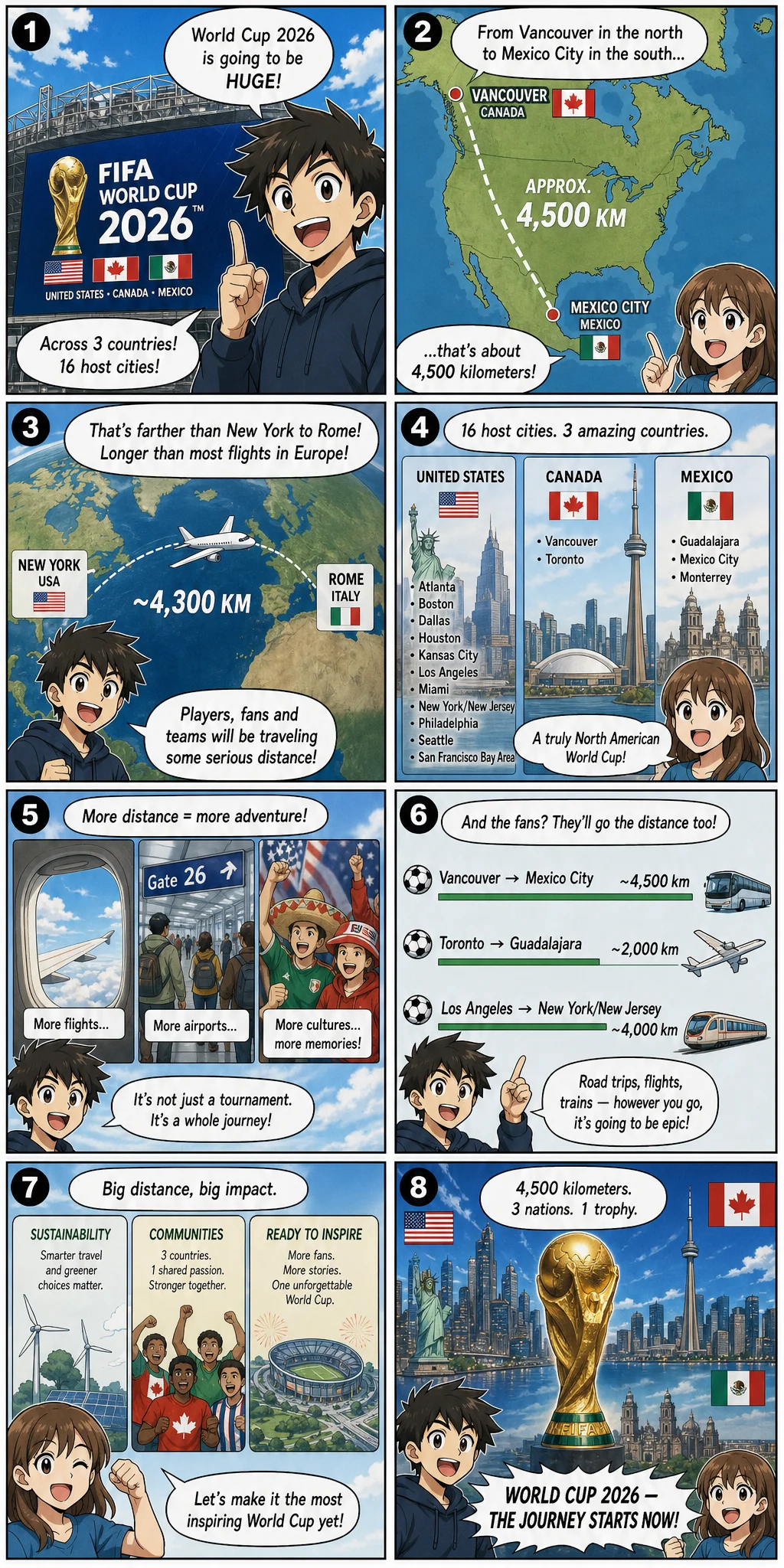
The 2026 World Cup will be played across a geographic span exceeding four thousand five hundred kilometers — from Vancouver on the Pacific coast to Mexico City at altitude, from Los Angeles in the southwest to Foxborough in the northeast. This is not a tournament in the traditional European or South American sense, where World Cup venues cluster within a few hundred kilometers of each other, where teams travel by coach between matches and supporters drink coffee in the same squares across multiple matchdays. This is a continental expedition, a tournament spread across a landmass larger than Western Europe, and the travel burden will fall unevenly across participants in ways that directly affect competitive outcomes. The distance between the most extreme venues — Vancouver and Foxborough — exceeds the distance from London to Baghdad. No previous World Cup has asked footballers to compete across such distances within a single tournament calendar.
The physiological cost of air travel for elite athletes has been quantified extensively by sports scientists, and the findings are not encouraging for the teams whose knockout bracket paths will send them crisscrossing the continent. Cabin pressure at cruising altitude, typically equivalent to approximately two thousand four hundred meters above sea level, reduces blood oxygen saturation by five to ten percent for the duration of the flight — essentially imposing mild altitude stress on athletes whose bodies are already recovering from the demands of a World Cup match played less than seventy-two hours earlier. The dehydration caused by the dry cabin air, which has humidity levels typically below twenty percent, impairs muscle recovery by reducing blood plasma volume and slowing the clearance of metabolic waste products from fatigued tissue. The prolonged immobility of a three-to-five-hour flight — the minimum duration for most inter-venue travel in the 2026 configuration — impairs circulation and delays the removal of inflammatory markers that accumulate during high-intensity exercise. Sports scientists estimate approximately one day of lost recovery quality per three thousand kilometers flown. A team that travels fifteen thousand kilometers during the knockout stage — a plausible figure for a semifinalist — has surrendered roughly five days of recovery that a more fortunately located opponent has retained.
The competitive unfairness is structural and largely uncorrectable. FIFA's regionalized group draw — designed to minimize travel during the group stage by clustering teams geographically, assigning groups to specific regional clusters rather than allowing random cross-continent group stage travel — provides partial mitigation for the tournament's opening phase. Teams assigned to the Pacific cluster might play all three group-stage matches within one time zone, based in Southern California or the Bay Area and traveling only for matchdays. Teams in the central cluster might base themselves in Dallas or Houston and operate within a manageable radius. But the knockout bracket does not respect geography and cannot be designed to do so without compromising the competitive integrity of the draw. A team that wins its group in Los Angeles could play a round-of-thirty-two match in Miami, a round-of-sixteen match in Foxborough, a quarterfinal back in Dallas, and a semifinal in Atlanta. Five cities, four time zones, approximately fifteen thousand kilometers traveled across five weeks of competition. The equivalent burden for a team whose knockout pathway runs through a single regional cluster might be one-third of that distance.
The base camp strategy has become a central element of pre-tournament planning for every qualified nation. Teams select a training base — a hotel, training facility, and local infrastructure — from which they travel to match venues for the minimum necessary period, typically arriving two days before a match and departing immediately afterward. The goal is to establish a single circadian rhythm, a single sleep schedule, a single pattern of meals and recovery sessions that remains consistent regardless of where the matches are played. Teams that base themselves centrally — Dallas, Kansas City, Atlanta — maximize their access to multiple regional venues while minimizing travel time. Teams that base themselves on the coasts risk longer flights to distant venues. The base camp decision, made months before the tournament begins, can determine a team's physical condition in the knockout rounds as much as any tactical decision made during the matches themselves.
Comparison with previous tournaments illustrates the unprecedented nature of 2026's travel challenge. Qatar 2022 was the most compact World Cup in history — all eight stadiums within a fifty-five-kilometer radius of central Doha, teams never flying between matches, recovery optimized by proximity. Russia 2018 spread venues across a single massive country but concentrated them in the European west, with only Ekaterinburg extending deep into Asian Russia. Brazil 2014 required significant domestic air travel but within a single nation's infrastructure, a single currency, a single language, a single immigration system. The 2026 tournament combines the geographic spread of Russia or Brazil with the cross-border complexity of three sovereign nations, three immigration systems, three currencies, and four time zones. Geography in 2026 is not destiny, but it is a variable with measurable consequences. The team that lifts the trophy will have overcome not only its opponents but the continent itself. The team that comes closest without winning will always wonder whether the draw — not the football draw, but the geographic draw — made the difference.