

Group G Power Analysis: Belgium, Egypt, Iran, New Zealand
Group G assembles Belgium, Egypt, Iran, and New Zealand into a configuration that the 48-team format's mathematical logic was specifically designed to produce: one former superpower in managed decline, one continental contender built around a single
Published: June 8, 2026
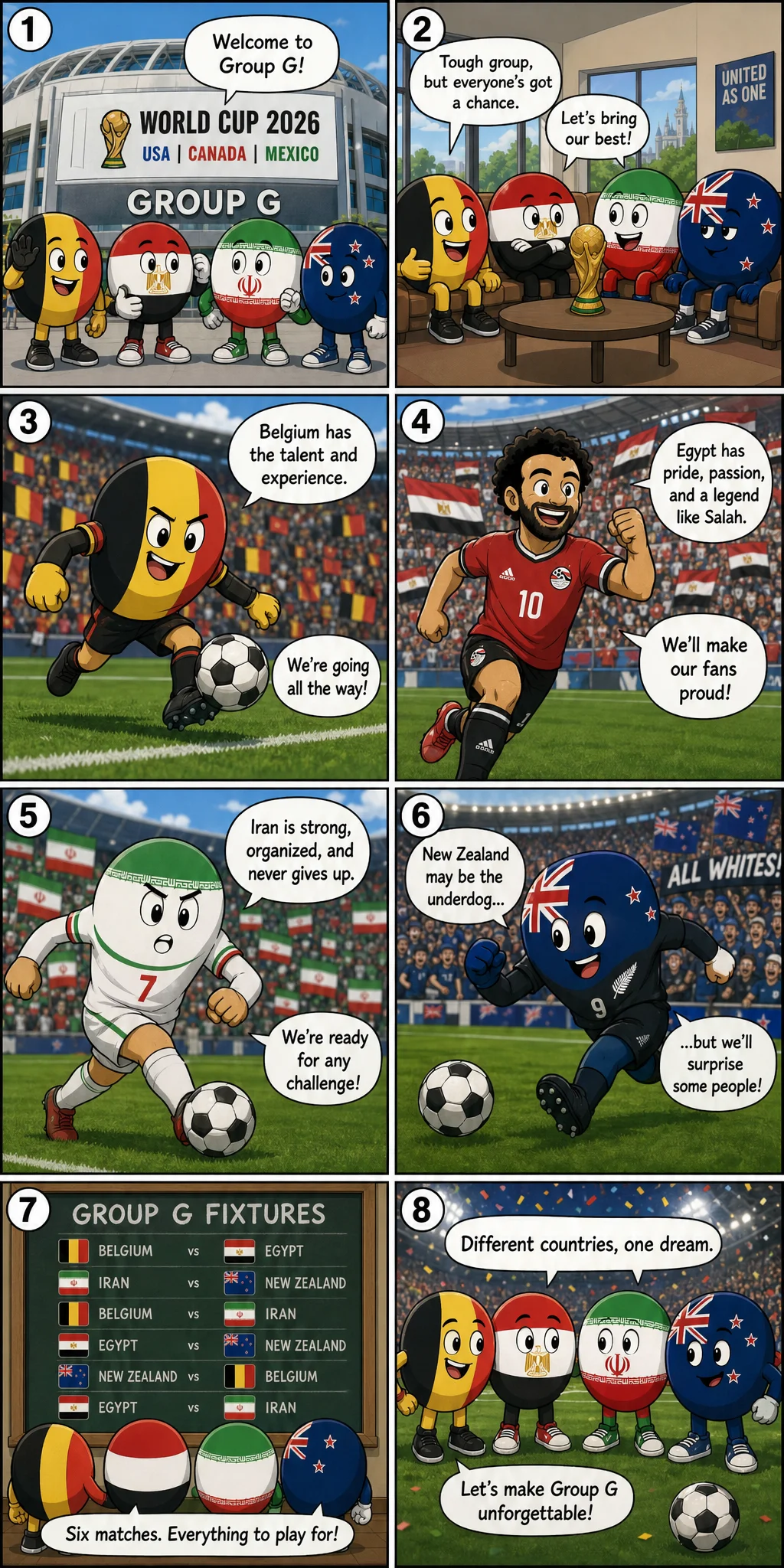
Comic content and match statistics are for entertainment purposes only and may contain inaccuracies. For Accurate Data, please refer to the reference's official website.
# Group G: Belgium's Structural Decline, Egypt's Salah Dependency, and the Algebra of Three-Team Groups
Group G assembles Belgium, Egypt, Iran, and New Zealand into a configuration that the 48-team format's mathematical logic was specifically designed to produce: one former superpower in managed decline, one continental contender built around a single transcendent talent, one Asian defensive fortress, and one Oceania debutant. The four narratives are distinct. The competitive dynamics that govern their interactions are anything but independent.
Belgium enters the 2026 World Cup as the most instructive case study in golden-generation lifecycle management that international football has produced. The Hazard-De Bruyne-Lukaku axis that powered the 2018 semifinal run — the quarterfinal victory over Brazil that represented the tactical apex of Roberto Martinez's tenure, the third-place finish that was simultaneously Belgium's greatest achievement and its most damning failure — has dissolved into its constituent parts. Eden Hazard retired. Toby Alderweireld and Jan Vertonghen, the centre-back partnership that accumulated more than two hundred international caps, are memories. Thibaut Courtois, the goalkeeper who might still be the world's best, has not reconciled with the Belgian federation after the captaincy dispute that fractured the dressing room in 2023. What remains is a diminished core operating within a tactical system that Domenico Tedesco has rebuilt around pragmatism rather than the expansive positional play that defined the Martinez era.
The Belgian squad is not weak. Kevin De Bruyne, at thirty-four, remains the most complete creative midfielder in football — a player whose passing range, the ability to deliver a ball with the precise weight and trajectory that transforms half-chances into goals, is undiminished by age. Romelu Lukaku, Belgium's all-time leading scorer, converts chances with an efficiency that his club career's itinerant quality has obscured. The midfield pairing of Amadou Onana and Youri Tielemans provides the physical and technical balance that the Martinez-era teams, for all their attacking fluency, never quite achieved in the defensive transition. The problem is structural rather than individual. Belgium's defensive unit cannot withstand the sustained pressure that knockout opponents generate. The full-backs, Timothy Castagne and Alexis Saelemaekers, are competent without being elite. The centre-back partnership lacks the recovery pace that modern defending requires against the counter-attacking threats that Egypt's Salah and Iran's Taremi represent. Belgium will dominate possession against every Group G opponent. The question is whether they can prevent those opponents from punishing the specific vulnerability that the possession game creates — the space behind the defensive line when full-backs advance.
Egypt's World Cup strategy is the simplest in the tournament and the most difficult to counter: absorb pressure, maintain defensive shape, and give Mohamed Salah the ball in spaces where his acceleration and finishing can decide matches that Egypt's collective quality cannot. This is not reductive analysis. It is an accurate description of Egyptian football's strategic organizing principle across the past eight years, and it has carried the Pharaohs to an Africa Cup of Nations final and three consecutive World Cup qualifications.
Salah is thirty-four. The Liverpool years that established him as the most prolific wide forward in Premier League history are behind him, but the specific qualities that make him dangerous — the diagonal runs from right to center, the first touch that eliminates defenders, the left-footed finishing from angles that most forwards consider low-percentage — are not dependent on the explosive acceleration of his youth. He has evolved into a more economical player, conserving energy for the moments when his movement creates separation from defenders, and those moments remain as dangerous as they have ever been. Egypt's supporting cast is deeper than the 2018 squad that lost all three group matches with a visibly injured Salah. Ahmed Hegazi organizes the defense with the authority of a veteran of Premier League and Serie A campaigns. The midfield, while lacking creativity beyond Salah, compensates with positional discipline and the specific competitive resilience that African football's grueling qualification campaigns cultivate.
Iran's tactical identity is the most coherent in Group G and the least celebrated. The defensive system institutionalized by Carlos Queiroz across eight years — the 4-1-4-1 formation that compresses space into a fist, that concedes possession in harmless areas and counter-attacks with surgical precision — has been preserved by his successors with the reverence of a religious tradition. Mehdi Taremi, the Porto striker whose movement between centre-back and full-back creates the passing angles that Iran's counter-attacks require, provides the cutting edge. Sardar Azmoun offers the complementary finishing threat from central positions. Iran's weakness is vulnerability to aerial threats — the specific physical dimension that Belgium's Lukaku and New Zealand's Chris Wood represent. New Zealand completes the group as Oceania's representative, the continent that only received a guaranteed World Cup qualification spot in the 48-team format. The All Whites arrive with tactical clarity: defend deep, compete aerially, and treat every set piece as a scoring opportunity. The presence of Chris Wood, a Premier League-proven striker with the aerial presence that creates chaos in any penalty area, gives New Zealand a genuine scoring threat. The supporting cast is thin beyond Wood, but thin supporting casts are not disqualifying in a format where one victory from three matches can be sufficient for progression.
The competitive dynamics of Group G are shaped by the format's three-team mathematics. Two group-stage matches rather than three means every moment carries proportionally greater weight. One bad performance can be fatal. One moment of individual brilliance — a Salah solo goal, a De Bruyne through-ball, a Taremi counter-attack — can transform a group's competitive calculus. Belgium should win the group. Egypt should advance as runner-up. Iran should push both. New Zealand should compete. But the format that makes Belgium the favorite is the same format that makes an upset more consequential than any thirty-two-team group stage could produce. Group G is the 48-team World Cup in miniature: structural logic meets competitive chaos, and the outcome belongs to neither.