

Group I Power Analysis: France, Senegal, Iraq, Norway
I was in Doha when Kylian Mbappe scored three goals in a World Cup final and still lost. The Lusail Stadium emptied slowly that night, Argentine celebrations rolling through the concourses, and somewhere in the exodus was a French forward who had jus
Published: June 8, 2026
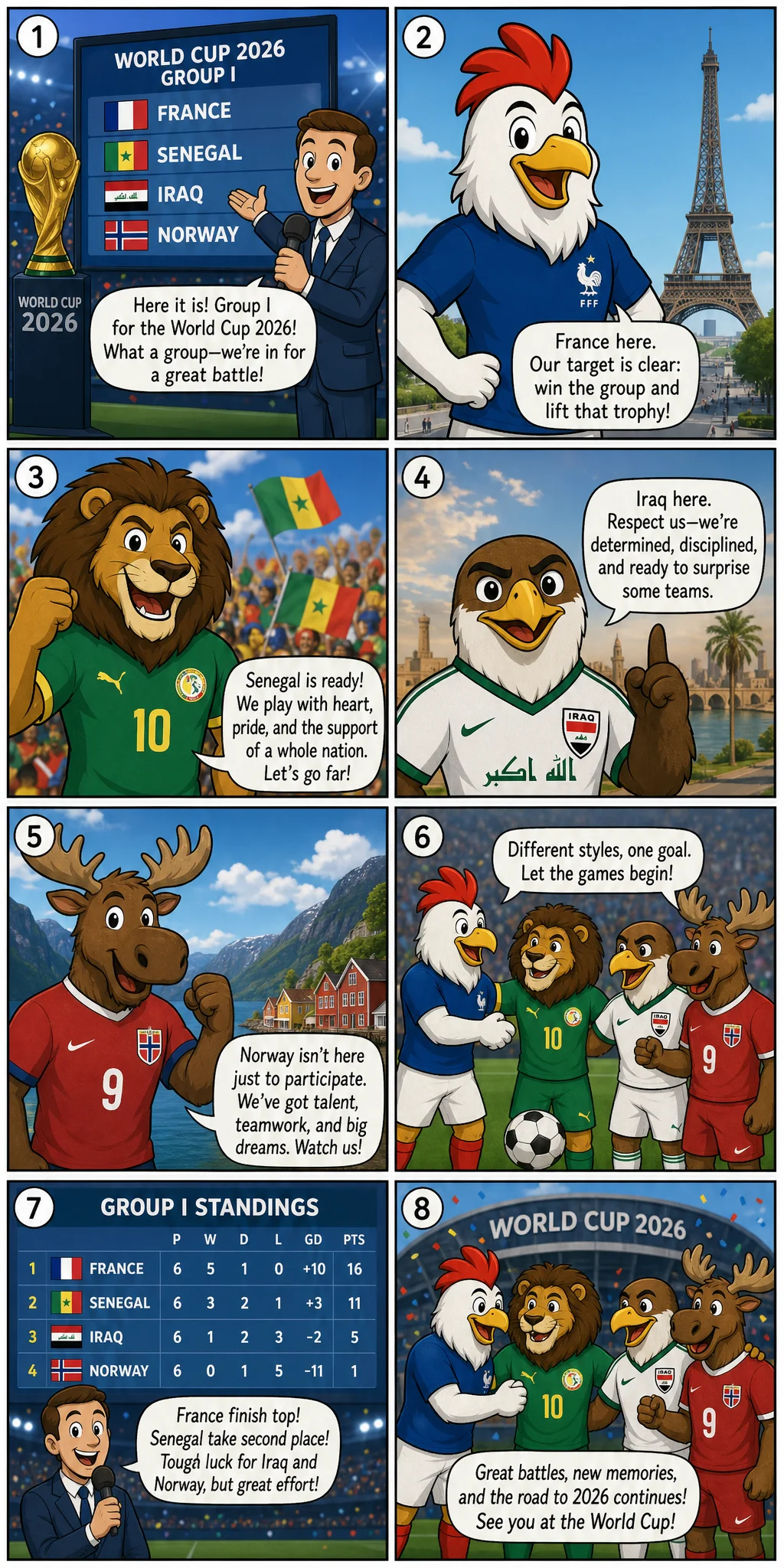
Comic content and match statistics are for entertainment purposes only and may contain inaccuracies. For Accurate Data, please refer to the reference's official website.
# Group I: The Haaland-Mbappe Parallel and What It Actually Means
I was in Doha when Kylian Mbappe scored three goals in a World Cup final and still lost. The Lusail Stadium emptied slowly that night, Argentine celebrations rolling through the concourses, and somewhere in the exodus was a French forward who had just produced the greatest individual final performance since Geoff Hurst and understood, with the specific clarity that only defeat provides, that none of it mattered. Mbappe walked past the World Cup trophy after collecting his Golden Boot and did not look at it. I have thought about that moment more than any other from 2022. Not because of what it said about Mbappe — we already knew he was extraordinary — but because of what it said about the tournament that awaits him in North America: he has already done everything a footballer can do in a World Cup except the one thing that counts.
Group I brings Mbappe back with France against Norway, Senegal, and Iraq. It places him in the same group as the only player whose career trajectory genuinely invites comparison: Erling Haaland. The matchup between France and Norway, between the forward who has scored twelve World Cup goals before turning twenty-seven and the forward who has scored more than 250 club goals without ever playing in a World Cup, is the group stage's marquee fixture. The marketing language writes itself. Mbappe versus Haaland. The king of the tournament against the king of the league season. The man who already owns a World Cup winner's medal, a final hat-trick, and twelve tournament goals against the man who has broken scoring records in Austria, Germany, and England and has never had the chance to score a single goal on the only stage that, in football's cruel hierarchy, truly counts.
The Norwegian qualification campaign that delivered Haaland to this tournament deserves more attention than casual observers have granted it. Norway last appeared at a World Cup in 1998, when Haaland was not yet born. The intervening twenty-eight years produced exactly zero tournament appearances despite possessing, at various points, genuinely competitive generations of Norwegian footballers. The European qualification system is ruthless in the specific way that punishes nations with population sizes in the single-digit millions and football infrastructures that cannot produce the squad depth required to survive the attrition of a qualifying campaign. Norway in 2026 qualified not through structural transformation but through the specific alchemy of two generational talents arriving simultaneously: Haaland, the most efficient scoring machine in football history, and Martin Odegaard, the Arsenal captain whose creative passing range provides the service that Haaland's club teams deliver through sheer weight of possession.
The Norway that faces France in Group I is a team with two world-class players and a supporting cast of professionals who would not start for any of the tournament's top ten national sides. This is not criticism. It is the competitive reality that defines Norway's entire tournament experience. Odegaard must find Haaland in the channels with the specific weighted pass that splits centre-back pairings and releases the Norwegian striker into the space behind a high defensive line — the pass that Odegaard executes weekly for Arsenal but will attempt for Norway under tournament pressure and against defensive systems that have spent months preparing specifically to deny it. Haaland must convert the limited chances that international football provides — three or four per match rather than the six or seven that Manchester City's possession machine generates — with an efficiency that even his extraordinary conversion rate has not consistently demonstrated in national team fixtures. The supporting cast — Sander Berge in midfield, Leo Ostigard in defense, the reliable but unspectacular professionals who fill the remaining positions — must perform at a level that their club careers have never required.
France should win Group I without meaningful difficulty. The depth of the French squad in 2026 is the deepest in the tournament: Mbappe at his physical peak at twenty-seven, captaining a team that has Champions League winners in its spine — Aurelien Tchouameni and Eduardo Camavinga, the midfield pairing that powered Real Madrid's latest European triumph. Ousmane Dembele, arriving as the reigning Ballon d'Or holder after a season that silenced every remaining critic of his end product. The defensive unit — William Saliba and Ibrahima Konate at centre-back, the full-back options extending two deep at each position — that no opponent can overwhelm through sustained pressure. Didier Deschamps concludes fourteen years managing France with one World Cup and three major finals, a record that places him among the greatest international managers in football history. The question is the one that always accompanies France: can this collection of individual talent cohere into a collective unit without the internal fractures that destroyed the 2010 campaign? The talent is undeniable. The chemistry is the variable that no scouting report can measure.
Senegal arrives as the most dangerous second-tier team in Group I. African champions in 2021, round of sixteen in 2022 under Aliou Cisse's remarkably steady leadership, the Lions of Teranga possess the specific blend of physical dominance, defensive organization, and attacking pace that makes them formidable tournament opponents. Sadio Mane is thirty-four but still operating at elite levels; the supporting cast — Ismaila Sarr, Nicolas Jackson, Kalidou Koulibaly — provides the physical and technical blend that enabled Senegal to beat France in the 2002 tournament opener, still the most famous result in the nation's football history. Iraq completes the group with a story that transcends results: returning after a forty-year absence, the nation whose football federation was once run by Uday Hussein, whose players were tortured after poor performances, arrives at a World Cup where the pitch is simply a pitch. Group I assembles France, Norway, Senegal, and Iraq because the 48-team format was designed to produce groups exactly like this — one superpower, one star-driven contender, one African power, one returning underdog — and the football that emerges will determine whether the format produces competitive balance or competitive predictability. The answer arrives with the opening whistle.