

Portugal 1-1 DR Congo: Neves, Wissa, and the Weight of Fifty-Two Years
Portugal 1-1 DR Congo. Joao Neves scored in the 6th minute before Yoane Wissa equalised in first-half stoppage time — DR Congo's first World Cup goal in 52 years. Cristiano Ronaldo's 6th and final World Cup began with a surprising draw.
Published: June 17, 2026
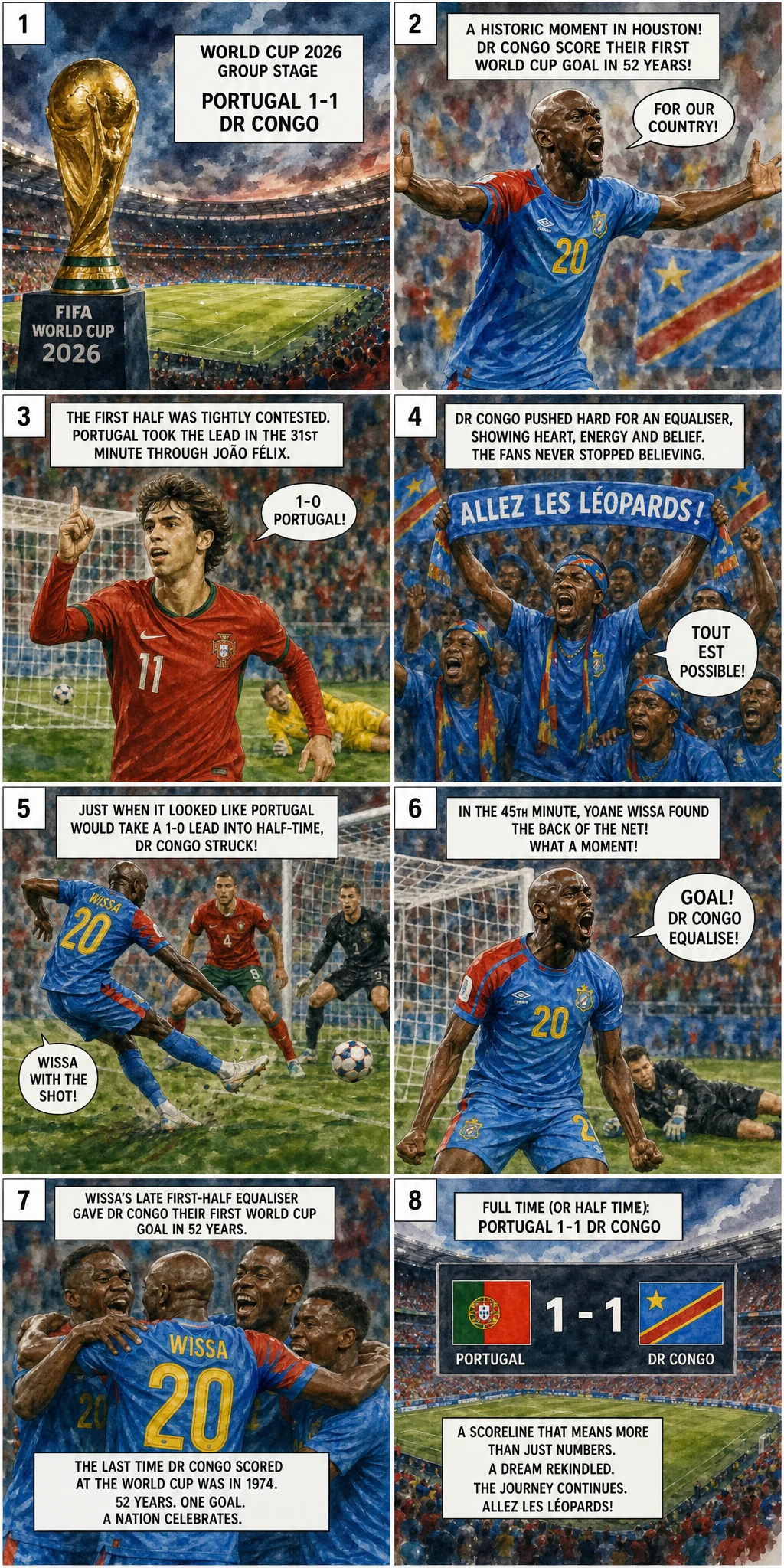
Comic content and match statistics are for entertainment purposes only and may contain inaccuracies. For Accurate Data, please refer to the reference's official website.
# Portugal 1-1 DR Congo: Neves, Wissa, and the Weight of Fifty-Two Years
The last time the Democratic Republic of Congo scored a goal at the World Cup, the country was called Zaire. Muhammad Ali was preparing for the Rumble in the Jungle in Kinshasa — a city that had not yet been renamed, because Mobutu Sese Seko had not yet been overthrown, because the nation's long, difficult reckoning with its own history had not yet properly begun. That was 1974. Fifty-two years. Half a century and then some. A nation whose football has been shaped by war, by exile, by diaspora, by the simple impossibility of playing the game in conditions that no footballer should ever have to endure — that nation finally wrote a new line in the World Cup record books at NRG Stadium in Houston, Texas, on a humid June evening in 2026.
The score at the final whistle was Portugal 1, DR Congo 1. It was a result that will be remembered not merely as a draw, but as an arrival.
The match carried a particular historical weight, and not only because of the Congolese context. This was, by every available description, Cristiano Ronaldo's sixth World Cup tournament — a number that carries meaning because no outfield player has ever contested six editions of this competition, and because the tournament taking place in North America in 2026 was always destined to be his last. The man from Madeira, the island off the coast of an empire that once stretched across four continents, was playing what may yet prove to be his final World Cup match as a starter. The symbolism was unavoidable: the old imperial metropole, its greatest modern footballing son, facing the footballers from the heart of Africa who had, in so many cases, been raised and trained in Europe — in England, in France, in Belgium — because the infrastructure of the game in their homeland had been systematically degraded over decades of misrule and neglect.
That is the political context within which this match was played. But the football itself, as it must, told its own story.
João Neves scored the opening goal in the sixth minute, and if there is any justice in the game, the name of the 21-year-old Benfica midfielder will be attached to this World Cup for a very long time. The goal was a thing of simplicity and precision: Pedro Neto, the Wolverhampton winger whose pace had already caused problems for DR Congo's left flank, delivered a cross that described a parabola of almost mathematical perfection. Neves — who stands no more than 174 centimetres, who was playing in Portugal's second division for Benfica B less than three years ago, who arrived at this tournament as one of the most coveted young midfielders in European football — met it with a header that should not have been possible for a man of his height. It was his first World Cup goal, on his first World Cup start, in the sixth minute of Portugal's first game of the tournament. The kind of beginning that narratives are built from.
For thirty-nine minutes after that, Portugal controlled the match in the manner that Roberto Martínez's teams tend to control matches: with possession figures that hovered around seventy percent, with passing sequences that seemed designed to lull the opponent into a state of tactical hypnosis, with a geometry of triangles that was technically proficient and, at times, genuinely difficult to disrupt. Bruno Fernandes moved between the lines with the quiet intelligence that has defined his career. Ronaldo, now forty-one years old, dropped deep to receive and spun into the penalty area with movements that, if not as explosive as the ones that defined his twenties and thirties, still carried the muscle memory of a thousand goals.
But the control was deceptive. DR Congo, playing a 5-3-2 system that Sébastien Desabre had clearly designed to absorb and counter, were not being outclassed so much as waiting. The Congolese defensive shape — five across the back when Portugal advanced into the final third — compressed the space that Ronaldo and Bruno Fernandes wanted to operate in. Aaron Wan-Bissaka, the England-born right-back who had committed his international future to DR Congo, was particularly effective in one-on-one situations against Nuno Mendes, repeatedly showing the defender onto his weaker foot with a discipline that has not always been a feature of his club career.
The equaliser arrived in the fifth minute of first-half stoppage time, and it arrived with a narrative force that transcended mere tactics. A free-kick conceded by Rúben Dias — a rare moment of indiscipline from the Manchester City defender — was floated into the Portuguese penalty area by Arthur Masuaku. What happened next was one of those moments that the World Cup, at its best, is uniquely capable of producing. Yoane Wissa, the Brentford forward whose journey to this tournament had taken him from the Parisian banlieues through the lower divisions of French football to the Premier League, rose between two Portuguese central defenders — Tomás Araújo and Renato Veiga, neither of whom would claim to have covered themselves in glory — and headed the ball past Diogo Costa.
The goal was DR Congo's first at a World Cup since 1974. Let that sink in, because it is the kind of statistic that deserves to be felt rather than merely registered. Fifty-two years of waiting. An entire nation's footballing existence — all the players who were born, who played, who retired without ever experiencing a World Cup moment — and then, in a single flash of connection between forehead and leather, it was over. The Congolese supporters behind the goal, a pocket of yellow and red in the vastness of NRG Stadium, erupted with a sound that contained within it the accumulated longing of half a century.
The second half failed to produce a winner, which is not the same thing as saying it failed to produce drama. Portugal pushed. Ronaldo had a header saved by Lionel Mpasi in the sixty-eighth minute — a save that, on replay, appeared to involve more instinct than technique, the goalkeeper throwing a hand toward the ball with the desperate faith of a man who knows he has nothing to lose. Bruno Fernandes struck the crossbar with a free-kick in the seventy-fourth minute. The ball bounced down, and Portuguese players appealed for a goal, and the referee's watch did not vibrate, and the match continued in the peculiar suspended animation of a draw that neither team wanted but both teams, in the end, could not escape.
For DR Congo, the result was a point earned against the reigning European Championship semi-finalists. For Portugal, it was a point dropped in a group they were expected to dominate. Both of those statements are true. Neither of them captures the full meaning of what happened.
Because beyond the mathematics of the group table, beyond the tactical breakdowns and the expected goals models and the post-match press conferences, what happened in Houston was something simpler and more profound. A football nation that had been absent from the World Cup for more than half a century came back. It scored a goal. It took a point from one of the most decorated national teams in the modern game. And in doing so, it reminded the watching world that the World Cup is not merely a competition but a form of recognition — a way of saying to a nation, and to its people, that they exist, that they belong, that their stories matter.
The Congolese players walked off the pitch to a standing ovation from their supporters. Ronaldo exchanged shirts with Chancel Mbemba, the DR Congo captain, in a gesture that felt both meaningful and slightly inadequate — the kind of exchange, between the global superstar and the defender from Kinshasa, that contains multitudes of unspoken history.
Portugal face Uzbekistan next. DR Congo will play against the group's other opponent. The tournament moves on, as tournaments do. But for one evening in Texas, the past was present in a way it had not been for fifty-two years. And that, in the end, is what this match was about.