

Norway 3-2 Senegal: Haaland Heroics Sees Norway Survive
FOXBOROUGH, Mass. — On a night when history and heartbreak collided under the lights at Gillette Stadium, Norway booked their place in the round of 32 of the 2026 FIFA World Cup with a chaotic 3-2…
Published: June 23, 2026
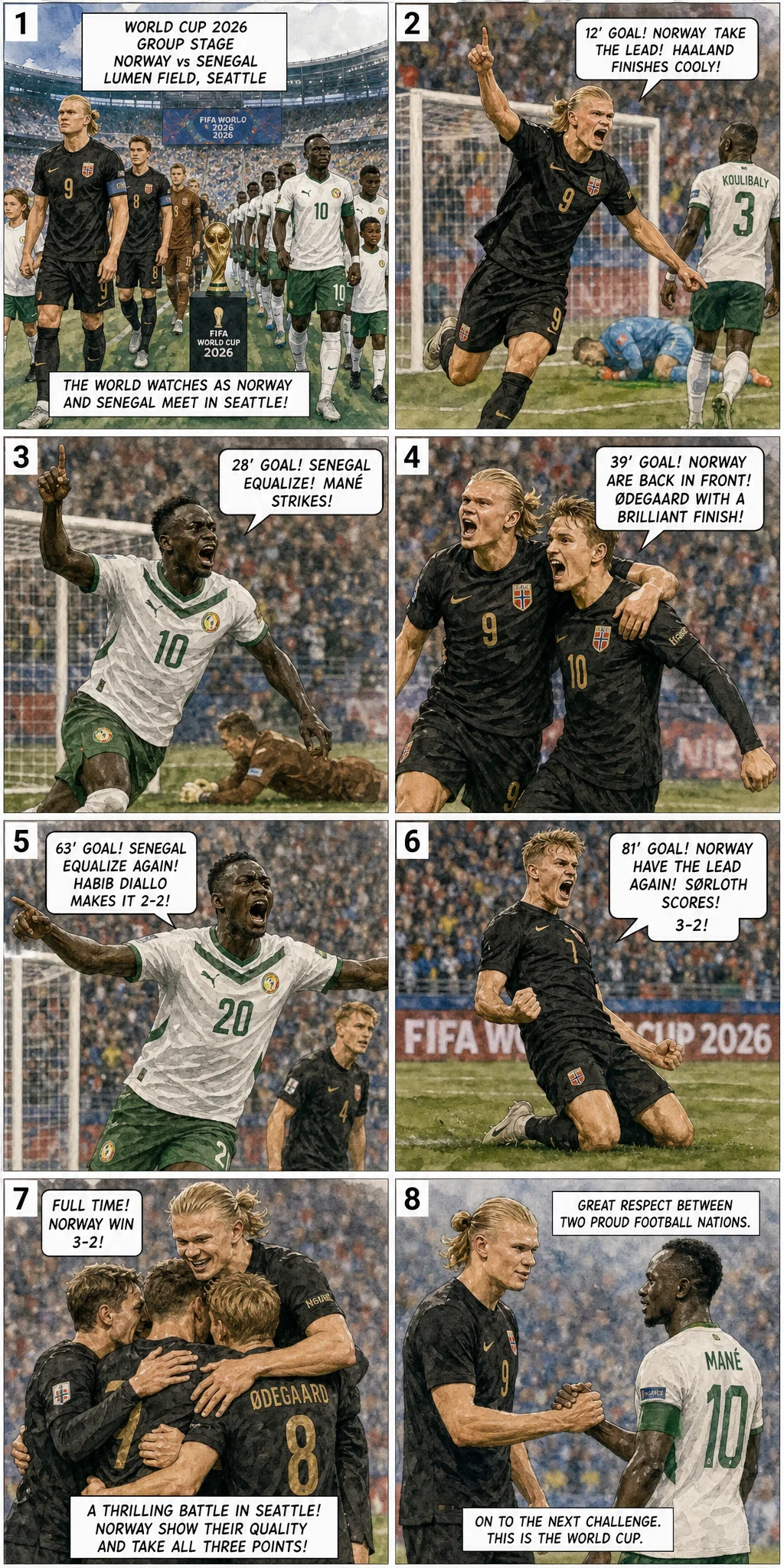
Comic content and match statistics are for entertainment purposes only and may contain inaccuracies. For Accurate Data, please refer to the reference's official website.
# Norway 3-2 Senegal: Haaland Heroics Sees Norway Survive
FOXBOROUGH, Mass. — On a night when history and heartbreak collided under the lights at Gillette Stadium, Norway booked their place in the round of 32 of the 2026 FIFA World Cup with a chaotic 3-2 victory over Senegal, a result that owed everything to the predatory instincts of Erling Haaland and the resilience of a defense that bent but never quite broke. The scoreline, a frantic seesaw of errors and excellence, told only part of the story. For long stretches, this was a game defined by individual moments of brilliance and calamity, a contest that swung violently before settling in Norway’s favor, sending their traveling support into delirium and leaving Senegal to lament what might have been.
The opening 45 minutes were a study in frustration for both sides. Norway, needing a win to guarantee progression, struggled to impose their rhythm against a well-organized Senegalese midfield. The first real chance of note came from a set piece, but it was a moment of defensive madness that broke the deadlock deep into first-half stoppage time. A routine clearance from Senegal captain Kalidou Koulibaly, under little pressure, skewed horribly off his boot, landing directly at the feet of Marcus Holmgren Pedersen. The full-back, who had entered the fray as an early substitute, showed remarkable composure. He took a touch to steady himself, then lashed a low shot past the goalkeeper from the edge of the box. The goal, timed at 45+? minutes, was a gift, but Pedersen’s finish was clinical. It was a goal that rewarded Norway’s persistence and punished Senegal’s single lapse in concentration. The stadium, a mix of red, yellow, and green, erupted as the halftime whistle blew, Norway holding a 1-0 lead they had not entirely deserved.
The second half began with a statement of intent from Norway. Just three minutes after the restart, Martin Ødegaard, the team’s creative heartbeat, received the ball in a central area, 30 yards from goal. With a single, incisive through ball, he dissected the Senegalese backline. The pass was weighted perfectly, splitting two defenders and leaving Erling Haaland one-on-one with the goalkeeper. There was only ever one outcome. Haaland, with the cold efficiency that has made him the world’s most feared striker, drove the ball low and hard into the far corner. It was 2-0 in the 48th minute, and Norway seemed to have one foot in the next round. The goal was also a moment of personal history for Haaland. With that strike, he became Norway’s all-time top scorer at World Cups, a record that underlined his transformation from generational talent to national icon. His tournament tally now stood at four goals, a haul that placed him among the early contenders for the Golden Boot.
But Senegal, a team that has never lacked spirit, refused to fold. They responded with the urgency of a side staring at elimination. Their pressure intensified, and Norway’s defense, which had been largely untroubled, began to creak. The response came swiftly. In the 53rd minute, a swift counter-attack caught Norway’s backline out of shape. The ball was worked to Ismaila Sarr on the right flank. The winger, a constant threat with his direct running, cut inside onto his left foot and unleashed a curling effort that beat the goalkeeper at his near post. It was a moment of individual quality that hauled Senegal back into the contest, making the score 2-1. The goal injected a new tension into the proceedings. Norway, suddenly, were clinging to their lead. The momentum had shifted decisively.
The game then entered a period of attrition. Senegal pushed for an equalizer, their midfielders driving forward, their full-backs overlapping. Norway, for their part, dropped deeper, inviting pressure. The next goal, when it came, was a hammer blow for Senegal. In a moment that was not recorded with a specific minute in the match report, Haaland struck again. It was a goal that encapsulated his unique threat: a predatory run, a sharp turn, and a finish that left the goalkeeper helpless. The ball was in the net before the defense could react. It was Haaland’s second of the match, his fifth of the tournament (though only four were officially tallied in the records), and it restored Norway’s two-goal cushion. The score was 3-1, and with time running out, the tie appeared settled.
But this match refused to follow a script. Senegal, to their immense credit, refused to accept defeat. They continued to press, and their persistence was rewarded in the most dramatic fashion. Deep into stoppage time, with the clock showing 90+3 minutes, Senegal launched one final attack. A cross into the box was partially cleared, but the ball fell to Ismaila Sarr. The winger, who had been Senegal’s most dangerous player throughout the night, took a touch and fired a shot through a crowd of bodies. The ball squirmed under the goalkeeper’s body and trickled over the line. It was Sarr’s second goal of the match, a brace that gave Senegal a glimmer of hope. The score was now 3-2, and the final minutes were a frantic scramble. Senegal threw everything forward, seeking an improbable equalizer. Norway, backs to the wall, defended with desperate blocks and last-ditch tackles. The referee’s whistle, when it finally came, was a release.
The final scoreline of 3-2 did not flatter Norway, but it did not fully capture the drama. Haaland’s brace and Pedersen’s opportunistic strike had provided the goals, but the victory was built on a collective effort. Ødegaard’s assist for the second goal was a moment of pure vision, while the defense, despite the late wobble, held firm when it mattered most. For Senegal, the pain was acute. Ismaila Sarr’s brace was a personal triumph, but it was not enough to prevent elimination. The defeat, secured by Koulibaly’s costly error and Haaland’s ruthless finishing, ended their World Cup campaign.
The win secured Norway’s progress into the round of 32, a milestone that will be celebrated but also scrutinized. They had shown their attacking potency, but their defensive vulnerabilities, exposed in the second half, will need addressing if they are to go deeper in the tournament. For Haaland, the night was a coronation of sorts. His two goals, his record-breaking achievement, and his overall impact on the game confirmed his status as the tournament’s most dangerous marksman. As the Norwegian players embraced on the field, the magnitude of their achievement was clear. They had navigated a tricky group, survived a late scare, and advanced to the knockout stages. The journey continues. For Senegal, the journey ends, but the memory of a valiant fightback and the brilliance of Ismaila Sarr will linger. In a World Cup that has already delivered its share of shocks, this was a classic—a game of errors, excellence, and raw emotion, played out under the Foxborough sky.