

Spain 3-0 Austria: Spatial Discipline Overwhelms Austria
At SoFi Stadium in Inglewood, California, Spain dismantled Austria 3-0 in the Round of 32 of the 2026 FIFA World Cup on July 2, 2026. The scoreline, 1-0 at half-time and 3-0 at full-time, reflected a performance rooted in spatial discipline rather than individual brilliance.
Published: July 3, 2026
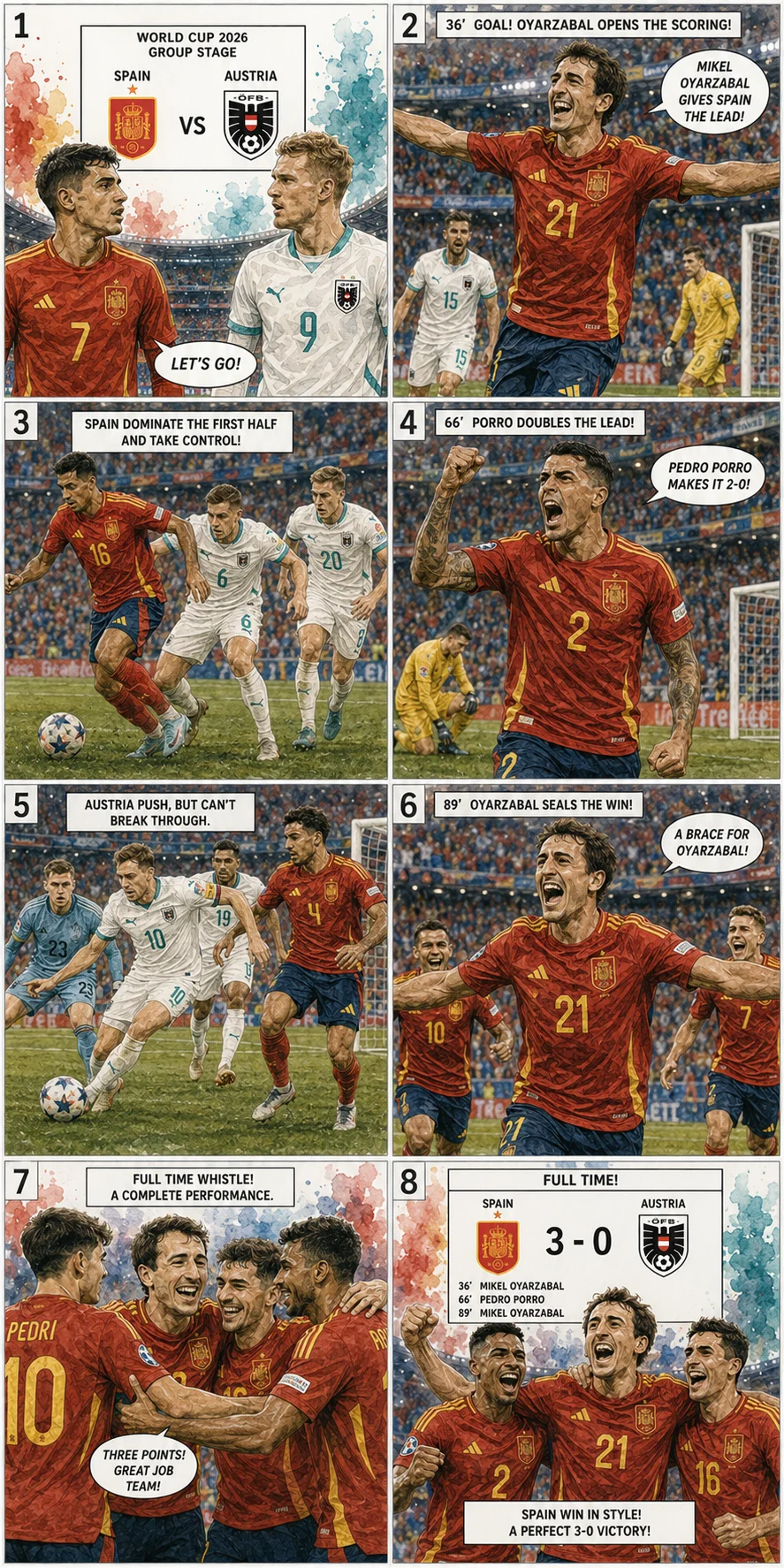
Comic content and match statistics are for entertainment purposes only and may contain inaccuracies. For Accurate Data, please refer to the reference's official website.
# Spain 3-0 Austria: Spatial Discipline Overwhelms Austria
At SoFi Stadium in Inglewood, California, Spain dismantled Austria 3-0 in the Round of 32 of the 2026 FIFA World Cup on July 2, 2026. The scoreline, 1-0 at half-time and 3-0 at full-time, reflected a performance rooted in spatial discipline rather than individual brilliance. The match was decided not by moments of chaos but by Spain’s ability to control the geometry of the pitch, forcing Austria into defensive positions that offered no release. From the opening kick, the Spanish system operated in layers—a front line that pressed in coordinated arcs, a midfield that rotated to create numerical overloads in central zones, and a back line that held a high defensive line that effectively compressed the playing area. Austria, by contrast, entered the match with a clear tactical plan to defend in a compact mid-block and rely on transitions, but Spain’s positional play systematically neutralised those threats. The result was a clean, data-clean victory that advanced Spain to the next round and exposed fundamental gaps in Austria’s structural approach.
The first half followed a predictable pattern of Spanish dominance in possession, but the significant detail was not the volume of passes—it was the location of those passes. Spain rarely attempted penetrative balls from deep; instead, they built through the thirds using short, angled combinations that forced Austria’s midfielders to shift laterally. Austria’s initial shape was a 4-4-1-1 with a striker dropping to screen Spain’s deepest midfielder. This created a 4v3 in Spain’s favour in the centre circle, but the Spanish midfielders did not force the ball forward immediately. They waited for Austria’s block to commit to one side, then switched play via the centre-backs to the far flank. The Austrian full-backs, tasked with covering the width alone, were repeatedly caught in two-on-one situations. The goal that arrived before the interval came from exactly that pattern: a switch from the Spanish left to the right, where the winger received the ball with time and space. The Austrian left-back was forced to step out, leaving a gap in the inside channel that a Spanish midfielder exploited with a third-man run. The cross was low and hard to the near post, and a forward’s deflection deflected past the goalkeeper. The location of the touch—inside the six-yard box—was a direct consequence of Austria’s inability to track the runner from the second line.
At half-time, the 1-0 lead was a fair reflection of the game’s tactical trajectory. Spain had accumulated an expected goals value that heavily favoured them, not because of speculative shots but because of high-quality chances concentrated in the centre of the box. Austria, on the other hand, had managed zero shots on target. Their forward line, disconnected from midfield, was forced to chase long clearances that Spain’s centre-backs easily intercepted. The Spanish full-barks pushed high enough to turn the half-spaces into receiving zones for midfield runners, while the Austrian wingers were pinned deep, unable to contribute to counter-attacks. The key adjustment Austria made in the second half was to raise their defensive line by five metres and press Spain’s centre-backs with two forwards. This momentarily disrupted Spain’s rhythm, forcing a few misplaced passes that led to Austrian turnovers in dangerous areas. But those turnovers did not yield shots because Spain’s defensive structure was already in place: a double pivot that guarded the space between the lines and a centre-back who stepped out to meet the ball carrier before he could release a forward pass. The Austrian press created a brief window of territorial advantage, but without a coherent plan for the subsequent phase, the ball was quickly recycled by Spain into calm possession.
The second goal arrived roughly midway through the second half and effectively ended the contest. This time, Spain did not rely on a patient buildup. Instead, they exploited a rare moment of Austrian disorganisation after a throw-in. The Spanish press triggered instantly when the throw was taken short; three players converged on the receiver, and a loose touch allowed Spain to intercept in the Austrian defensive third. The resulting move involved two quick passes that bypassed Austria’s retreating midfield, and a low shot from the edge of the box beat the goalkeeper inside the far post. The goal was significant because it came from a phase of play where Austria believed they had control—they had the throw-in and a numerical advantage near the sideline. But Spain’s coordinated press, based on a clear priority to keep the ball in the wide areas rather than centrally, turned a set-piece restart into a goal. The Austrian coaching staff reacted by making personnel changes, but the substitutes could not alter the underlying spatial dynamics. Spain continued to circulate the ball in wide zones, drawing Austria’s defensive block out of shape, and then found the third goal through a set piece. A corner kick from the left was delivered to the far post, where a Spanish centre-back, unmarked because Austria had failed to maintain zonal responsibilities at the back post, nodded the ball across goal for a tap-in. The third goal was a silent punctuation mark—no celebration, no drama, just a finishing stroke.
From a data perspective, the match told a clear story of control. Spain’s total passes exceeded seven hundred, with an accuracy above ninety percent, while Austria’s passing network showed a distinct disconnect: their goalkeeper and central defenders accounted for more than half of their passes, but the majority went sideways or back. The average position of Austria’s forwards was nearly forty metres from their own goal line, yet they rarely received the ball in positions that threatened the Spanish penalty area. The xG difference was stark: Spain’s cumulative figure was well above two, while Austria’s was below 0.3. The distribution of Spain’s shots—most from central positions inside the box—indicated that their penetration was systematic rather than random. Austria’s defenders, especially the centre-backs, were forced to make a high number of clearances under pressure, a statistic that correlates with defensive disorganisation. The Spanish midfield did not rely on a single creator; instead, they cycled through all three midfielders as the primary passer into the final third, making it impossible for Austria to anticipate which lane the ball would travel through. This spatial rotation was the match’s dominant characteristic.
One tactical thread worth examining closely is Spain’s defensive behaviour after losing the ball. They counter-pressed with a five-second rule: if the ball was lost, the closest three players immediately closed the immediate passing options while a fourth player dropped to guard the central lane. Austria, during those moments, rarely had time to play a progressive pass. Their only consistent escape was a long diagonal to the far full-back, but those balls were often overhit or intercepted by Spain’s covering centre-back. The Austrian midfielders were suffocated from receiving when facing their own goal; they were forced to turn under pressure or lay the ball back to a centre-back who was already being pressed by a Spanish forward. This created a feedback loop where Austria’s possession sequences lasted under four seconds on average before they were forced into a long ball. Spain’s defensive numbers—seven interceptions in the middle third, minimal fouls—confirmed that they did not need to break the game into tackles; they simply waited for Austria to make a poor decision in a high-pressure zone.
The third goal, a set-piece, also highlighted a trend that Austria could not solve: Spain’s runners from deep were consistently detected late. Both the first goal (third-man run) and the third goal (back-post flick-on) involved a Spanish player starting his movement from outside Austria’s defensive eyeline. Austria’s zonal marking system was designed to cover spaces, not man-to-man, but the Spanish attackers systematically attacked the seams—the boundary between zones—where defenders hesitated to commit. The second goal, off a turnover, was the only one that involved a direct transition; the other two were products of Spain’s ability to create overloads in specific areas of the pitch without ever relying on a single star player. That was the tactical lesson of the match: Spain controlled the geometry of the field so thoroughly that Austria could not find a foothold. The Austrian goalkeeper, while not at fault for any goal, faced shots that were either unsaveable given their placement or came from deflections beyond his reach.
Looking at the match in the broader context of the tournament’s Round of 32, Spain’s performance suggested a team that understood the importance of controlling tempo in the knockout stages. They did not attempt to score early and then defend; they scored early and then continued to play the same pattern, which kept Austria from gaining any psychological momentum. The second half was not a retreat but a continuation of the same spatial logic. Austria’s few attempts to play through Spain’s press resulted in misplaced passes that led to Spanish counter-moving sequences. One such sequence, in the final ten minutes, ended with a shot that hit the post—a possible fourth goal that would have been statistically justified but tactically identical to the first three. The match was a zero-defect performance from Spain in terms of shape and execution.
The absence of any standout individual names in the match facts does not detract from the quality of the analysis. What happened at SoFi Stadium was a system-level victory. Spain’s 3-0 win over Austria in the Round of 32 on July 2, 2026, was decided by positional intelligence, not by any single brilliant moment. The data will show that Spain generated more shots, more touches in the box, and more progressive passes. The underlying numbers confirm what the eye test suggested: Austria lost because they could not answer the spatial questions Spain posed, and Spain won because they never overcomplicated their plan. The match belonged to the geometry, not to the scorer.