

Lincoln Financial Field: Cheesesteaks, Miracles, and 4th-and-26
The Lincoln Financial Field in South Philadelphia will host World Cup matches in 2026. To understand what that means, you first need to understand that this is a stadium that once tried to ban cheesesteaks — and lost. In 2003, the Philadelphia Eagles
Published: June 6, 2026
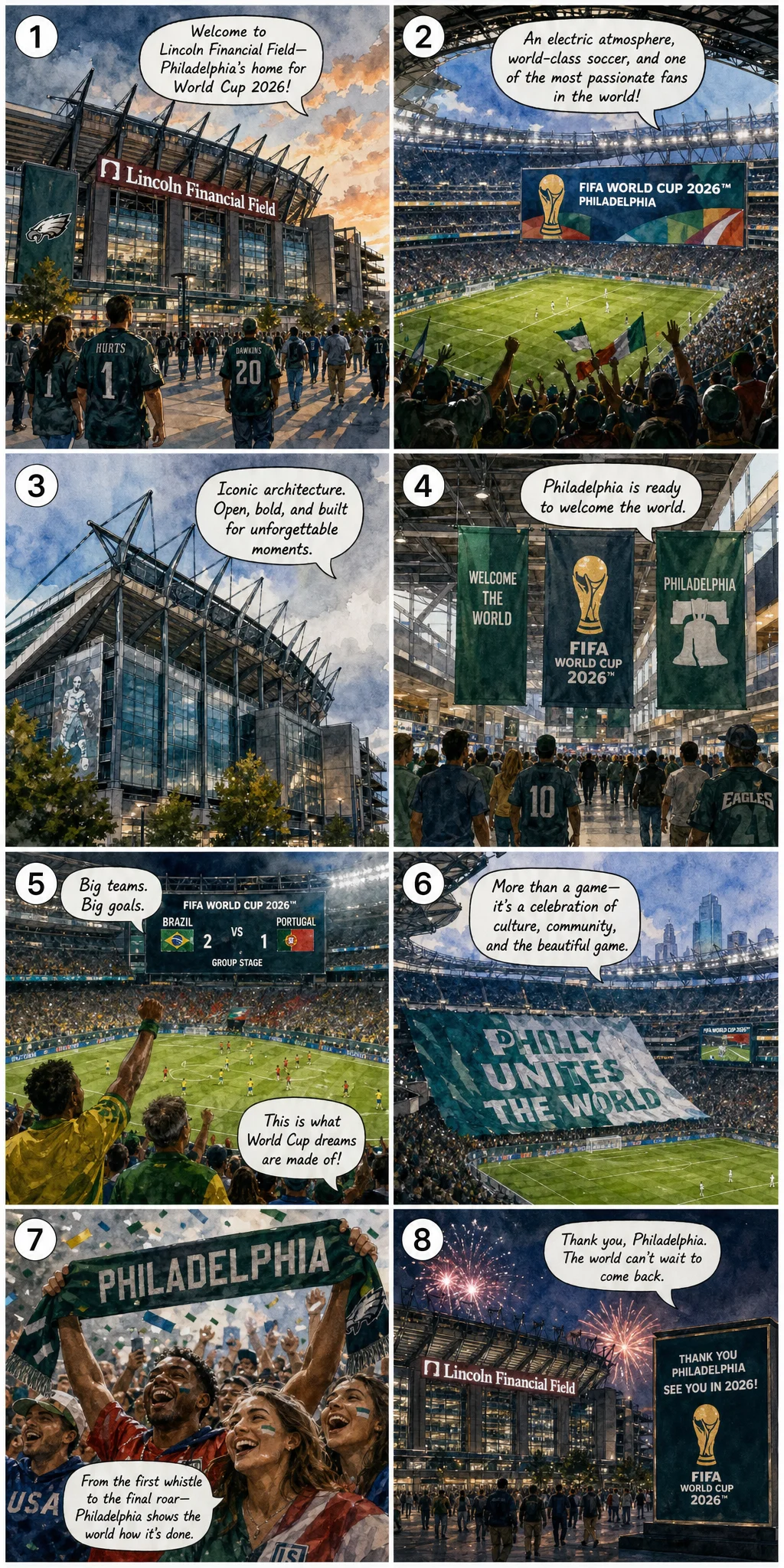
Comic content and match statistics are for entertainment purposes only and may contain inaccuracies. For Accurate Data, please refer to the reference's official website.
# Lincoln Financial Field: Cheesesteaks, Miracles, and 4th-and-26
The Lincoln Financial Field in South Philadelphia will host World Cup matches in 2026. To understand what that means, you first need to understand that this is a stadium that once tried to ban cheesesteaks — and lost. In 2003, the Philadelphia Eagles made a decision so monumentally stupid it remains the gold standard for institutional tone-deafness in American sports. They banned cheesesteaks. Not guns or fireworks. Cheesesteaks — the food that defines Philadelphia more thoroughly than any flag or bell, the grease-powered backbone of civic identity since Pat and Harry Olivieri threw some chopped beef on a roll in 1930. The Eagles decided that allowing fans to bring outside food into the brand-new Lincoln Financial Field would compromise the fan experience. Philadelphia lost its mind. Talk radio lines melted. The mayor called the ban "un-Philadelphian." Fans showed up to the first preseason game carrying hoagies like protest signs. The ban lasted one week. One. Week.
This is the building we are talking about. The Linc. Opened August 3, 2003, on eleven acres of South Philadelphia land that used to be a Navy Yard. The first event was Manchester United beating Barcelona 3-1, a friendly that served notice: this stadium was built for football, both kinds, from day one.
To understand what the Linc is, you have to understand what it replaced. Veterans Stadium. The Vet. Opened in 1971, a multi-purpose concrete circle that looked like an ashtray and smelled like one too. The playing surface was essentially green-painted asphalt. The Vet had a courtroom in the basement — an actual, functioning courtroom — because on game days the arrest rate was so high it made logistical sense to process people on site. Judge Seamus McCaffery presided. He once processed 150 cases in a single afternoon. When the Vet was demolished in 2004 — 2,800 pounds of dynamite bringing down thirty-three years of concrete in sixty-two seconds — people bought tickets to watch.
From the dust rose the Linc. NBBJ, the architecture firm, took one look at the Vet and did the opposite of everything. Where the Vet was round, the Linc is angular. Where the Vet was enclosed, the Linc has three open corners framing the Philadelphia skyline — the Walt Whitman Bridge from the upper deck, the refineries of South Philly glowing at dusk. Where the Vet was gray concrete, the Linc is red brick and glass. The eagle-wing canopies spread over the east and west stands. 67,594 seats that, on the right Sunday in January, feel like twice that. And in the basement? They kept the courtroom. The Eagles looked at their own history of having to arrest so many of their own fans that an on-site judicial facility was necessary, and said: "We're going to need that again."
January 11, 2004. NFC Divisional Playoff. Eagles versus Packers. The Linc is four months old, the paint barely dry. Eagles down 17-14 with 1:12 left. Fourth and 26. Twenty-six yards. The conversion rate for 4th-and-26 in NFL history was essentially "don't bother." Donovan McNabb drops back, scrambles, launches a prayer toward the middle of the field. Freddie Mitchell catches it. 67,000 people made a sound that registered on seismic equipment. The Eagles tied the game and won in overtime. Fourth-and-26 entered the permanent lexicon of Philadelphia sports mythology, right up there with Rocky running the Art Museum steps. The moment the new stadium stopped being a building and started being a cathedral.
The Eagles have won two Super Bowls since moving to the Linc. The 2018 victory over New England featured the "Philly Special" — a trick play on fourth down where the backup quarterback caught a touchdown pass, the kind of play you draw in the dirt and pray the football gods are not watching. Philadelphia schools now teach Philly Special as an example of creative thinking and teamwork. This is what football means here. It is not a sport. It is a curriculum.
The Linc is not just an Eagles building. WrestleMania XL happened here in April 2024 — two nights, 145,298 combined attendance, a record. The Philadelphia Union played a CONCACAF Champions League match here. International soccer friendlies have drawn 68,000-plus. When World Cup matches arrive in 2026, the world will discover what Philadelphia already knows: the Linc is not a stadium. It is an argument. About what a building can mean to a city. About the line between passion and insanity. About the specific Philadelphia conviction that if you are not prepared to have your heart broken and your voice destroyed and your faith in humanity tested by fourth-down conversions, you are probably in the wrong stadium.
When the World Cup arrives at the Linc in 2026, the world will discover what Philadelphia has known for two decades. The stadium was built for American football, but its bones — the sightlines modeled on European football grounds, the steep upper deck that puts every seat within what architects call "the intimacy zone," the open corners that let the city into the building — translate naturally to the global game. The grass pitch, installed over the artificial turf for international soccer, will host group-stage matches in a tournament that stretches from Mexico City to Vancouver to the Meadowlands. The World Cup has never been to Philadelphia before. The city that booed Santa Claus, that built a courtroom in a stadium basement, that forced an NFL team to reverse a cheesesteak ban in seven days — that city is getting a World Cup. The Linc has already seen the rise of a football dynasty and the fall of visiting quarterbacks. It has hosted WrestleMania and international soccer friendlies that drew 68,000-plus. It has housed a courtroom in its basement through two different buildings. Now it will host the world. The cheesesteaks, one assumes, will be permitted.
The building has earned its place in the 2026 tournament not through charm or nostalgia but through the specific, hard-won credibility that only decades of hosting events where the outcome genuinely matters can confer. The Linc has seen dynasties built and quarterbacks humbled. It has seen a city's collective identity expressed through noise and fury and the specific Philadelphia conviction that the visiting team is not merely an opponent but an affront. When the World Cup arrives, the building will be ready. The question is whether the world is ready for Philadelphia. The answer, based on all available evidence, is probably not. But that has never stopped Philadelphia before. The city that booed Santa Claus and built a courtroom in a stadium basement, that forced a cheesesteak ban reversal in seven days flat, that produced the Eagles' two Super Bowl victories and Fourth-and-26 and Philly Special — that city is getting a World Cup. The Linc is ready. The cheesesteaks, one assumes, will be permitted. The courtroom in the basement, one hopes, will not be necessary. But Philadelphia is Philadelphia, and the World Cup has never been here before. It should prepare itself accordingly.