
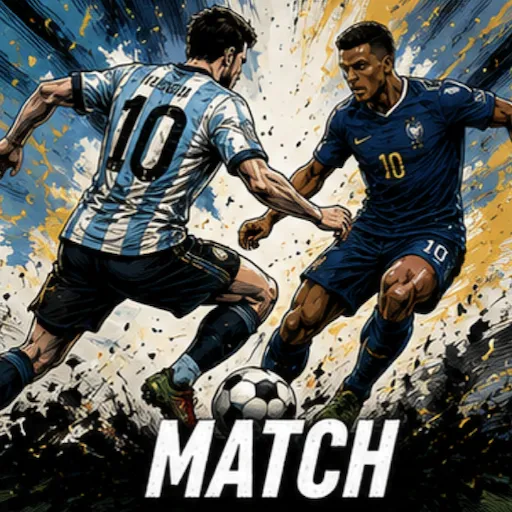
Netherlands vs Sweden: An Orange and Blue-Yellow European Variation
Two European systems operating at the peak of their respective tactical evolutions meet in a fixture that should, by any reasonable assessment, determine the winner of Group F and the corresponding seeding for the knockout stage. The Netherlands arri
Published: June 6, 2026

Comic content and match statistics are for entertainment purposes only and may contain inaccuracies. For Accurate Data, please refer to the reference's official website.
# Netherlands vs Sweden: Orange Order Meets Viking Steel
Two European systems operating at the peak of their respective tactical evolutions meet in a fixture that should, by any reasonable assessment, determine the winner of Group F and the corresponding seeding for the knockout stage. The Netherlands arrives with its most balanced squad since the 2014 World Cup semifinalists — Frenkie de Jong orchestrating from deep with the specific combination of press resistance and progressive passing that makes him one of the most important midfielders in international football, Xavi Simons providing creative friction in the final third whose movement creates spatial puzzles that opposition defensive structures must solve in real time, and Cody Gakpo cutting inside from the left with the menace of a forward who has scored at two consecutive major tournaments. Sweden arrives with a team that has evolved beyond the post-Ibrahimovic identity crisis into something genuinely coherent: organized, physically dominant in the specific Scandinavian tradition that has been producing physically imposing football teams since the sport was formalized, and built around the most exciting Swedish attacking generation since the 1994 World Cup semifinalists.
Ronald Koeman's Dutch tactical identity is possession structured around a single organizing principle that is simple to describe and extraordinarily difficult to execute against coordinated pressing: De Jong receives the ball from the center-backs and scans forward for the passing options that will progress the ball through the opposition's defensive structure. The shape in possession is a 3-2-5, the positional configuration that Pep Guardiola's Manchester City standardized during their period of Premier League dominance and that has become the default attacking template for the most sophisticated club and international sides. Virgil van Dijk and his partner split wide. The defensive midfielder drops between them. The full-backs advance — Denzel Dumfries on the right, a physical specimen whose heatmap in possession is almost indistinguishable from that of an orthodox winger. The wingers stay wide to stretch the opposition horizontally, creating the central spaces through which Simons and the late-arriving midfielders operate. The left-sided overload is created by Gakpo cutting inside onto his stronger right foot while the left-back overlaps outside. The right-sided directness is provided by Dumfries' physicality and crossing ability.
The system works brilliantly when De Jong has time: when the opposition press is either insufficiently coordinated to disrupt his receiving positions or insufficiently intense to force hurried passes. When the center-backs find him with clean deliveries allowing him to receive facing forward. When he can lift his head and scan for Simons between the lines, Gakpo isolating the right-back, Dumfries arriving at the far post. The Dutch possession game becomes a siege in the geometric sense: the ball circulating from side to side, the opposition defensive shape stretched horizontally and compressed vertically until the spaces between structural components become large enough to exploit.
When the press is effective, however, the system becomes alarmingly fragile in ways inherent to its design. De Jong receives under immediate pressure, facing his own goal, the first forward lane cut off. The full-backs have already advanced to their attacking positions. The midfield has pushed forward. The players available to defend the transition are two center-backs and the goalkeeper — three defenders against three or four attackers arriving at speed, a numerical disadvantage even Van Dijk cannot reliably overcome. This vulnerability is not a bug correctable through tactical adjustment without abandoning the attacking principles that make the system effective. It is the necessary structural consequence of committing seven or eight outfield players to attacking positions.
Sweden's tactical system is a 4-4-2 that is not merely a formation but a statement of competitive philosophy — defend as a unit, attack as a unit, succeed or fail through collective execution. The system is built around direct transitions through the channels that Alexander Isak's movement is designed to locate and exploit. Isak operates in the spaces between the Dutch center-backs and the advanced full-backs — the exact spaces the Dutch 3-2-5 leaves unprotected when full-backs have pushed forward. He does not stay central, where Van Dijk would neutralize him through positional authority. He drifts into channels, creating a structural dilemma: follow him and create central spaces for Gyokeres, or stay central and let Isak receive with time to turn.
Viktor Gyokeres provides the physical presence to occupy Van Dijk — not to defeat him in individual duels, which Van Dijk wins more often than probability suggests is sustainable, but to engage him, to prevent him drifting into channels to provide cover. Dejan Kulusevski operates from the right side, his left foot delivering inswinging crosses from the inside-right channel that bend toward the goal and away from the goalkeeper. Jens Cajuste's task in central midfield is to disrupt De Jong — to press with timing that denies clean receptions and forces hurried decisions, understanding that no holding midfielder can reliably neutralize De Jong alone and that collective pressing coordination is required.
The Xavi Simons factor introduces a level of attacking creativity Sweden's defensive organization will find extremely difficult to contain across ninety minutes. He operates in the space between Sweden's midfield and defensive lines — the pocket the 4-4-2 is structurally vulnerable to. If Swedish midfielders drop deeper to deny him space, the press loses forward pressure and the Dutch buildup gains comfort. If center-backs step forward, Gakpo's diagonal runs exploit the space behind. If neither engages, Simons receives with time to turn. The trilemma has no perfect resolution, only the specific quality of coordinated defensive execution determining whether it is resolved temporarily in the defense's favor.
The set-piece dimension favors the Netherlands. Van Dijk arriving from deep with momentum, center-forwards attacking near-post runs, the structured opportunities that transform corners from speculative deliveries into genuine scoring chances. Sweden counters through Kulusevski's delivery mechanism and the aerial presence of Isak and Gyokeres, operating through a narrower range of options. A Dutch victory positions them to win Group F and secure favorable knockout seeding. A draw introduces complications in the three-team format where every dropped point accumulates exponentially. A defeat — unlikely on paper, possible given Sweden's demonstrated capacity to exceed expectations — would restructure the group. Sweden enters as competitive challenger carrying the motivation of a squad that exceeded all expectations in 2018 and believes it possesses the structural capacity to do so again. The 2018 quarterfinal appearance established a competitive baseline that the Ibrahimovic-era Sweden, for all the individual brilliance of its star player, never approached — finishing above Germany and Mexico in the group stage, defeating Switzerland in the round of sixteen, losing narrowly to England. Andersson's current squad is expected to meet or exceed that standard, and a victory over the Netherlands would be the signature result validating the entire post-Ibrahimovic football project — the specific moment when the quiet success story that football insiders have been tracking for years becomes a headline that the broader global football audience can no longer ignore.