
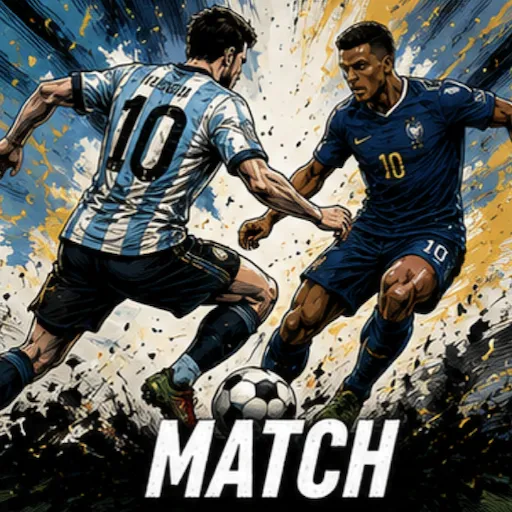
Belgium vs Egypt
Belgium versus Egypt pairs Kevin De Bruyne against Mohamed Salah in a group-stage opener that carries disproportionate significance for both nations. Belgium's golden generation — what remains of it — opens what is almost certainly its final World Cu
Published: June 6, 2026

Comic content and match statistics are for entertainment purposes only and may contain inaccuracies. For Accurate Data, please refer to the reference's official website.
# Belgium vs Egypt: De Bruyne Meets Salah — The Golden Generation's Final Opening Statement
Belgium versus Egypt pairs Kevin De Bruyne against Mohamed Salah in a group-stage opener that carries disproportionate significance for both nations. Belgium's golden generation — what remains of it — opens what is almost certainly its final World Cup campaign. Egypt, carrying the expectations of 110 million people and the specific hunger of a nation that has qualified for only four World Cups in its entire history, arrives with Salah at what is undoubtedly his final tournament at the peak of his powers.
De Bruyne, at 33, remains the most complete creative midfielder of his generation. His passing range — the ability to deliver a ball from any position to any teammate with a weight and trajectory that seems to have been calculated by instruments rather than a human foot — is undiminished. Romelu Lukaku, the all-time Belgian goalscorer whose club career has become a study in productive impermanence, must convert the chances De Bruyne creates with an efficiency that has occasionally eluded him in international competition. The Belgian defense — Jan Vertonghen at 39, a backline that was slow in 2022 and is slower in 2026 — represents the specific vulnerability that Egypt's counter-attacking system, built around Salah's diagonal runs from right to center, is specifically designed to exploit. Courtois, if he plays — the goalkeeper's relationship with Belgian management has been, charitably, complicated — remains the best goalkeeper in the world behind a defense that increasingly needs him to be. Egypt's plan is uncomplicated: defend compactly, transition through Salah, and trust that Africa's most decorated active player can produce a moment against an aging Belgian backline that no tactical preparation can prevent.
Belgium's golden generation narrative has become, over the past decade, one of the most exhaustively analyzed stories in international football — and for good reason. The generation that included De Bruyne, Eden Hazard, Lukaku, Courtois, Vincent Kompany, and a supporting cast of elite professionals reached the semi-finals of the 2018 World Cup and occupied the top position in the FIFA world rankings for nearly four years. They never won a trophy. The third-place finish in Russia 2018, a victory over England in a match that neither team particularly wanted to play, represents the high-water mark of a generation that was supposed to do more, be more, achieve more. The failure — and it is a failure, measured against the talent available — has been attributed to tactical incoherence under Roberto Martinez, to the linguistic and cultural divisions within the Belgian squad that the golden generation narrative papered over rather than resolved, to the specific bad luck of encountering a France team in 2018 and an Italy team in 2021 that were slightly, marginally, heartbreakingly better at the exact moments when Belgium needed them not to be. The 2026 tournament represents the last opportunity for De Bruyne, Lukaku, Vertonghen, and the remnants of the generation to convert a decade of nearly into a moment of finally.
The current Belgian squad under Domenico Tedesco — appointed after Martinez's departure following the 2022 group-stage exit — represents a transition that is simultaneously necessary and painful. The players who defined the golden generation are aging; the replacements are talented but unproven at the highest level. Jérémy Doku provides the direct dribbling threat from wide areas that the aging Hazard could no longer deliver, but his end product — the final pass, the shot selection, the decision-making in the penalty area — remains inconsistent. Amadou Onana brings physical presence to the midfield, the kind of athleticism that Belgium's midfield has historically lacked, but his passing range and positional discipline are not yet at the level De Bruyne requires from a midfield partner. Loïs Openda offers pace in behind defenses, the specific quality that Lukaku's game has never featured, but his hold-up play and physical presence do not offer the reference point that Lukaku provides. Belgium in 2026 is a team in transition, caught between the generation that nearly achieved everything and the generation that must achieve something.
Egypt's World Cup history is defined by absence more than presence. The nation has qualified for only four World Cups — 1934, 1990, 2018, and 2022 — a record that vastly underrepresents the nation's footballing significance and historical achievements. Egypt won the Africa Cup of Nations a record seven times, produced some of the greatest players in African football history — Mohamed Aboutrika, Mahmoud El Khatib, Hossam Hassan — and has maintained a domestic league that, for all its structural challenges, remains one of the most passionately supported in the world. The World Cup has simply never been Egypt's competition. The 2018 qualification, after a twenty-eight-year absence, was a national catharsis; the 2018 performance, three defeats and elimination at the group stage, was a national disappointment that the drama of qualification could not redeem. The 2022 qualification was a validation; the 2022 performance — a narrow defeat to the Netherlands, a draw with Ecuador, a defeat to Senegal that eliminated them — was evidence that Egypt could compete at World Cup level without quite being able to prosper.
Mohamed Salah's World Cup story is itself a miniature of Egypt's broader World Cup narrative: moments of individual brilliance surrounded by structural limitations that prevent those moments from translating into results. Salah's goal against Russia in 2018, scored on the occasion of his return from the shoulder injury inflicted by Sergio Ramos in the Champions League final weeks earlier, was a moment of individual redemption that a 3-1 defeat could not contextualize. Salah's goal against Saudi Arabia in the same tournament was a moment of competitive relevance in a match Egypt lost 2-1. Salah's performance against the Netherlands in 2022 — a goal, an assist, the specific sense that the best player on the pitch was wearing red rather than orange — was not quite enough to secure the result Egypt needed. The narrative of Salah's international career — the best player Africa has produced in a generation, unable to carry his nation to the World Cup achievements that his individual quality demands — is either a tragedy or an unfinished story, and the 2026 World Cup will determine which.
The tactical matchup centers on De Bruyne's creative capacity against Egypt's defensive organization. Portugal's Rui Vitoria, appointed as Egypt manager, has built a system organized around defensive compactness and rapid transitions — the classic underdog tactical framework that has served African nations at World Cups with varying degrees of success. The midfield block, featuring Mohamed Elneny as the defensive anchor and a rotating cast of more mobile partners, is designed to deny De Bruyne the central spaces where his passing is most dangerous. The defensive line, organized around Ahmed Hegazi's experience and the specific aerial presence that Egyptian center-backs have historically provided, drops to deny the space behind that Lukaku's runs target. The attacking plan is reductionist but not simplistic: win the ball in midfield, find Salah in space, and trust that the specific magic that has produced more than two hundred Liverpool goals can produce a World Cup moment against a Belgian defense that will not be able to match his pace. The plan leaves Egypt vulnerable to sustained pressure, to De Bruyne's capacity to find passes that no defensive organization can prevent, to the individual quality that Belgium possesses at almost every position. It is also the only plan available to a team that is, by any objective measure, the underdog in this fixture, and the specific quality of Egyptian football — resilience, defensive organization, the capacity to suffer without breaking — gives that plan a credibility that statistical models may undervalue.