
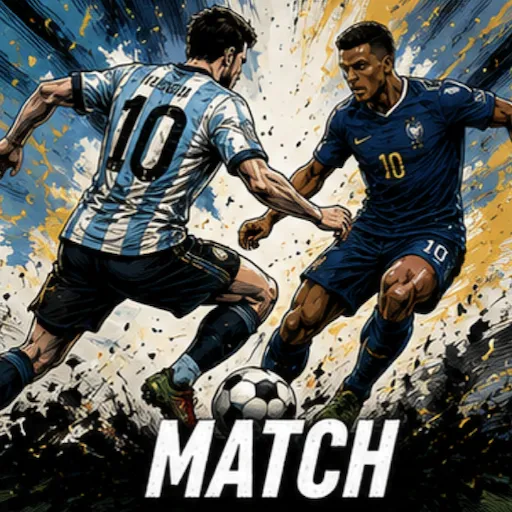
Iran vs New Zealand
Iran and New Zealand meet in a Group G fixture that both teams have internally categorized as their most winnable match of the group stage. The arithmetic is straightforward for both sides: defeat the other, and knockout qualification becomes a genui
Published: June 6, 2026

Comic content and match statistics are for entertainment purposes only and may contain inaccuracies. For Accurate Data, please refer to the reference's official website.
# Iran vs New Zealand: Asian Discipline Meets Oceanian Physicality in Group G
Iran and New Zealand meet in a Group G fixture that both teams have internally categorized as their most winnable match of the group stage. The arithmetic is straightforward for both sides: defeat the other, and knockout qualification becomes a genuine possibility regardless of results against Belgium and Egypt. Lose, and the path forward narrows to the width of a mathematical miracle.
Iran's defensive organization under Amir Ghalenoei represents the most disciplined tactical system in Asian football. The 4-1-4-1 formation operates as a coordinated pressing machine: when the ball enters the middle third, the midfield line drops to deny central progression. When possession moves wide, the near-side winger and full-back compress space against the touchline. When the ball is lost, the entire structure resets within three seconds. Mehdi Taremi provides the counter-attacking outlet — his movement between the center-back and full-back, his hold-up play, his capacity to transform a defensive clearance into an attacking transition — while Sardar Azmoun offers the complementary finishing threat from central positions. New Zealand's approach under Darren Bazeley is direct, physical, and entirely unapologetic about both qualities. Chris Wood's aerial dominance functions as the primary attacking reference point. Set pieces represent the most probable source of goals. The 5-3-2 defensive block is designed to frustrate technically superior opponents by denying the central spaces where Iranian creativity operates. The tactical contrast is absolute: Iranian patience and positional discipline against Oceanian physicality and directness. Iran should win on technical quality and tournament experience. New Zealand could win on set-piece execution and the specific freedom of a debutant playing without pressure. The gap between should and could is where this match will be decided.
Iran arrives at this World Cup as Asia's most consistent tournament participant, having qualified for four of the last five World Cups and established a pattern of competitive group-stage performances that have fallen tantalizingly short of knockout qualification. The 2018 campaign in Russia — a narrow victory over Morocco, a competitive defeat to Spain, a draw with Portugal that nearly produced a knockout berth — demonstrated that Iranian defensive organization could neutralize technically superior opponents. The 2022 campaign in Qatar — a humiliating defeat to England followed by a dramatic victory over Wales and a narrow defeat to the United States — demonstrated the specific volatility of Iranian tournament performance, the capacity to oscillate between defensive collapse and competitive resilience within the same tournament. The 2026 campaign represents the convergence of Iran's most experienced generation — Taremi and Azmoun at their tournament peaks, a defensive unit that has played together across multiple World Cup cycles, a tactical system refined through a decade of Asian competition — with the most favorable format the World Cup has ever offered Asian qualifiers. The expectation, unspoken but understood, is that this Iranian team must deliver knockout qualification. The alternative — another competitive exit, another tournament of what-ifs — would represent a ceiling that Iranian football, for all its structural challenges and institutional limitations, has earned the right to break through.
Taremi and Azmoun form one of the most productive strike partnerships in Asian football history, a combination of complementary qualities that allows Iran to attack in multiple ways. Taremi's game is built on intelligent movement, hold-up play, and the specific capacity to receive the ball with his back to goal and turn defenders in a single motion — a skill that, at Porto and Inter Milan, has made him one of the most effective link forwards in European football. Azmoun provides the complementary finishing threat: a penalty-box predator whose movement in the six-yard box, his capacity to find half a yard of space in congested areas, converts Taremi's hold-up work into goals. Together they represent a partnership that no opponent in Group G, including Belgium and Egypt, can defend with complacency. The challenge for Iran is delivering the ball to Taremi in positions where his qualities matter — against New Zealand's deep defensive block, the passing lanes will be narrow, the space will be contested, and the midfielders who must thread those passes will be operating under physical pressure that Asian competition does not replicate.
New Zealand's qualification for the 2026 World Cup represents a structural opportunity created by the expanded tournament format. Under the thirty-two-team format, Oceania was allocated zero or half a qualification spot, requiring the regional champion to survive an intercontinental playoff against a team from Asia, South America, or CONCACAF. New Zealand navigated this gauntlet successfully in 2010, qualifying for the South Africa World Cup and producing the tournament's most improbable statistical achievement: three group-stage draws, no defeats, elimination as the only unbeaten team at the tournament. The 2026 format awards Oceania a guaranteed qualification spot, and New Zealand, as the region's dominant football nation, is the primary beneficiary. The All Whites arrive at this World Cup not as the romantic underdog who defied continental odds but as the expected representative of an entire confederation, carrying the responsibility of demonstrating that Oceania's guaranteed qualification is not merely a political concession but a competitive justification.
Chris Wood embodies New Zealand's football identity with a directness that is both tactical and symbolic. The Nottingham Forest striker, now in his mid-thirties, has built a Premier League career on precisely the qualities that define New Zealand's approach to this fixture: physical presence, aerial dominance, the capacity to score goals from limited service. Wood's trajectory — from West Bromwich Albion's academy through Leicester City, Leeds United, Burnley, Newcastle United, and Nottingham Forest — has been a study in productive persistence, a career built on converting the specific physical advantages that New Zealand football produces into the specific competitive attributes that Premier League football rewards. At international level, Wood is more than New Zealand's primary goal threat. He is the tactical reference point around which the entire attacking system is constructed. Every New Zealand clearance is aimed toward his head. Every set piece is designed to find his run. Every defensive action is calibrated to win the second ball that follows his aerial contests. Iran's center-backs will spend ninety minutes in physical confrontation with a player whose entire career has prepared him for exactly this challenge — and the outcome of those individual battles may determine the outcome of the match.
The set-piece dimension warrants detailed analysis because it represents New Zealand's most probable path to a result. The All Whites have traditionally generated a disproportionate percentage of their goals from dead-ball situations, a statistical pattern that reflects both the aerial quality of their attacking players and the limitations of their open-play chance creation. Winston Reid's header against Slovakia in 2010 — the goal that secured New Zealand's first World Cup point — came from a set piece. Shane Smeltz's goal against Italy in the same tournament — the goal that briefly, impossibly, gave New Zealand a lead against the defending champions — came from a set piece. The delivery from Sarpreet Singh and the targeting of Wood, with secondary runs from the center-backs arriving late into the penalty area, creates a set-piece threat that Iran's defensive organization, for all its structural discipline, has historically struggled to neutralize against physically imposing opponents. Iran's goalkeeper, Alireza Beiranvand, is renowned for his remarkable throwing distance — his assisted goal against Portugal in 2018 traveled more than sixty meters — but his command of the penalty area on crosses and set pieces has been a persistent vulnerability that New Zealand's scouting department will have identified and targeted.
The broader significance of this fixture extends beyond the immediate competitive stakes. It is a meeting between two football nations that represent different models of development, different relationships with the global game, and different answers to the question of how a nation without the structural advantages of Europe or South America can compete at the World Cup. Iran's model — domestic league development, centralized tactical identity, the cultivation of specific technical qualities through the youth system — has produced a consistent World Cup presence and a specific competitive identity that opponents must prepare for. New Zealand's model — exporting talent to European academies, building the national team around a core of European-based professionals, leveraging the physical qualities that New Zealand athletes have historically developed through other sports — has produced a smaller pool of elite footballers but a team that, at its best, can compete with anyone on its own terms. The match is a laboratory for competing theories of football development, and the result will be cited for years by advocates of each approach.