
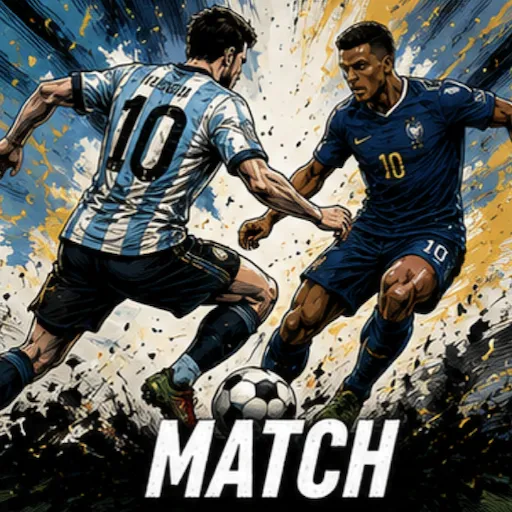
Belgium vs Iran
Belgium versus Iran presents the Group G favorite with the precise tactical challenge that has historically frustrated this golden generation's tournament campaigns: a deep defensive block deployed by an opponent that concedes possession willingly, d
Published: June 6, 2026

Comic content and match statistics are for entertainment purposes only and may contain inaccuracies. For Accurate Data, please refer to the reference's official website.
# Belgium vs Iran: The Golden Generation's Efficiency Test — De Bruyne Faces Asia's Wall
Belgium versus Iran presents the Group G favorite with the precise tactical challenge that has historically frustrated this golden generation's tournament campaigns: a deep defensive block deployed by an opponent that concedes possession willingly, defends its penalty area with religious commitment, and counter-attacks with the surgical precision of a team that has spent a decade perfecting the art of transition.
Belgium's attacking system under Domenico Tedesco has evolved from the counter-attacking unit of 2018 into a possession-dominant machine that builds through the half-spaces. Kevin De Bruyne operates from the right channel with license to drift centrally, where his passing range — the ability to weight a ball into the space behind the full-back, to deliver a cross that lands on a forehead with the precision of a guided missile — remains the most potent creative weapon available to any team in this group. The full-backs advance to provide width while the double pivot of Amadou Onana and Youri Tielemans screens against the counter-attacks that represent Iran's primary attacking mechanism. Romelu Lukaku provides the physical reference point, his hold-up play creating the platform from which De Bruyne and the wide forwards can operate. Iran's defensive structure is the most disciplined in Asian football. The 4-1-4-1 low block compresses space into a fist, conceding possession in harmless areas while daring opponents to find the gaps that the system is designed to deny. Mehdi Taremi operates as both the defensive leader from the front and the counter-attacking outlet — his movement into the channels behind Belgium's advanced full-backs represents Iran's most probable route to goal. Belgium should win comfortably. Belgium should have beaten Morocco in 2022. The gap between expectation and execution has defined this generation more than any World Cup achievement ever could.
The psychological dimension of this fixture is impossible to separate from the tactical analysis. Belgium has spent a decade as the team that should win and sometimes doesn't, the golden generation that accumulated FIFA ranking points and individual accolades without ever converting either into the trophy that both were supposed to deliver. The 2022 World Cup — elimination at the group stage, a tournament that ended with the squad's internal divisions spilling into public view, with De Bruyne's infamous "we're too old" interview becoming the epitaph for a project that had already died — represented the nadir of the golden generation narrative. The 2026 tournament represents the redemption opportunity, and matches against organized, defensive opponents like Iran are precisely the fixtures where Belgium's tournament campaigns have historically foundered. Morocco in 2022. Japan in 2018. Wales in the Euro 2016 quarterfinal — a victory, but a victory that required the specific brilliance of Radja Nainggolan's long-range strike rather than the systematic deconstruction of a defensive block that a truly elite team should be able to produce. The pattern is established and worrying: Belgium struggles to score against teams that defend deep, absorb pressure, and counter-attack with precision. Iran does exactly those three things better than any team in Asia, and the specific match-up between Iran's defensive organization and Belgium's attacking creativity is the tactical axis around which the entire fixture will rotate.
Iran's defensive system deserves the detailed analysis that opponents who underestimate it come to regret. The 4-1-4-1 is not merely a formation; it is a coordinated pressing and defensive structure that has been refined across multiple World Cup cycles and against every variety of international opponent. The defensive midfielder — Saeid Ezatolahi, a physically imposing presence whose reading of the game and positional discipline belie the stereotype of the destroyer — operates as the screen in front of the back four, cutting off the passing lanes to Lukaku's feet and forcing Belgium's creative players to attempt the riskier passes that Iran's defensive structure is specifically designed to intercept. The midfield line of four compresses horizontally and vertically, the wingers tucking inside to deny the half-spaces that De Bruyne and Belgium's wide forwards target. The back four drops to deny the space behind, with the full-backs positioned to deal with Belgium's wide overloads and the center-backs organized around the specific physical challenge of marking Lukaku. When Iran wins possession — and they will win possession, because Belgium will inevitably misplace passes against a defensive block this compact — the transition is immediate and targeted. Taremi peels into the channel between Belgium's advanced full-back and the center-back. Azmoun provides the secondary run, arriving late into the penalty area for the cross or cut-back. The pattern has produced goals against Spain, against Portugal, against Wales — against opponents who assumed possession dominance would translate into defensive security and discovered, too late, that Iranian counter-attacks punish precisely that assumption.
De Bruyne's individual role in breaking down Iran's defensive structure will be the subject of extensive pre-match analysis and, regardless of the result, extensive post-match commentary. He is the best creative passer of his generation, a player whose technical capacity to deliver the ball to any teammate from any position is unmatched in world football. But Iran's defensive structure is specifically designed to deny him the central spaces where his passing is most dangerous, to force him wide where his passing angles narrow, to surround him with defensive pressure that limits the time and space his creative vision requires. De Bruyne has solved this problem before — his performance against Brazil in the 2018 quarterfinal, where his counter-attacking passing and his goal-scoring run from deep defined Belgium's greatest tournament victory, demonstrated his capacity to produce against elite opposition. But Brazil in 2018 was a team that wanted to attack, that left space behind its defensive line, that played into the transitional game that Belgium's golden generation was built to exploit. Iran in 2026 will not cooperate with those tactical premises. Iran will defend deep, defend compactly, and dare De Bruyne to find passes through defensive lines that offer no gaps. The question is not whether De Bruyne is capable of doing so — he is, and he has demonstrated that capability across a decade of elite club and international football. The question is whether he can do so consistently across ninety minutes against an opponent organized specifically to prevent it, and whether his teammates can convert the chances he creates when the margins are as narrow as Iran's defensive system is designed to make them.
Lukaku's performance will be equally decisive and equally scrutinized. He is Belgium's all-time leading goalscorer, a striker whose combination of physical power and penalty-box finishing has produced extraordinary numbers at international level — more than eighty goals in approximately 120 appearances, a ratio that places him among the most prolific international strikers in football history. But his World Cup performances have been erratic in ways that his overall record conceals. The 2018 tournament — four goals, including two against Tunisia in the group stage and one against Japan in the round of sixteen — was productive but also highlighted the dependence on De Bruyne's service that Iran's defensive structure is designed to disrupt. The 2022 tournament — no goals, a series of missed chances against Croatia in the decisive group-stage match, the image of Lukaku punching the dugout in frustration after elimination — was a tournament that crystallized every criticism of his international output. Against Iran, Lukaku will face center-backs who are physically capable of matching his strength — Hossein Kanaanizadegan and Shoja Khalilzadeh, experienced defenders who have faced elite opposition across multiple World Cups — and a defensive system that will deny him the space in the penalty area that his finishing requires. His hold-up play, his capacity to receive the ball with his back to goal and bring De Bruyne and the wide forwards into attacking positions, may prove more important than his goal-scoring — and the specific irony of Lukaku's career is that his all-around game has always been more complete than his critics acknowledge, even as his finishing has occasionally been less reliable than his defenders claim.
The wider significance of this match for Group G is substantial. Belgium expects to win the group, and victories against Iran and New Zealand are the prerequisite for that expectation. A draw — let alone a defeat — would transform the group dynamics entirely, placing pressure on the Egypt match that a team with Belgium's psychological history would prefer to avoid. Iran expects to compete for knockout qualification, and taking points from Belgium is the most direct path to that objective — a draw would represent a significant achievement, a victory would represent the greatest result in Iranian World Cup history, and either outcome would place Iran in position to advance from Group G for the first time. The match is, in tactical terms, a contest between creativity and organization, between individual brilliance and collective discipline, between the team that expects to win and the team that has spent a decade perfecting the art of preventing exactly that expectation from being fulfilled. The result will determine not simply the Group G standings but the narrative that follows both teams into the remainder of their tournament campaigns, and the specific pressure that World Cup football generates — the knowledge that everything can be won or lost in ninety minutes — will be as present in this match as in any knockout fixture.