
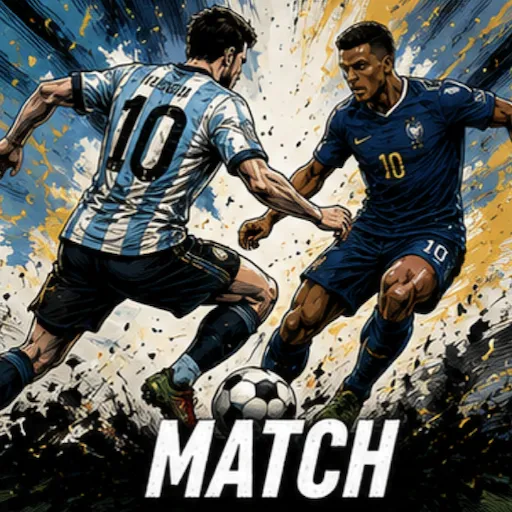
France vs Senegal: Group I Opener — Deschamps Final Chapter Meets Mane Last Dance
France and Senegal collide in a fixture crackling with historical resonance, diaspora connections, and World Cup pedigree — the defending runners-up against Africa's strongest contender, a rematch of 2002's seismic opening-day shock. This breakdown dissects Mbappe's French machine against the Lions of Teranga's athletic power in a match that could define the group's final standings.
Published: June 6, 2026
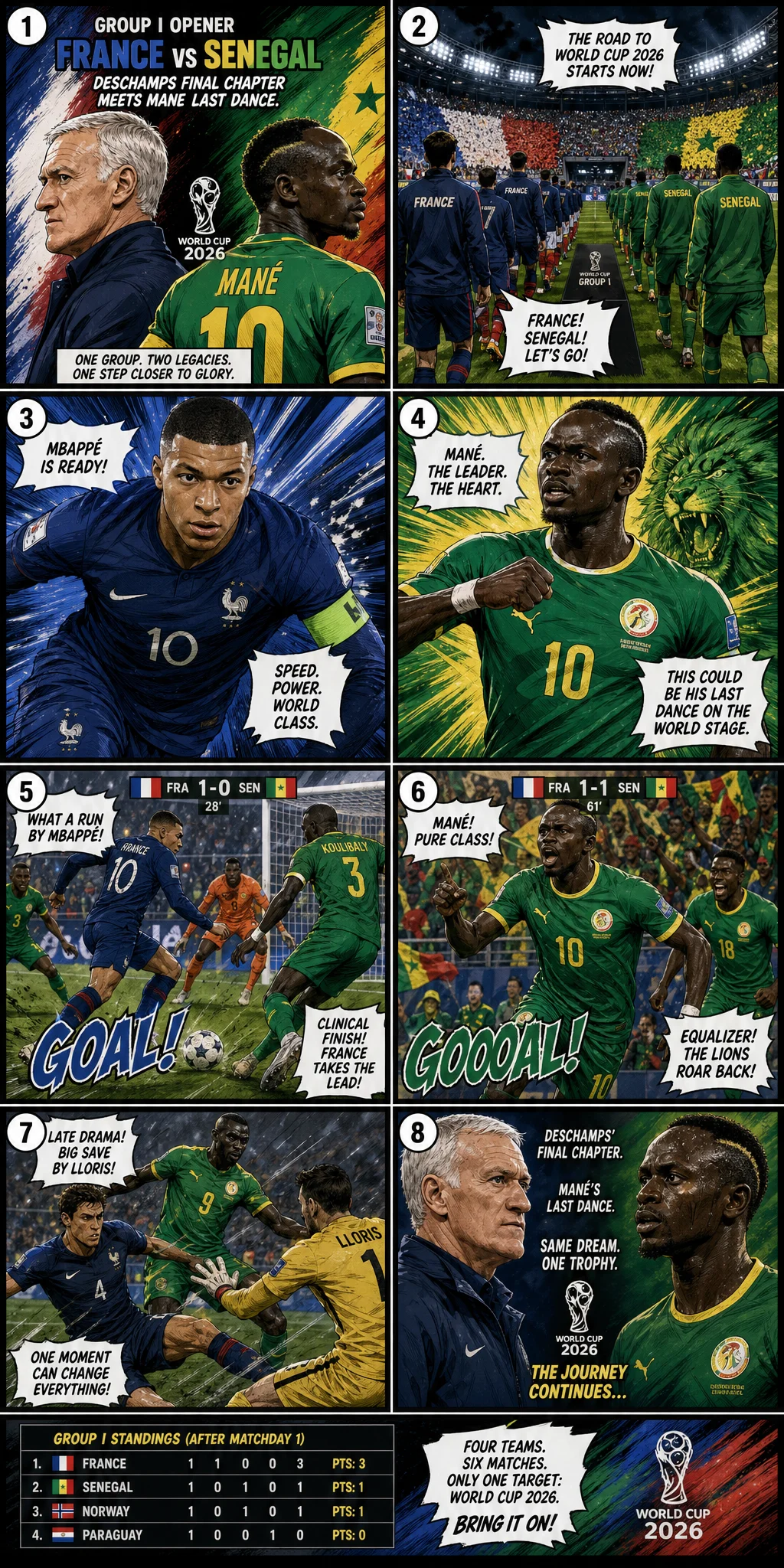
Comic content and match statistics are for entertainment purposes only and may contain inaccuracies. For Accurate Data, please refer to the reference's official website.
France vs Senegal: Deschamps' Final Campaign Opens Against Africa's Elite
Didier Deschamps begins his final tournament as France manager with a fixture that carries more historical weight than any opening group match has a right to. Senegal's 1-0 victory over the defending champion France in the opening match of the 2002 World Cup remains the defining African World Cup moment — the result that announced, to anyone still in doubt, that the old footballing order was not permanent. Twenty-four years later, the teams meet again with different stakes but the same symbolic charge. France arrives as the deepest squad in the tournament. Senegal arrives as the most accomplished African side of the past decade. The tactical patterns will be shaped by history, but they will be decided by systems.
France under Deschamps has become the most tactically flexible team in international football. The 4-3-3 base formation can morph into a 4-2-3-1 against teams that defend deep, a 4-4-2 defensive block against teams that dominate possession, or a direct transition unit when the game state demands verticality. Kylian Mbappe, now captain at 27, operates from the left with license to drift into central shooting positions — his movement patterns are less about position and more about space, less about formation and more about finding the defensive gap that every system creates. Antoine Griezmann, deployed as the most advanced midfielder in a three-man unit, links midfield to attack with the tactical intelligence that has made him Deschamps' most trusted player. The midfield base of Aurelien Tchouameni and Eduardo Camavinga provides the physical platform — ball recoveries, progressive carries, the defensive screening that allows France's full-backs to advance.
Senegal's system under Pape Thiaw is built on principles that were established during the Aliou Cisse era and have been refined rather than reinvented: defensive compactness, physical dominance in midfield, and explosive transitions through wide areas. The 4-3-3 defensive shape compresses into a 4-5-1 without the ball, with the wingers dropping to form a second bank of four and the central striker — likely Nicolas Jackson or Boulaye Dia — pressing alone. Sadio Mane, at 34, remains the creative focal point, operating from the left with the freedom to drift inside and link with the midfield. Ismaila Sarr provides the complementary threat on the right, his pace in transition the outlet that turns defensive recoveries into counter-attacking opportunities. Kalidou Koulibaly, at 35, marshals a defense that has conceded fewer goals per match than any African team over the past four years.
The tactical battle will be defined by France's approach to Senegal's defensive block. Deschamps' France has historically struggled against teams that defend deep and transition quickly — the template that Switzerland used to eliminate them from Euro 2020, the template that Tunisia troubled them with in Qatar. Senegal's midfield three of Pape Gueye, Idrissa Gueye, and Lamine Camara is not technically superior to France's but is physically capable of matching the French midfield's intensity, and the speed of Senegal's wide forwards in transition creates a counter-attacking threat that forces France's full-backs to consider their defensive responsibilities.
Mbappe's positioning against Senegal's right-back — likely Youssouf Sabaly — is the individual matchup that will shape the attacking patterns. Mbappe's tendency to receive the ball wide and cut inside onto his right foot is well-established; Senegal's defensive response will likely involve doubling the coverage, with the right-sided central midfielder sliding across to provide a second layer of protection. If Senegal can deny Mbappe the space to cut inside, France's attacking fluency diminishes significantly. The alternative — Mbappe going outside on his left foot — is less threatening but not harmless, and the quality of crosses he can deliver from the byline creates a different set of problems.
France's defensive organization without the ball has been the foundation of Deschamps' tournament success. The 2018 World Cup victory was built on a counter-attacking system that conceded possession willingly and struck with surgical precision. The 2026 version is more possession-oriented but maintains the defensive structure that made the earlier iteration successful. The key question is whether N'Golo Kante, at 35, can still provide the counter-attack insurance policy that has been the defining feature of Deschamps' France. Kante's ability to recover possession in transition — to snuff out counter-attacks before they develop into chances — has no direct replacement in the French squad. If Senegal's transitions find space behind France's advanced full-backs before Kante can recover, the vulnerability becomes structural rather than individual.
Mane's final World Cup group stage adds an emotional dimension that tactical analysis cannot fully account for but cannot entirely ignore. The forward who defined Senegal's golden generation — the AFCON champion, the Champions League winner, the player who carried a nation's hopes for a decade — faces the defending World Cup champions in a match that could define his international legacy. The tactical reality is that Mane will be double-marked, that France's defensive preparation will center on denying him space, that the system is designed to neutralize the individual. But World Cup history is filled with moments where individuals transcended systems. This is the tension that makes tournament football the most compelling version of the sport.
The group-stage opener sets the psychological tone for both teams' campaigns. France expects to win; Deschamps' final tournament cannot begin with dropped points against a team, however accomplished, that France considers beatable. Senegal expects to compete; Thiaw's system is designed for matches exactly like this, against opponents exactly like France. The tactical patterns are established. The historical resonance is inescapable. The match begins when the first pressing trigger is activated and the first passing lane is closed. Everything else is narrative. And narrative, in World Cup football, has a habit of shaping outcomes in ways that tactical analysis can describe but never predict.