
Iraq vs Norway: 40-Year Wait Meets 28-Year Drought — David, Goliath, and Haaland
Iraq versus Norway pitches one of football's most inspiring comeback stories against a Nordic generation finally delivering on its promise. This analysis explores Haaland's predatory brilliance against Iraqi defensive organization, the Odegaard-led midfield creativity duel, the stark contrast in football resources, and the emotional power of Iraq's very presence on the world stage.
Published: June 6, 2026
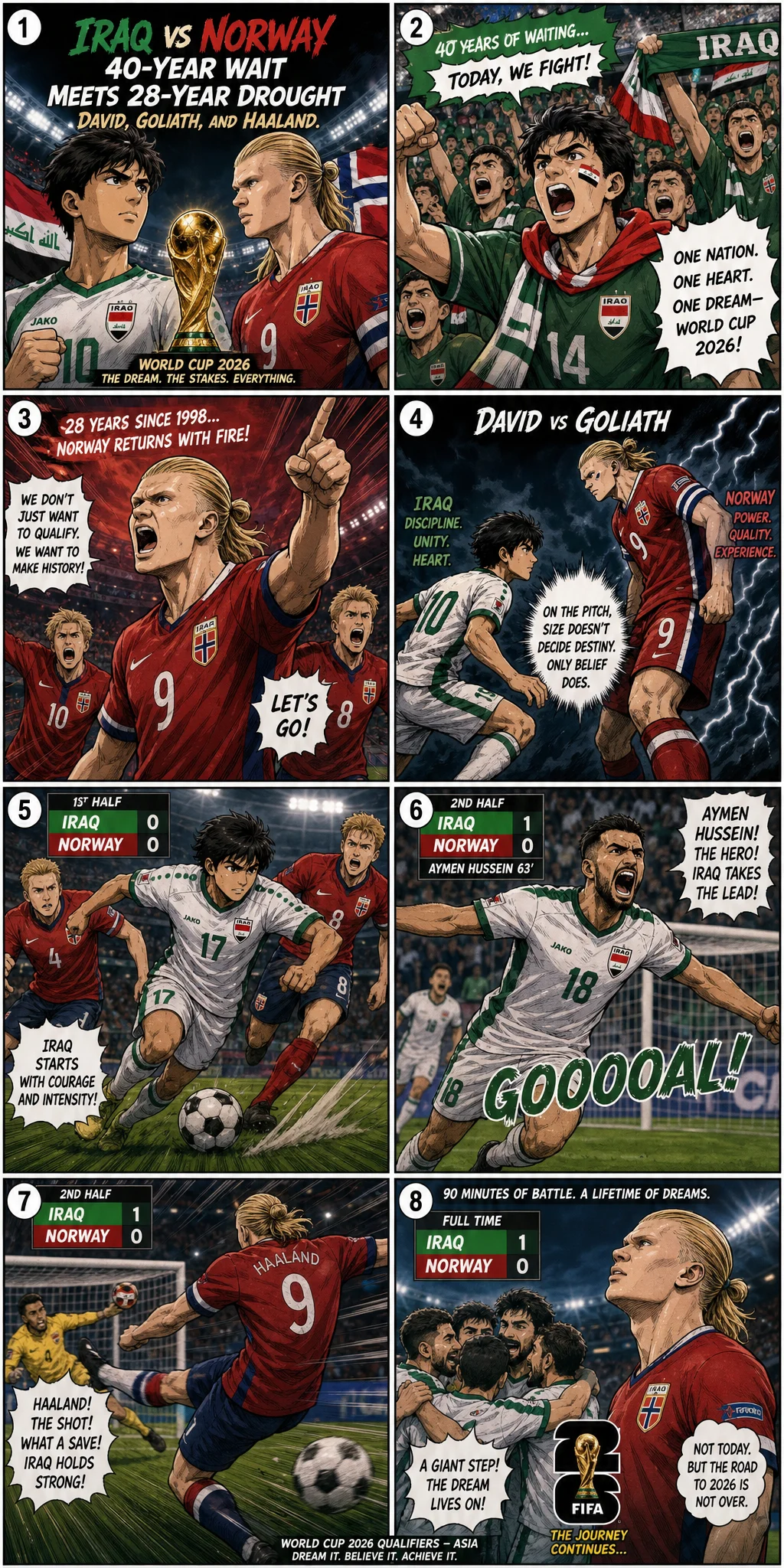
Comic content and match statistics are for entertainment purposes only and may contain inaccuracies. For Accurate Data, please refer to the reference's official website.
Iraq vs Norway: A 40-Year Wait Meets Haaland's World Cup Debut
Two nations return to the World Cup stage on the same night, with histories that took wildly different paths to reach this shared moment. Iraq's last appearance came in 1986, before the wars, before the sanctions, before the years when football became a distant priority. Norway's last appearance came in 1998, before Erling Haaland was born, before the Norwegian football federation had produced a generation of players who compete at Europe's elite clubs. The 40-year wait and the 28-year drought converge on a single group-stage fixture, where the tactical equation is straightforward — Haaland versus a deep defensive block — but the emotional calculus is immeasurable.
Norway's system under Stale Solbakken has been constructed with a single organizing purpose: maximize Erling Haaland. The Manchester City striker is the most efficient finisher in world football, converting chances at a rate that statistical models struggle to explain — his expected goals numbers are elite, but his actual goals numbers are otherworldly, suggesting a finishing ability that operates independently of chance quality. The Norwegian 4-3-3 becomes a 3-2-5 in possession, with the full-backs advancing to provide width and the midfield three creating a platform from which Martin Odegaard can operate. Odegaard's positioning between the lines — receiving the ball in the half-space, scanning forward, locating Haaland's movement — is the mechanism that connects Norway's possession to its finishing. Everything in the Norwegian system flows through the Odegaard-Haaland axis.
Iraq's tactical approach under Jesus Casas is defensive organization reduced to its logical conclusion: a 5-4-1 low block that surrenders possession entirely and dares the opponent to break through. The five defenders occupy the width of the penalty area, with the four midfielders positioned directly in front, creating a nine-man structure that denies central access. The lone forward — Aymen Hussein, the target man whose aerial presence provides the outlet for clearances — remains at the halfway line, waiting for the single moment when Iraq can break forward. This is the tactical universal of the underdog, and its effectiveness depends entirely on concentration. A low block works until it doesn't. One moment of defensive disorganization, one passing lane left open, one runner not tracked — against Haaland, one moment is all it takes.
The specific tactical problem for Iraq is Haaland's movement in the box. Haaland is not a forward who drops deep to link play or drifts wide to receive possession. He occupies the central channel, between the two center-backs, making runs that are timed to meet crosses at the exact moment the ball arrives. His movement is less about direction than about timing — he arrives in scoring positions at the moment the defender is flat-footed, when the cross is already in flight and the defensive adjustment is a half-second late. Iraq's center-backs must maintain constant visual contact with Haaland while simultaneously tracking the ball — a dual attention demand that elite defenders manage and that lower-tier defenders, which is what Iraq's domestic-based backline represents, struggle to sustain for 90 minutes.
Odegaard's role deserves separate analysis. The Arsenal captain operates as a creative midfielder whose passing range is calibrated for exactly the kind of match Norway faces: an opponent defending deep, denying central space, requiring the attacking team to find passes through defensive gaps that appear and close in fractions of a second. Odegaard's capacity to play first-time passes — to receive and release in a single motion, before the defensive block can adjust — is the skill that makes Norway's possession dangerous rather than sterile. If Iraq's midfield block can pressure Odegaard on his first touch, denying him the time to scan forward, Norway's attacking patterns become predictable. If Odegaard receives with time, Haaland receives with chances.
Iraq's route to goal — and there is one — runs through set-pieces and the occasional breakaway. Norway's full-backs advance so aggressively in possession that the space behind them is always exploitable. If Iraq can win a defensive header and direct it into the channel where a midfielder is breaking forward, the transition creates a numerical situation — three against three, sometimes three against two — that even technically inferior teams can convert. Iraq's wingers, Ali Jasim and Ibrahim Bayesh, possess the pace to trouble Norway's recovering defenders. The question is whether they receive the ball in positions where that pace matters.
The broader significance of this match extends beyond the tactical patterns. Norway's golden generation — Haaland, Odegaard, the collection of players who have competed at the highest level of European club football — has waited its entire career for this moment. The absence from Euro 2024, the missed qualification cycles, the years of watching major tournaments from home while possessing players who would start for the teams competing in them — all of it ends here, against Iraq, in a match that Norway cannot afford to lose. Iraq's story is different but produces the same emotional intensity. Forty years of waiting, a generation of players who grew up hearing about the 1986 team as a legend, a nation for whom World Cup qualification is not a sporting achievement but a national healing. Both teams will feel they have already won by being here. The scoreline will determine which feeling survives the full 90 minutes.