
Argentina vs Algeria: Group J Opener
Argentina versus Algeria opens the Albiceleste's World Cup defense against a gifted North African side with nothing to lose and diaspora talent eager to shock the world. This analysis examines the defending champions' transitional phase, Algeria's creative midfield and rapid counterattack, historical echoes of 1982, and the delicious possibility of an early plot twist in Argentina's opening chapter.
Published: June 6, 2026
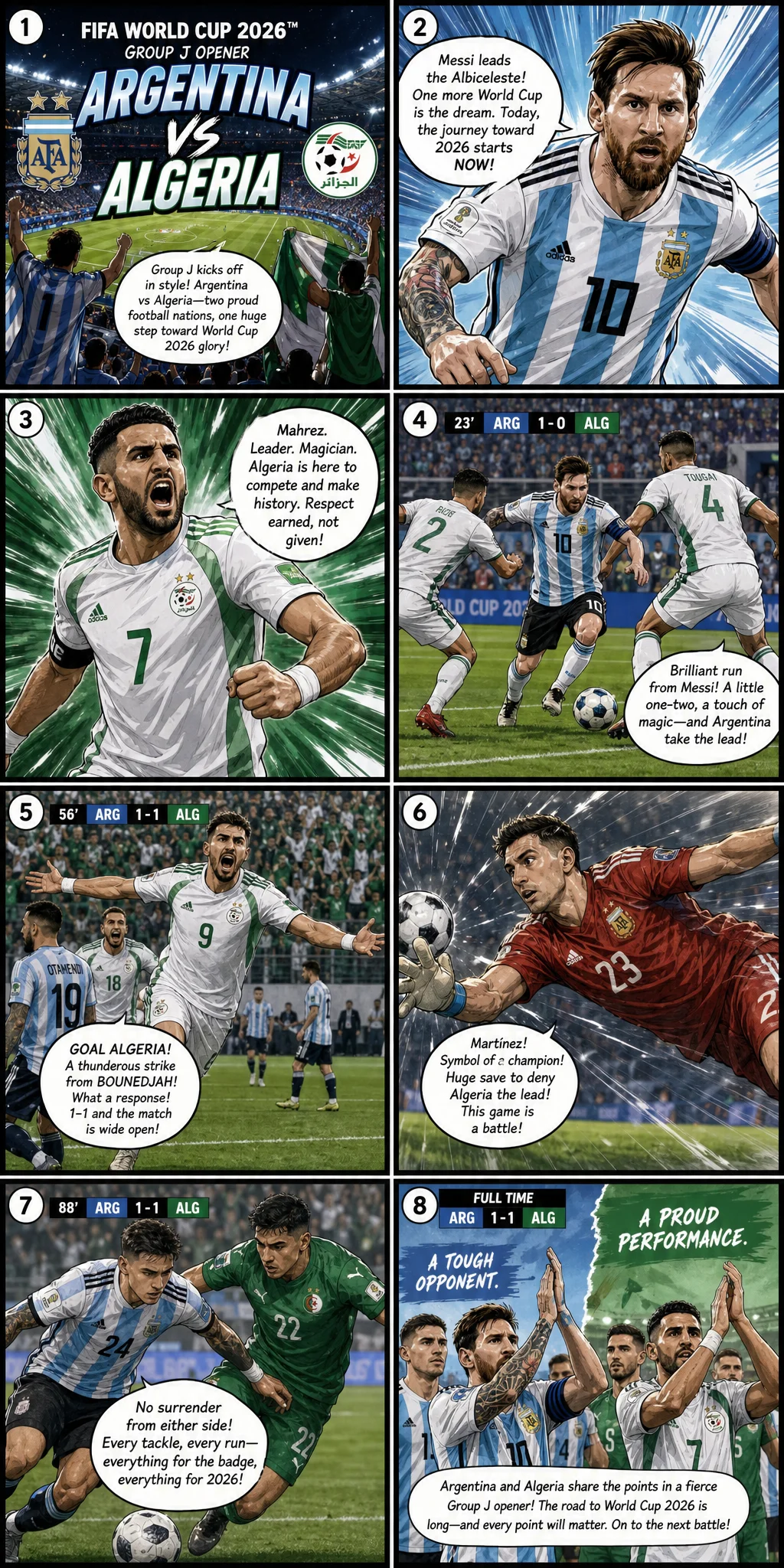
Comic content and match statistics are for entertainment purposes only and may contain inaccuracies. For Accurate Data, please refer to the reference's official website.
Argentina vs Algeria: The Champion Opens Group J Against a Familiar Adversary
Argentina begins its World Cup title defense against the nation that authored one of the tournament's most famous upsets when these teams last met in a competitive context. Algeria did not face Argentina in 2014 — they faced Germany, and they beat them, a 2-1 victory that announced Algeria as a team capable of competing with the world's elite. Argentina went on to reach the final that year. The paths of these two nations have crossed indirectly, through shared opponents and shared tournament histories, but this is different. This is direct. This is Messi's final World Cup group-stage opener. This is the champion against the challenger, and the tactical tension between Argentina's possession system and Algeria's counter-attacking design will define whether the champion begins its defense with a statement or a stumble.
Argentina under Lionel Scaloni has evolved significantly since the chaotic opening defeat to Saudi Arabia in the 2022 tournament. That loss — the most improbable result in World Cup history, measured by Elo rating differential — forced a tactical recalibration that produced the most resilient Argentina team of the modern era. The 4-3-3 base formation now operates with a midfield three — Enzo Fernandez, Alexis Mac Allister, and Rodrigo De Paul — that provides a balance of creativity, physicality, and defensive coverage that the 2022 iteration lacked. Messi, at 38, operates as a nominal right forward with complete positional freedom, drifting centrally to receive possession between the lines and create the passing angles that unlock defensive blocks. Julian Alvarez leads the line, his movement creating the space that Messi exploits, his pressing intensity setting the defensive tone from the front.
Algeria's system under Vladimir Petkovic is built on the same principles that produced the 2014 upset and the 2019 Africa Cup of Nations title: defensive organization as the non-negotiable foundation, rapid transitions through wide areas, and the creative freedom of Riyad Mahrez as the mechanism that connects defense to attack. The 4-3-3 becomes a 4-5-1 without the ball, with Mahrez and the opposite winger dropping to form a compact midfield line. The midfield three deny central progression, forcing opponents wide where crosses must contend with the aerial presence of the center-backs. Ramy Bensebaini and Aissa Mandi provide the defensive experience at the back — a combined 170 international caps between them, the kind of tournament-hardened knowledge that cannot be coached in training sessions.
The tactical battle will center on Argentina's approach to Algeria's defensive block. Scaloni's Argentina has become expert at breaking down organized defenses — the system that won the 2022 World Cup was built on grinding victories against opponents who defended with numbers and countered with speed. The key mechanism is Messi's positioning between the lines. When Messi receives the ball in the half-space, with time to turn and scan, he becomes the most dangerous player in the world — his passing range can release Alvarez, his dribbling can beat a defender, his shooting from the edge of the box requires no assistance. Algeria's defensive response will be to deny Messi exactly that time and space — to have a midfielder in close attendance whenever he receives, to foul him before he can turn and face goal. This is the tactical universal of defending Messi: accept the yellow cards, accept the free-kicks in non-threatening positions, accept anything except allowing him to receive between the lines with time to operate.
Algeria's attacking threat runs through Mahrez in what is almost certainly the Manchester City and Al-Ahli winger's final World Cup. Mahrez operates from the right, cutting inside onto his left foot — the mirror image of Messi's movement pattern, the same diagonal trajectory that made him the most productive wide creator in Premier League history. Argentina's left-back, Nicolas Tagliafico or Marcos Acuna, must prevent Mahrez from cutting inside while maintaining the attacking width that Argentina's system demands. This is a physically and mentally exhausting assignment — defend against one of the world's best one-on-one players while providing the overlap that creates space for Argentina's midfield. The left-back's performance will be as important to Argentina's defensive solidity as any center-back's.
The set-piece dimension deserves specific attention. Algeria's aerial threat from corners and wide free-kicks — Islam Slimani, if selected, or Baghdad Bounedjah, combined with Bensebaini's attacking headers — gives Algeria a route to goal that bypasses Argentina's possession dominance. Argentina's zonal marking system at set-pieces has been statistically effective but visually nervous — the kind of system that works until a single miscommunication produces a free header. In a match where Algeria may create only three or four chances from open play, the set-piece becomes the most likely source of a goal. Argentina must defend dead-ball situations with a concentration that their possession dominance sometimes erodes.
The psychological dimension of opening a World Cup as defending champion carries specific tactical implications. Argentina's 2022 opener against Saudi Arabia was defined by early confidence — an early goal, a sense that the match was a formality — that gradually gave way to the realization that Saudi Arabia's high defensive line and aggressive press were causing problems that Argentina's first-half intensity had masked. Scaloni will not allow that pattern to repeat. Expect Argentina to start with controlled aggression — high intensity without recklessness, possession dominance with defensive security, the measured approach of a team that has learned from the most painful lesson in its World Cup history.
Messi's final World Cup — the phrase carries weight that no tactical analysis can fully process. The tournament's greatest-ever player, at 38, begins the final chapter of an international career that already includes every honor football can confer. The system around him is the best Argentina has produced in his lifetime. The opponent is a team that has already authored one famous World Cup upset and possesses the tactical organization and individual quality to author another. The champion begins its defense not against a hand-picked opening opponent but against a team that has made a habit of defying expectations. The pieces are arranged. The tournament that will define legacies begins with a single match, a single system, a single test of whether the champion can defend what it won.