
Senegal vs Iraq: Pride and Points — Mane's Last Group Match Meets Iraq's Historic Journey
Senegal and Iraq meet in an encounter spanning football's established and emerging worlds — Africa's most convincing contender against the Middle East's most inspiring qualification story. This analysis breaks down Senegal's athletic dominance against Iraqi resilience, the Senegalese stars who must be contained, and a fixture where the Lions of Teranga face expectation against opponents playing with house money.
Published: June 6, 2026
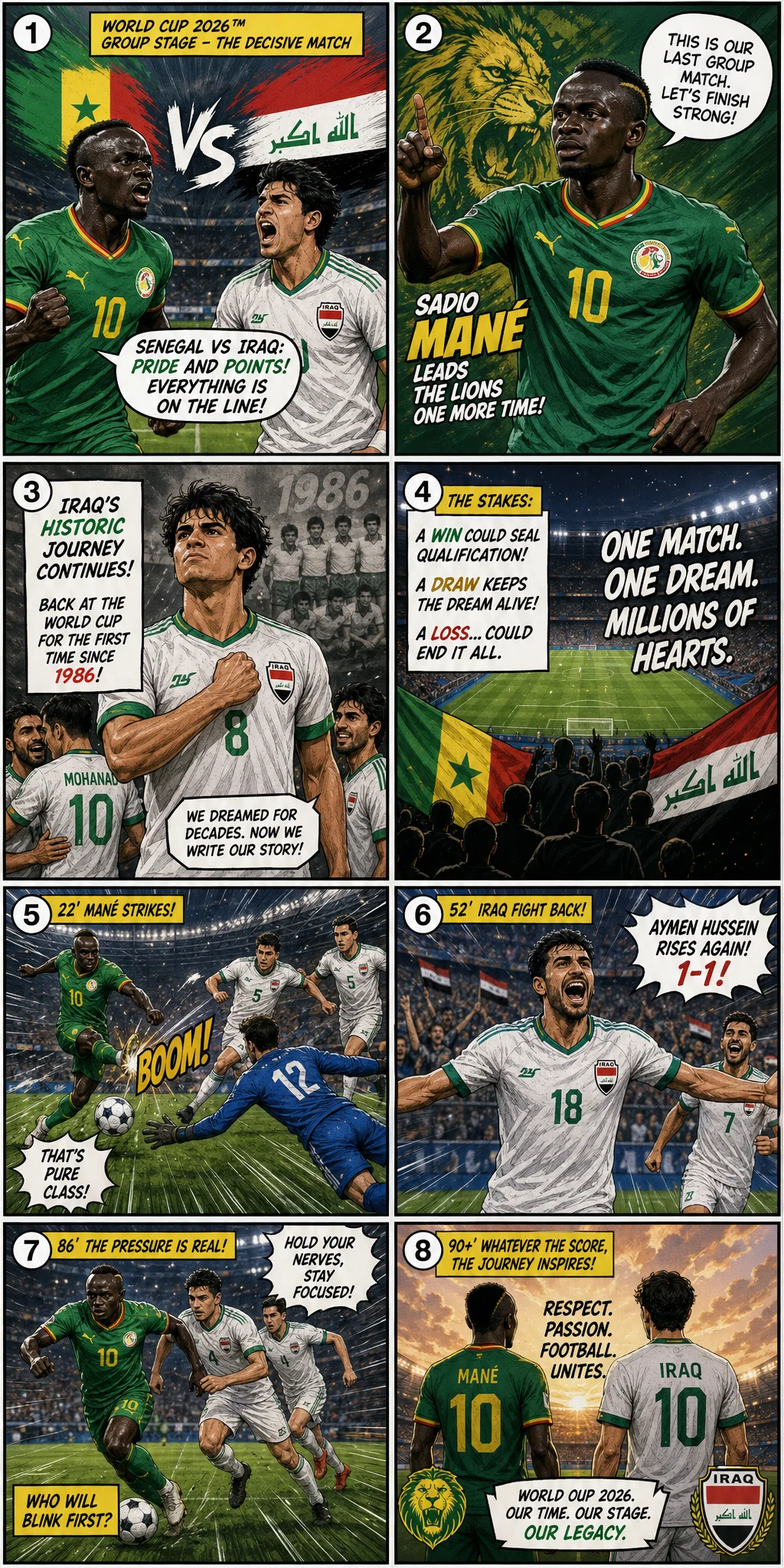
Comic content and match statistics are for entertainment purposes only and may contain inaccuracies. For Accurate Data, please refer to the reference's official website.
Senegal vs Iraq: Mane's Farewell and Iraq's Historic Journey Reach Their Final Group Act
Two teams at opposite ends of the World Cup experience spectrum meet in a group-stage finale where the outcome matters for different reasons. Senegal plays for knockout qualification — a win guarantees progression, a draw likely suffices, a defeat means depending on other results. Iraq plays for honor, for history, for the satisfaction of a campaign that has already exceeded every expectation by simply existing. Sadio Mane's final World Cup group-stage match. Iraq's first World Cup appearance in 40 years. The tactical equation is straightforward — Senegal's physical organization against Iraq's deep defensive resilience — but the emotional current running through this match makes tactical analysis feel like describing the architecture of a cathedral during a service.
Senegal's system under Pape Thiaw is the product of a football culture that has become the most reliable producer of elite African talent. The 4-3-3 formation is built on three principles: defensive compactness between the lines, physical dominance in midfield duels, and explosive transitions through wide areas. Kalidou Koulibaly anchors the defense, his positional intelligence and aerial authority providing the platform from which Senegal's more attacking players can operate. Pape Gueye and Idrissa Gueye form the midfield screen — ball-winners whose primary function is to recover possession and release the wide forwards before the opponent's defensive shape can reset. Mane, operating from the left, remains the creative focal point, his ability to receive possession in tight spaces and manufacture chances through individual skill making him the player Iraq's defensive structure must prioritize neutralizing.
Iraq's approach under Jesus Casas will follow the template that has defined their tournament: a 5-4-1 low block that concedes possession entirely, compresses central space into a fist, and waits for the single transition moment that can produce a goal. The defensive structure has been Iraq's competitive advantage throughout the group stage — a collective discipline that transforms individual limitations into structural strength. Aymen Hussein, the lone forward, carries the dual burden of pressing Senegal's center-backs and providing the aerial outlet for clearances. It is a thankless role, the kind of position that exists to serve the team rather than the player, and Hussein has performed it with a dedication that reflects the national pride that Iraq's return to the World Cup has generated.
The tactical battle will be defined by Senegal's approach to breaking Iraq's block. Senegal's attacking patterns are less suited to patient possession than to transition moments — the system is designed to punish opponents who overcommit, not to dismantle opponents who refuse to. Against Iraq's deep block, Senegal will dominate possession (projections suggest 58-62%) in a match where the question is not whether chances will be created but whether they will be converted. Mane's finishing from the left half-space, where he cuts inside onto his right foot and shoots across goal, is the most reliable route to goal. Iraq's right-sided defenders — the right-back and the right-sided center-back — must prevent Mane from receiving in positions where that movement pattern becomes available.
The set-piece dimension cannot be overstated. Senegal's aerial threat — Koulibaly, Abdou Diallo, the collective height advantage that has made them one of the most dangerous dead-ball teams in African football — provides a route to goal that bypasses Iraq's organized defensive structure entirely. Iraq has defended set-pieces with discipline throughout the tournament, but the physical mismatch in the penalty area creates moments where discipline alone cannot compensate. A single corner, a single delivery, a single header — and the entire tactical plan shifts. For a team like Iraq, defending set-pieces is as much about preventing the delivery as about contesting the header; the wide players must pressure the taker, force the ball to be played from non-optimal angles, reduce the quality of the service into the box.
Mane's individual role carries the weight of a decade of international football compressed into 90 minutes. The forward who won the Africa Cup of Nations for Senegal, who carried Liverpool to a Champions League title, who has been the face of Senegalese football through its most successful era — this is almost certainly his final World Cup group-stage match, and the possibility that it could be his final World Cup match period adds an urgency that tactical analysis can measure through movement patterns but cannot fully account for. Mane will want the ball. He will demand it in positions that matter. Iraq's defensive structure will be designed to deny him precisely that.
Iraq's tournament, regardless of this result, has already achieved its purpose. The 40-year wait for a World Cup appearance has ended. The players who grew up hearing stories of the 1986 team have written their own chapter. The question is whether they can write a conclusion — a result against Senegal that sends Iraq home with points, with dignity, with the knowledge that their defensive structure held against one of Africa's most accomplished teams. The tactical answer is that Senegal's superior quality should prevail. The World Cup answer — and this is what makes tournament football the most compelling version of the sport — is that group-stage finales between teams with asymmetric stakes produce outcomes that logic never predicts.
The match will be decided in the final 20 minutes. If the score is level or Senegal leads by a single goal, Iraq's defensive concentration will face its most demanding test as fatigue erodes the compactness that has defined their defensive structure. Senegal's substitutes — the fresh legs that Pape Thiaw can introduce against tiring Iraqi defenders — will find space that was not available in the opening hour. If Senegal scores early, the contest effectively ends and becomes a matter of margin. If Iraq reaches halftime at 0-0, the tension becomes the story, and tension in World Cup group-stage finales has a habit of producing moments that tactical analysis can describe only after they have happened.