
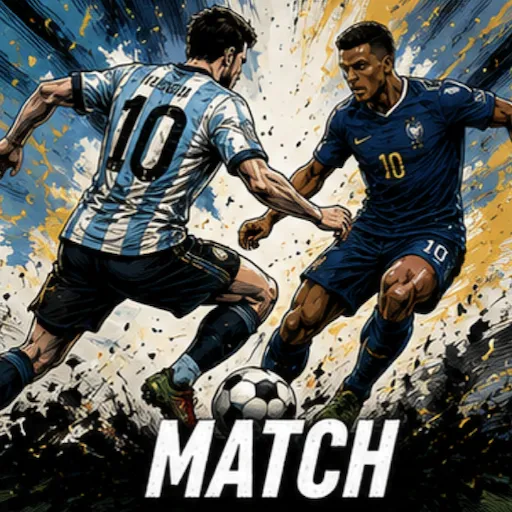
Argentina vs Austria: Clash of Philosophies
The last time Lionel Messi faced a Ralf Rangnick team, the Argentine was playing for Paris Saint-Germain and the German was managing Manchester United through the most miserable interim period in that club's modern history. The match ended 1-1, notab
Published: June 6, 2026
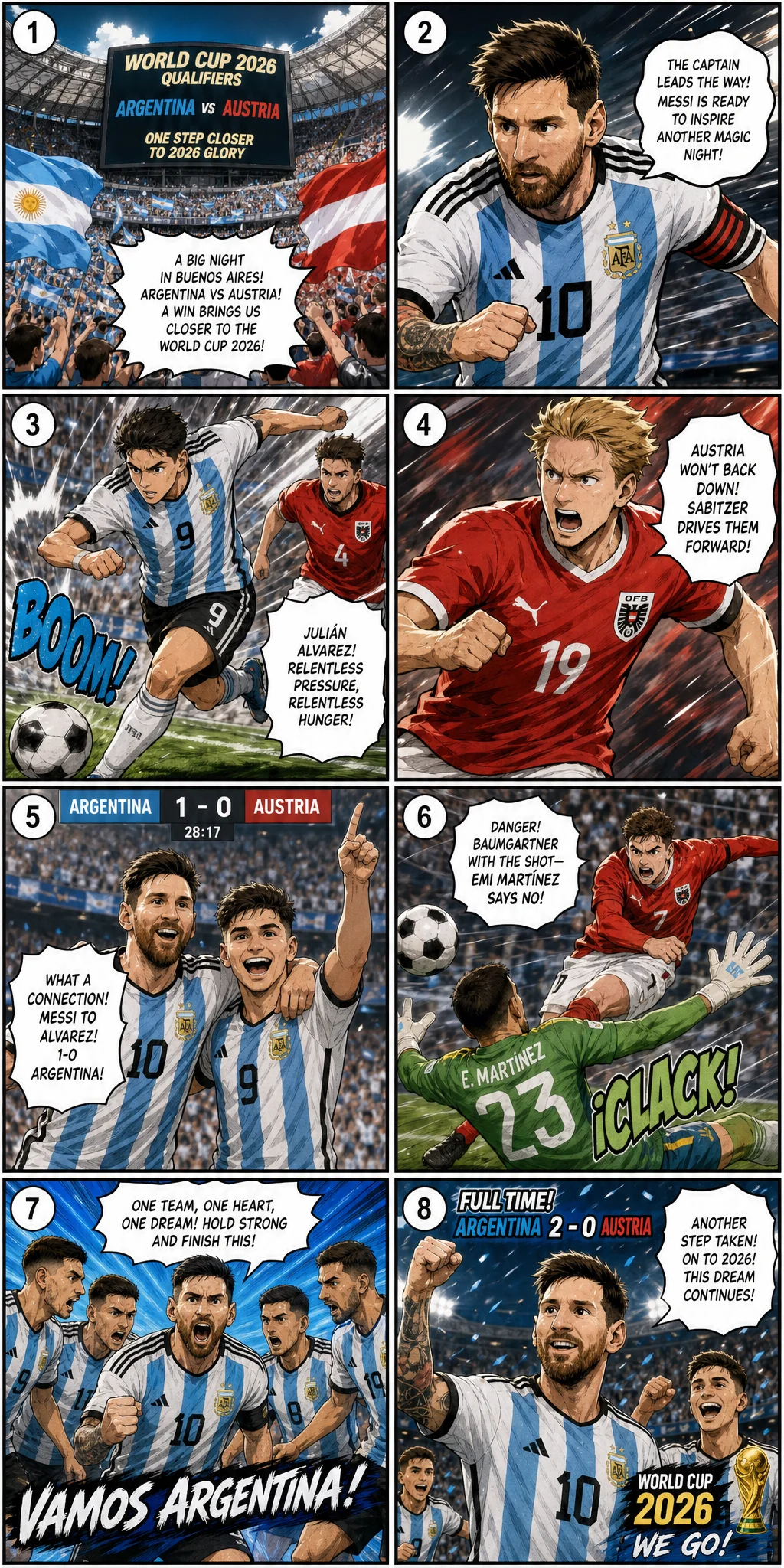
Comic content and match statistics are for entertainment purposes only and may contain inaccuracies. For Accurate Data, please refer to the reference's official website.
# Argentina vs Austria: The Champion and the Professor — Messi Meets the Machine
The last time Lionel Messi faced a Ralf Rangnick team, the Argentine was playing for Paris Saint-Germain and the German was managing Manchester United through the most miserable interim period in that club's modern history. The match ended 1-1, notable only for the chasm between the football Messi attempted to play and the football Rangnick's squad was capable of executing. Three years later, the circumstances could hardly be more different. Messi wears the world champion's armband. Rangnick commands the most tactically coherent Austrian team in a generation. And the World Cup group stage provides the canvas.
Argentina versus Austria is the marquee fixture of Group J, the match that will likely determine the group winner, and a stylistic confrontation that poses the question football theorists have debated for a decade: can a perfectly organized system neutralize individual genius? Rangnick's Austria is the system. Messi is the genius. The answer will not be theoretical.
Argentina's World Cup defense has begun with the quiet confidence of a champion that knows what it takes. The scars of the Saudi Arabia defeat that opened the 2022 campaign have healed, replaced by the institutional memory of the six consecutive victories that followed. Lionel Scaloni's team is not the most talented Argentina squad in history — that honor belongs to some combination of the 1986 and 1978 vintage — but it is the most resilient, the most unified, the squad that has learned through the hardest possible tournament education that winning ugly counts the same as winning beautifully.
Messi, at 38, is no longer the player who could dribble through an entire defense from the halfway line. What remains is more refined and, in its own way, more dangerous — the passing range that operates on a frequency no opponent can intercept, the positional intelligence that creates space where none exists, the leadership that transforms a collection of talented players into a team that believes it cannot lose. Against Austria's press, Messi's ability to receive the ball in tight spaces and release it to the right pass becomes the tactical fulcrum. Austria will press high. Messi will find the space behind the press. This is the chess match within the football match.
Rangnick's tactical plan will not be subtle. Austria will press Argentina's buildup, targeting the center-backs and the goalkeeper, forcing the ball wide to full-backs who are more comfortable defending than constructing. The 4-2-2-2 formation will compress the midfield, denying Enzo Fernández and Alexis Mac Allister the time and space to find Messi between the lines. The press is designed to create turnovers in dangerous areas, the one scenario where Austria can hurt Argentina without requiring sustained possession. It is a high-risk strategy against a team that includes the greatest player in football history to exploit the space the press leaves behind, but it is the only strategy that gives Austria a genuine chance.
The individual duel that will define the match is Sabitzer against Messi — not in a direct marking sense, but in the contest between Sabitzer's pressing triggers and Messi's spatial manipulation. Sabitzer must decide when to press, when to hold, when to commit a teammate to the double-team. Messi must decide when to drop deep, when to stay high, when to drift into the half-spaces where Austria's midfield structure is most vulnerable. Every decision by one player conditions the decision of the other. The match will be decided in the aggregate of those micro-decisions.
For Austria, a draw would represent a historic result — a point against the world champions, a validation of the Rangnick project, a platform from which to secure qualification against Jordan and Algeria. For Argentina, anything less than victory would trigger the familiar anxiety, the questions about whether the champion's mentality has survived the four-year gap between tournaments. Messi has faced this pressure before, in 2022 against Mexico, in the final against France. He has always found an answer. Rangnick's machine represents the most systematic challenge yet, but systematic challenges have never been the ones that trouble Messi most. Genius does not care about systems. The professor will find out whether his equations account for the unaccountable.