
Jordan vs Algeria: The Weight of Identity
Riyad Mahrez carries Algeria on his shoulders the way Atlas carries the world in mythology — not because anyone asked him to, but because the weight settled there naturally and he has never once complained about it. The Manchester City winger, now in
Published: June 6, 2026
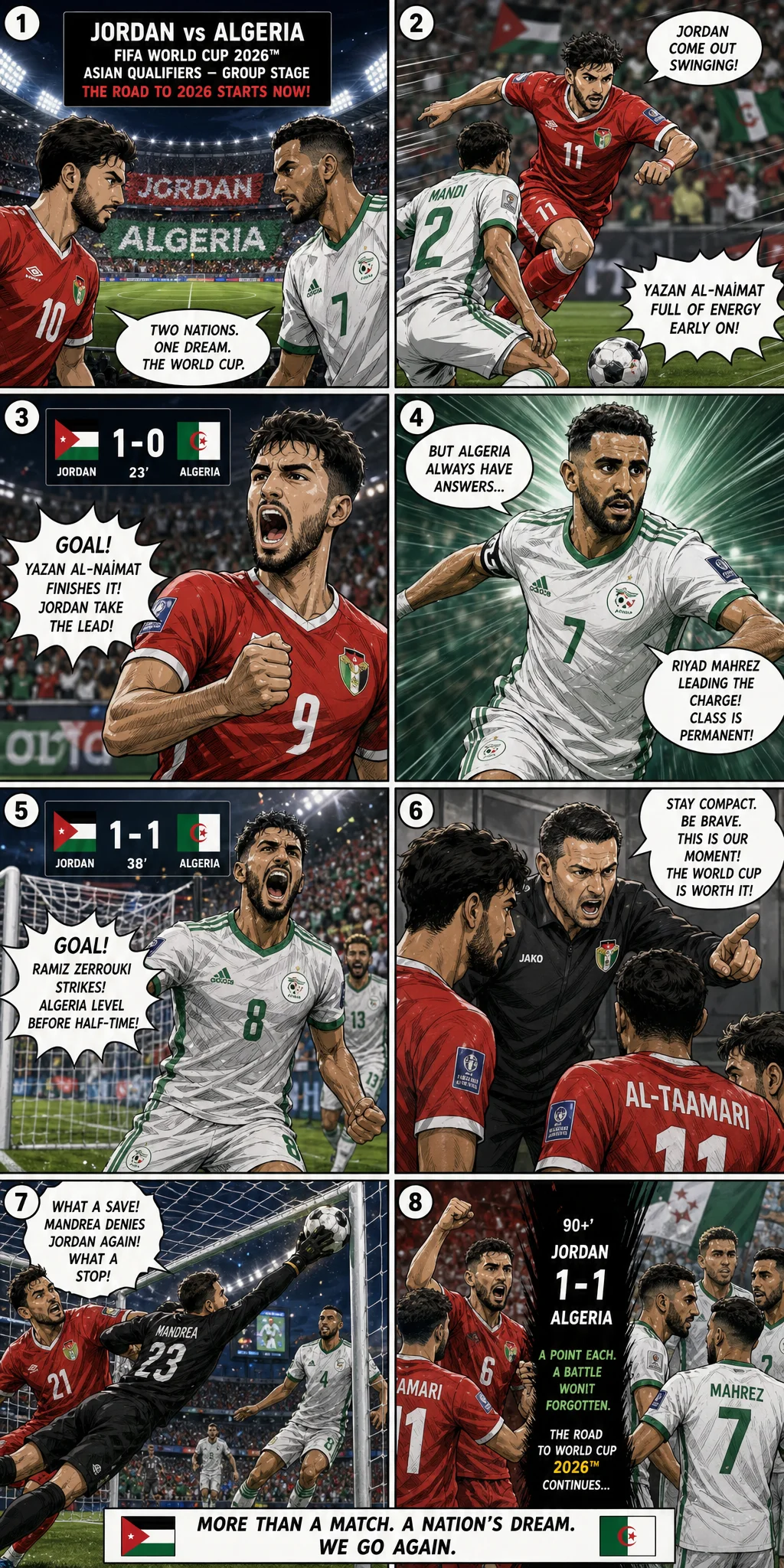
Comic content and match statistics are for entertainment purposes only and may contain inaccuracies. For Accurate Data, please refer to the reference's official website.
# Jordan vs Algeria: The Newcomer and the Returning Hero — Mahrez's Final Tournament
Riyad Mahrez carries Algeria on his shoulders the way Atlas carries the world in mythology — not because anyone asked him to, but because the weight settled there naturally and he has never once complained about it. The Manchester City winger, now in the autumn of his career at thirty-five, enters his final World Cup knowing that the 2026 tournament represents the last chapter of a story that began in the streets of Sarcelles and reached its improbable peak on the pitch in Brazil twelve years ago. Jordan versus Algeria, on paper, is a match between a debutant and a former knockout-stage participant. On the pitch, it is a match about what history demands from those who carry it.
Algeria's 2014 World Cup campaign remains one of the most celebrated in African football history — not for the result, a round-of-sixteen elimination to Germany, but for the manner. The Fennecs took the eventual champions to extra time, matching them physically and tactically, producing a performance that forced the football world to reconsider what an African team could achieve at a World Cup. Mahrez was twenty-three then, a promising winger at Leicester City before the Premier League title, before the Ballon d'Or nomination, before the four Premier League medals and the Champions League final. He was the future. Now he is the past, and the past carries its own weight.
The 2026 Algeria squad is built around the generation that experienced 2014 and the generation that came after. Islam Slimani, improbably still leading the line at thirty-eight, provides the physical presence that occupies center-backs and creates space for the wingers. Ismaël Bennacer, the AC Milan midfielder, provides the technical composure that allows Algeria to control matches against opponents who would prefer chaos. But the system runs through Mahrez — the left-footed winger cutting inside from the right, the signature move that Premier League defenders studied for years and never quite solved, the moment of individual quality that separates Algeria from the dozens of teams that defend well but lack the creative spark to turn defense into victory.
Jordan's task against this Algeria team is simultaneously simple and nearly impossible: contain Mahrez. The Jordanian defense, organized around the compact 4-5-1 block that served them through Asian qualification, will attempt to deny the winger space to cut inside, forcing him wide onto his weaker right foot, doubling when he receives the ball in dangerous positions. The plan works on the tactical board. On the pitch, Mahrez has spent a decade making tactical boards look naive. The problem with containing a player of his quality is that containment requires ninety minutes of perfect concentration, and Mahrez only needs one moment.
Jordan's attacking identity — built on Al-Taamari's pace on the counter and the aerial threat of Yazan Al-Naimat in the box — is designed precisely for matches like this, against opponents who will dominate possession and leave space behind their defensive line. Algeria's center-backs, Aissa Mandi and Ramy Bensebaini, are experienced but not fast. The spaces will exist. The question is whether Jordan, in its first World Cup, operating under the pressure of a match it knows is winnable, can exploit them.
The tactical battle in midfield will determine whether Jordan can make this a contest. Nizar Al-Rashdan must track Bennacer's movements, deny the passing lanes that feed Mahrez, and disrupt Algeria's attacking rhythm. Al-Rashdan's performance against Bennacer — the Champions League midfielder against the Asian qualifier — is the mismatch Jordan must somehow neutralize. If Al-Rashdan succeeds, Algeria's service to Mahrez becomes less reliable. If Bennacer finds his rhythm, the match tilts inexorably toward Algeria. The set-piece dimension also favors Algeria, with Bensebaini's aerial threat on corners offering one of their most reliable routes to goal.
For Jordan, this match represents a genuine opportunity — not for a moral victory, but for three points that would transform the group-stage landscape. Al-Taamari, if he performs at his best, can trouble a defense that has shown vulnerability to pace in wide areas. Al-Naimat, if he receives the service his aerial ability demands, can convert the half-chances Jordan will create. The path to victory exists. It is narrow, steep, and littered with obstacles. But it exists.
The emotional architecture of this match is built on contrasting narratives. Jordan, the debutant, playing with house money, every positive moment a bonus, every goal a national holiday. Algeria, the established power, carrying the expectations of a football nation that remembers 2014 and demands a sequel. The pressure is asymmetrical, and pressure has a way of producing strange outcomes. Watch Mahrez closely in the tunnel before kickoff. The expression on his face will tell you everything about what this tournament means — to him, to Algeria, to the story that began in the streets of Sarcelles, reached its peak in the Premier League and Champions League, and now approaches its final page in the stadiums of North America.