
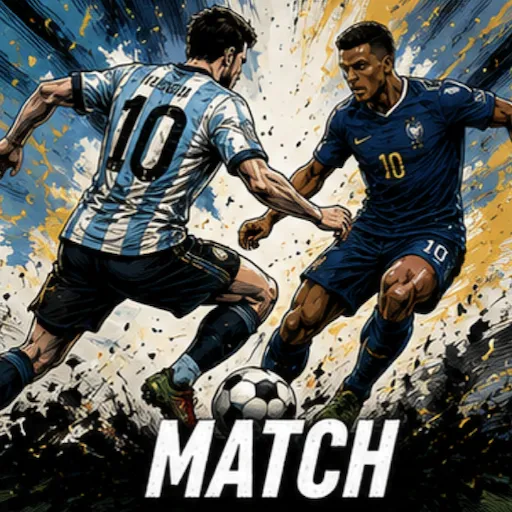
Jordan vs Argentina: Mission Impossible?
Imagine being a Jordanian defender. You grew up watching grainy YouTube compilations of a small Argentine dribbling through defenses that looked like they were moving through water while he moved through air. You studied his movements the way music s
Published: June 6, 2026
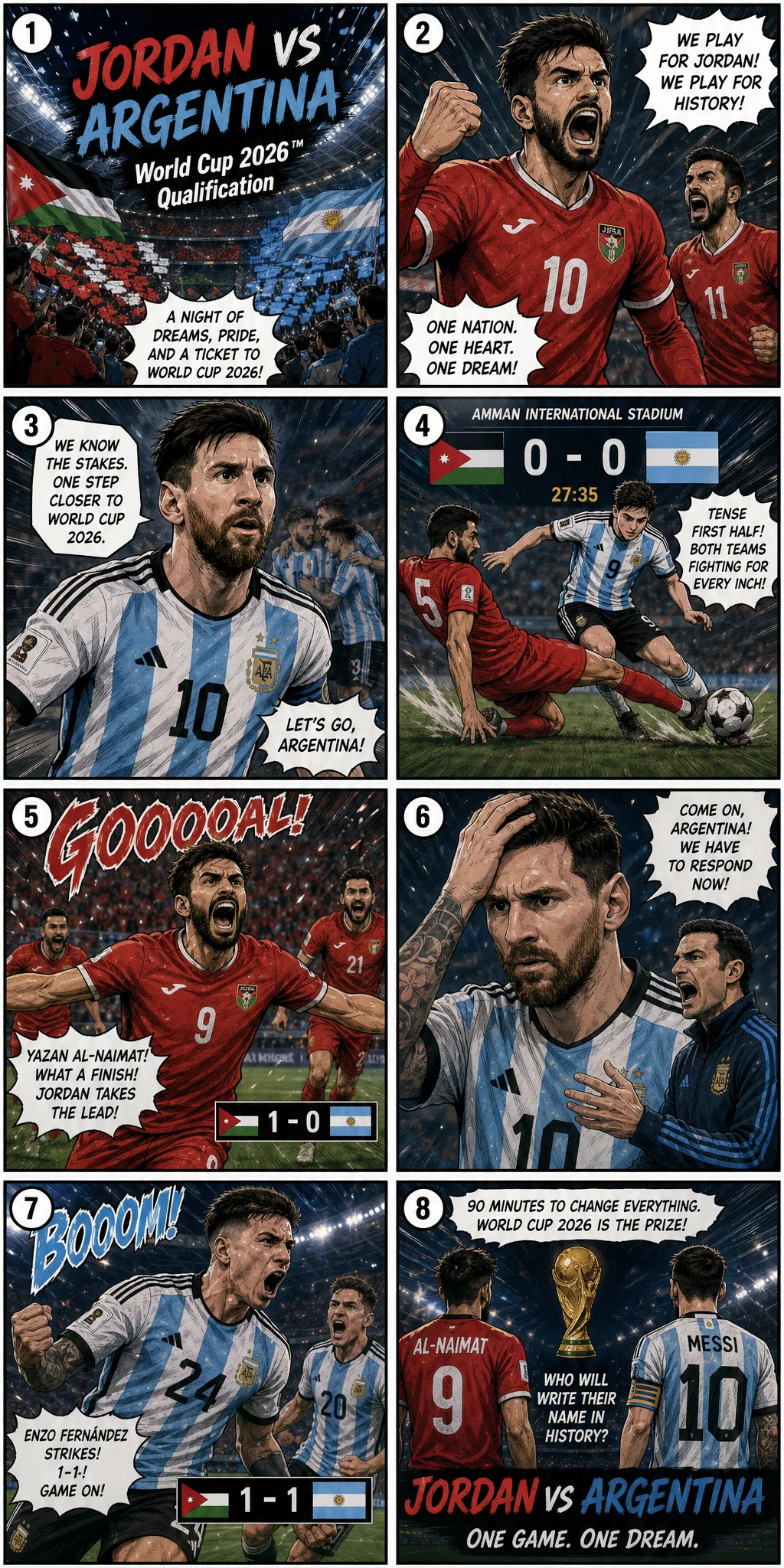
Comic content and match statistics are for entertainment purposes only and may contain inaccuracies. For Accurate Data, please refer to the reference's official website.
# Jordan vs Argentina: The Debutant Meets the Dynasty — Messi's Last World Cup Dance
Imagine being a Jordanian defender. You grew up watching grainy YouTube compilations of a small Argentine dribbling through defenses that looked like they were moving through water while he moved through air. You studied his movements the way music students study Mozart — aware that true understanding is impossible but trying anyway. And now, on a Tuesday evening in a World Cup stadium somewhere in North America, you are jogging out of the tunnel and there he is, ten yards to your left in those blue-and-white stripes, and the reality of the situation hits you with the force of something physical: you have to play against Lionel Messi.
Jordan versus Argentina is the match that defines the World Cup's expansion to forty-eight teams — the football superpower against the debutant, the champion against the newcomer, the greatest player in history against a nation experiencing this stage for the first time. The gap in resources, in history, in talent, in everything that can be measured and most things that cannot, is as wide as any gap at this tournament. And yet the match must be played, and Jordan must find a way to make it competitive, and the players who take the field in the white Jordanian shirts will experience something that no amount of tactical preparation can replicate.
Argentina's priorities in this match are twofold: win, and preserve legs for the knockout stage. Scaloni's squad rotation will likely see some of the starters from the Austria match rested — perhaps Julián Álvarez for Lautaro Martínez, perhaps Rodrigo De Paul for Exequiel Palacios — but Messi will start. He always starts. The man who has played more than a thousand professional matches understands that his body is no longer the instrument it once was, but he also understands something more important: every World Cup match, even against a debutant, even in the group stage, is irreplaceable. He will not miss a single minute of his final tournament if he can help it.
The Argentine system under Scaloni has evolved since Qatar. The 4-3-3 that won the World Cup in 2022 was built on defensive solidity — three central midfielders who protected the back four, allowed the full-backs to advance cautiously, and created the platform for Messi's creative freedom. The 2026 iteration is more aggressive, more vertical, designed to overwhelm opponents earlier rather than managing matches to the final whistle. Enzo Fernández and Alexis Mac Allister push higher. The full-backs overlap more frequently. The transition from defense to attack is faster. The system is designed to score early and score often, removing the necessity for the tense, narrow victories that characterized the 2022 knockout run. Against Jordan, the system should produce goals. The question is how many, and how quickly.
Jordan's defensive organization will be tested in ways that no Asian qualification opponent tested it. Messi's movement — the way he drifts from the right wing into central spaces, pulling defenders out of position, creating gaps that his teammates exploit — is a tactical problem that elite defenses have spent years failing to solve. For a Jordanian defense that has never faced him, the first twenty minutes will be a disorienting education. The defenders will follow Messi, because he is Messi, and in following him they will create the spaces that Álvarez, Mac Allister, and the Argentine runners will exploit. The solution is defensive discipline — hold position, trust the system, resist the gravitational pull of the number 10. But the solution is easier described than executed, and the gap between the tactical board and the pitch is where Argentina's superior quality lives.
Argentina's bench strength underscores the gap between these two squads. Ángel Di María, retired after Qatar, left a void that Alejandro Garnacho and Nico González have filled with youthful energy. Paulo Dybala provides an alternative creative option from the bench. Lautaro Martínez arrives in the best scoring form of his career. The depth is deeper than any Argentina squad since the 2006 vintage that included Crespo, Riquelme, and Saviola alongside a teenage Messi.
For Messi, the match represents something more tender. His final World Cup group stage, his final match against an opponent experiencing their first — the symmetry of a career that began in 2006, when he was the teenager facing established powers with nothing to lose, and ends in 2026, when he is the legend facing newcomers who will tell their grandchildren about the night they shared a pitch with him. The ball will feel different in his feet during this match. Not heavier — Messi has never made the ball look heavy in his life — but more significant. Every touch is a memory in the making.
Argentina will win. The scoreline is the only unknown. But somewhere in the second half, when the result is settled and the Jordanian legs are heavy and the adrenaline is fading, a Jordanian player will look across the pitch at the number 10 in blue and white and feel something that transcends the scoreboard. Football is not only about who wins. It is about who was there. Jordan will be there. Messi will be there. That is enough.