
Portugal vs Uzbekistan: The System Gap and the Structural Problem — Group K Tactical Preview
Portugal versus Uzbekistan is a match that exists on two entirely different planes of football reality. On one plane, the European elite — Champions League winners, Premier League champions, players whose weekly wages exceed the annual budgets of ent
Published: June 6, 2026
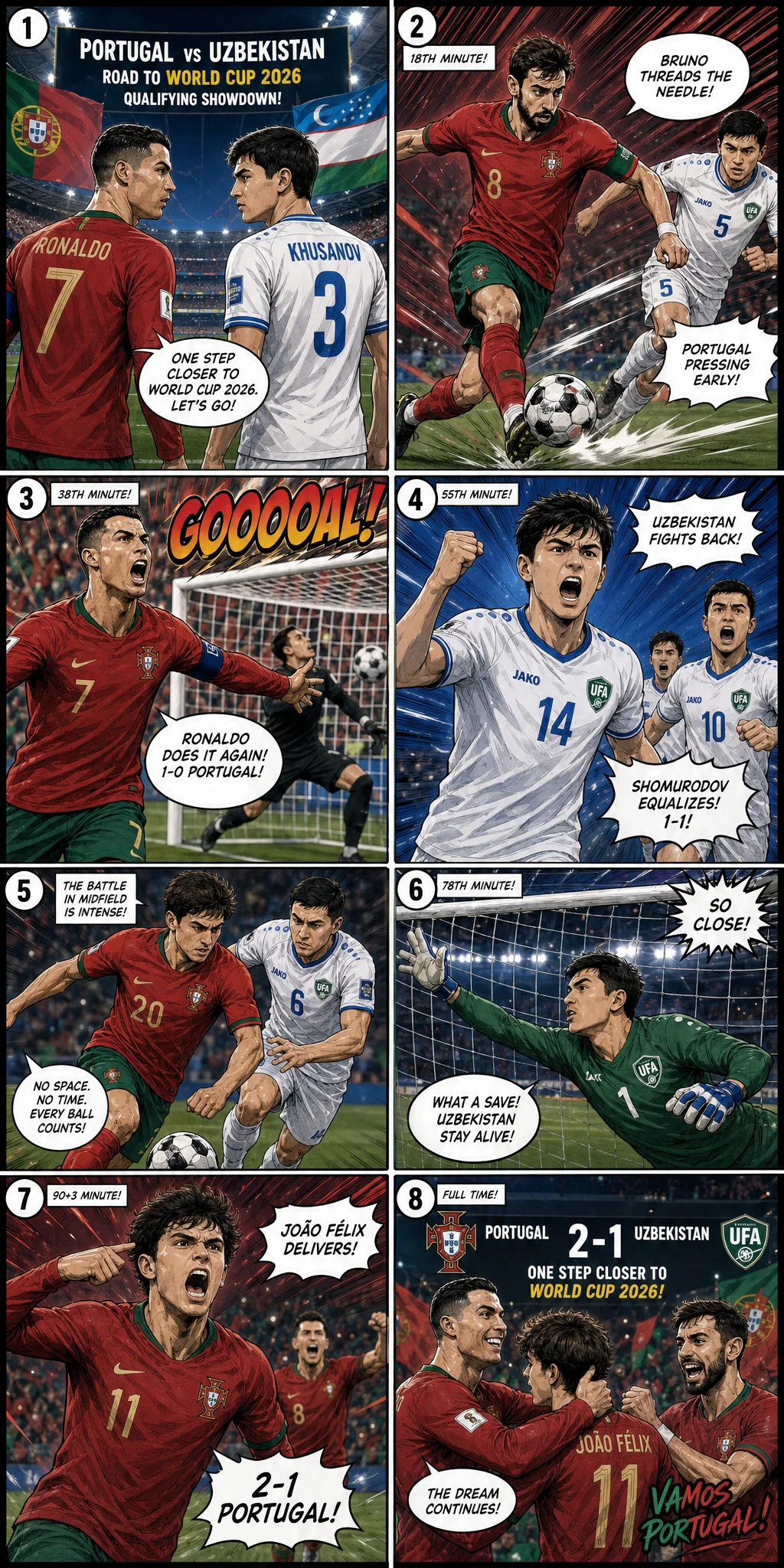
Comic content and match statistics are for entertainment purposes only and may contain inaccuracies. For Accurate Data, please refer to the reference's official website.
# Portugal vs Uzbekistan: The System Gap — European Elite Meets Asian Promise
Portugal versus Uzbekistan is a match that exists on two entirely different planes of football reality. On one plane, the European elite — Champions League winners, Premier League champions, players whose weekly wages exceed the annual budgets of entire national federations. On the other, the Asian debutant — a team that has never before played on this stage, that qualified through persistence and organization rather than star power, that represents thirty-five million people who waited decades for this moment. The gap between these two realities is so vast that describing it accurately requires acknowledging that normal football metrics do not apply.
Portugal's squad depth has been covered extensively in the build-up to this tournament — Dias, Fernandes, Bernardo, Leao, a collection of talent that should overwhelm any opponent outside the top tier of international football. Against Uzbekistan, the overwhelming should happen early. Roberto Martinez will likely rotate his squad for this match, preserving legs for the decisive group-stage finale against Colombia, but even Portugal's second-choice eleven would qualify as one of the strongest starting lineups in this tournament. Goncalo Ramos leading the line. Joao Felix creating from the left. Vitinha dictating tempo from midfield. The depth is absurd. The quality is undeniable.
The tactical question for Uzbekistan is not how to win but how to survive with competitive credibility intact. The 5-4-1 block that served Katanec's team through Asian qualification will be tested by the specific challenge of Portugal's attacking patterns — the positional rotations that make marking assignments impossible to maintain, the passing combinations that open spaces where no spaces should exist, the individual moments of quality that break down even perfectly organized defenses. Uzbekistan's defenders will spend ninety minutes solving tactical problems that Portugal's attackers will present one after another, each solution creating a new problem, each problem requiring a solution that was not part of the preparation.
The one area where Uzbekistan can compete is set pieces. Katanec's team is tall. Shomurodov, at six-foot-three, provides an aerial target that Portugal's center-backs — despite their quality — will not relish facing on corners and free kicks. The Uzbek delivery from wide areas, practiced endlessly in training sessions that emphasized the specific opportunity that dead-ball situations create for underdogs, is designed to produce chaos in the six-yard box. Chaos, for an underdog facing an elite opponent, is the most valuable tactical commodity. Portugal's defensive organization on set pieces has been, throughout Martinez's tenure, adequate rather than exceptional. The vulnerability exists.
The mental challenge for Uzbekistan in this match is as significant as the tactical one. The players who take the field against Portugal have spent their careers in the Uzbekistan Super League, the Russian Premier League, and the middle tiers of European football. They have never faced an opponent of this caliber. The psychological preparation — the sports psychologists, the visualization exercises, the team meetings where Katanec has emphasized that the eleven men in burgundy and green put on their boots one at a time, just like the eleven men in white — can only do so much. When Bruno Fernandes receives the ball between the lines and releases a pass that no Uzbek defender has seen coming, the psychological preparation collides with the physical reality.
Uzbekistan's path to respectability runs through the counter-attack. Shomurodov's hold-up play, his ability to receive long clearances with his back to goal and bring midfield runners into the attack, is the mechanism that can relieve pressure and create the occasional moment of danger. Masharipov, the Al-Nassr winger who has spent his career in the Saudi Pro League, provides the pace and directness on the transition. The plan is clear: defend deep, win the ball, release Masharipov into the space behind Portugal's advanced full-backs, and hope that Shomurodov can convert the one or two chances that will arrive. It is the underdog's template, executed a thousand times across a thousand matches, succeeding just often enough to justify its continued use.
For Uzbekistan's players, the match against Portugal will be the most memorable of their careers regardless of the result. Shomurodov sharing a pitch with Dias. Masharipov testing himself against Joao Palhinha. The Uzbek midfielders watching Bruno Fernandes find space with movements they have studied on video but never experienced in real time. This is the education that only a World Cup can provide, the accelerated learning that transforms the promising into the proven, the lesson that lingers long after the final whistle. The 2026 tournament is Uzbekistan's first. The lessons learned here will determine whether 2030 is its second.
Portugal should win, and Portugal will win. The margin is the question. A one-goal victory sends a message: Portugal struggled against an opponent it should have dominated. A four-goal victory sends a different message: Portugal is serious, ruthless, ready for the challenges that await in the knockout stage. Martinez knows that the margin matters. Tournament momentum is built on performances, not merely results, and the performance against Uzbekistan will shape the narrative for the decisive match against Colombia. The system gap between European elite and Asian debutant is real, measurable, and almost certainly decisive. But football has never been a sport that respects measurements. The ninety minutes will provide the only numbers that count.