
Colombia vs DR Congo: Rhythm, Colour, and Survival — Group K Tactical Preview
There is a particular intensity to matches between nations whose footballing identity has been shaped by diaspora. Colombia and DR Congo share this condition — both nations whose best players are forged in European academies, whose squads are scatter
Published: June 6, 2026
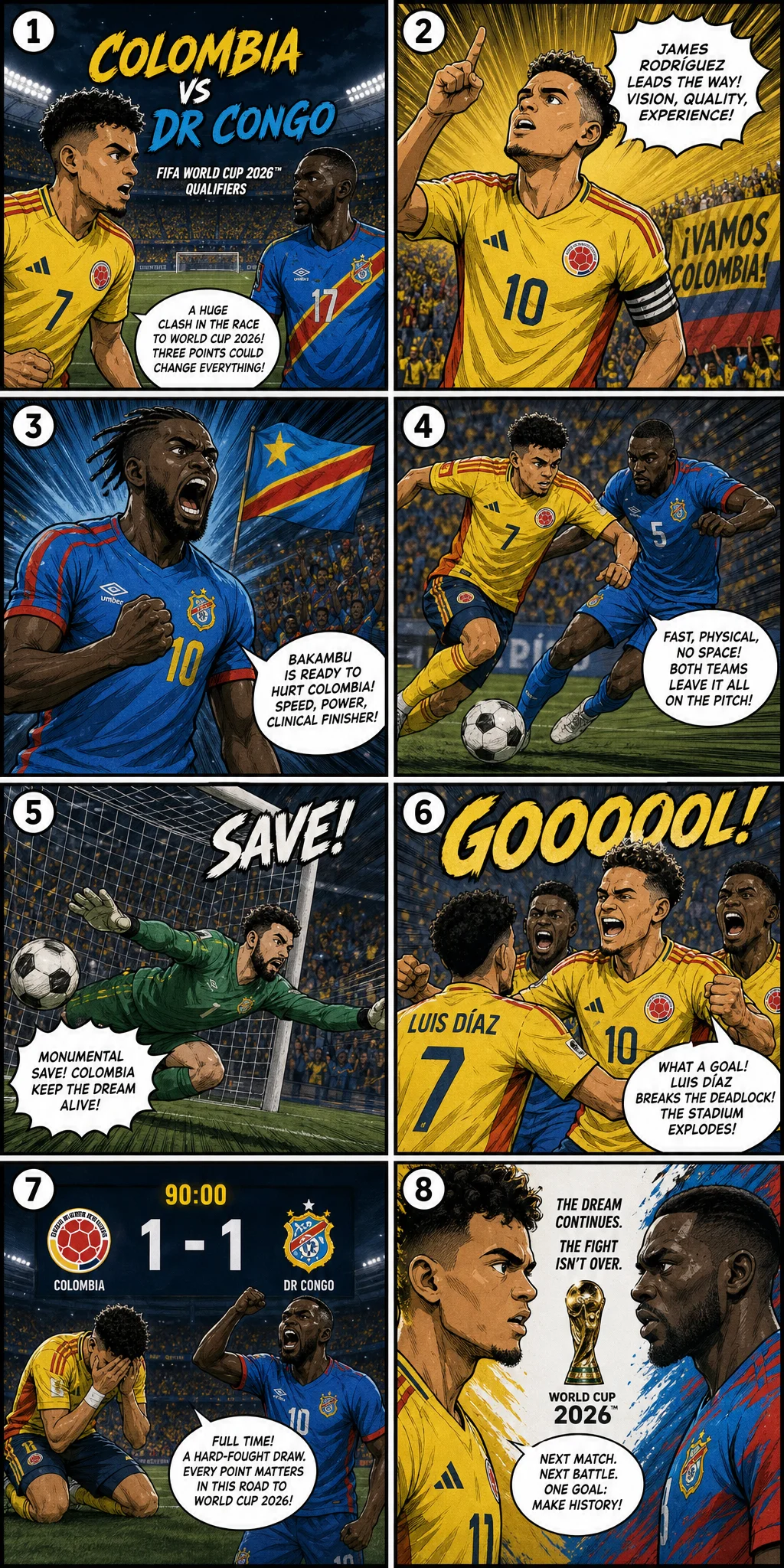
Comic content and match statistics are for entertainment purposes only and may contain inaccuracies. For Accurate Data, please refer to the reference's official website.
# Colombia vs DR Congo: Rhythm and Roots — A Diaspora Derby on the World Stage
There is a particular intensity to matches between nations whose footballing identity has been shaped by diaspora. Colombia and DR Congo share this condition — both nations whose best players are forged in European academies, whose squads are scattered across the continent's top leagues, whose connection to the home audience is mediated through television screens and social media rather than the weekly ritual of domestic football. Colombia versus DR Congo is not, in the traditional sense, a derby. But it carries the emotional charge of one: two teams that understand each other's rhythms, each other's roots, each other's specific relationship with a game that is simultaneously local and global.
Colombia enters this match needing a result to maintain its position in Group K. The opening fixture against Uzbekistan should have delivered three points, but the specific circumstances of that match — whether Colombia won comfortably, struggled, or suffered an upset — will determine the emotional state of the squad entering this second fixture. Lorenzo's team is built on a contradiction that Colombian football has always contained: attacking flair and defensive fragility, creative improvisation and organizational vulnerability. Luis Diaz provides the former. Davinson Sanchez is supposed to prevent the latter. The contradiction resolves, or it does not, and the match against DR Congo will test it in ways the Uzbekistan fixture could not.
DR Congo's Leopards play a different kind of football from any opponent Colombia faces in this group. Where Uzbekistan is organized and reactive, Congo is physical and transitional. Where Portugal is technical and possession-oriented, Congo is direct and explosive. The challenge for Colombia's defensive organization is the challenge of unpredictability — defending against a team that does not follow the predictable patterns of possession football, that attacks in bursts rather than builds, that creates danger from chaos rather than structure. Lorenzo's center-backs, Sanchez and Mina, are more comfortable dealing with aerial threats and positional attacks than with the chaotic transitions that define the Congolese approach. The coaching staff will have studied the footage. The players will have prepared the tactical responses. But preparation for chaos is always, at some level, incomplete.
The midfield duel will determine the match's character. Jefferson Lerma, Colombia's midfield anchor, must control the central spaces that DR Congo's powerful runners will attempt to exploit. Wissa and the Congolese wingers will look to bypass Lerma, attacking the spaces behind the Colombian full-backs rather than challenging the midfield directly. The Colombian response — whether to press high and risk the ball over the top, or to sit deeper and surrender the initiative to an opponent that thrives on initiative — is the tactical decision that will shape the ninety minutes.
The diaspora connection adds a layer of cultural resonance that most group-stage matches lack. Both squads contain players who grew up in Europe, who chose to represent the nation of their parents or grandparents, whose relationship with the national team is filtered through the experience of dual identity. When the Colombian national anthem plays in a stadium in North America and the Congolese anthem follows, the players singing will understand something about each other that goes beyond tactical scouting reports. They share the experience of belonging to two places, of representing a nation from a distance, of carrying expectations that are heavier because they are carried across borders.
The specific matchup between Wissa and the Colombian back line deserves closer examination. Wissa's movement is not the movement of a traditional center-forward — he drifts, he drops deep, he pulls wide, he creates confusion in the defensive structure that Congolese runners from midfield can exploit. Sanchez and Mina will need to communicate constantly, deciding who follows Wissa and who holds position, maintaining the defensive shape that Lorenzo has drilled throughout the preparation period. The moment of miscommunication — one defender stepping up while the other drops, creating the gap that Wissa's movement is designed to find — is the moment DR Congo's counter-attacking system is designed to produce.
Colombia's attacking response will likely come through Diaz isolating his full-back. The Congolese defense, for all its physical gifts, is vulnerable to the specific challenge that Diaz presents: explosive one-on-one dribbling from a standing start, the ability to go either direction, the unpredictability that makes him impossible to prepare for. If the Congolese right-back can contain Diaz without requiring a double-team, DR Congo's defensive structure holds and the midfield can focus on denying Rodriguez the space he needs to operate. If Diaz beats his man — and he usually does — the double-team opens spaces elsewhere, and the Colombian attacking patterns begin to flow.
The match is winnable for both teams, and that mutual winnability is what makes it compelling. Colombia, on talent, should win. DR Congo, on physicality and transitional threat, could win. The margin between should and could is where this group will be decided. The team that manages the emotional intensity — the diaspora derby energy, the knowledge that three points here changes everything — will emerge with the result it needs. The other will face the consequences. In a group that also includes Portugal and Uzbekistan, every point matters. Colombia and DR Congo both know that the loser of this match will almost certainly be going home. The knowledge sharpens everything.