
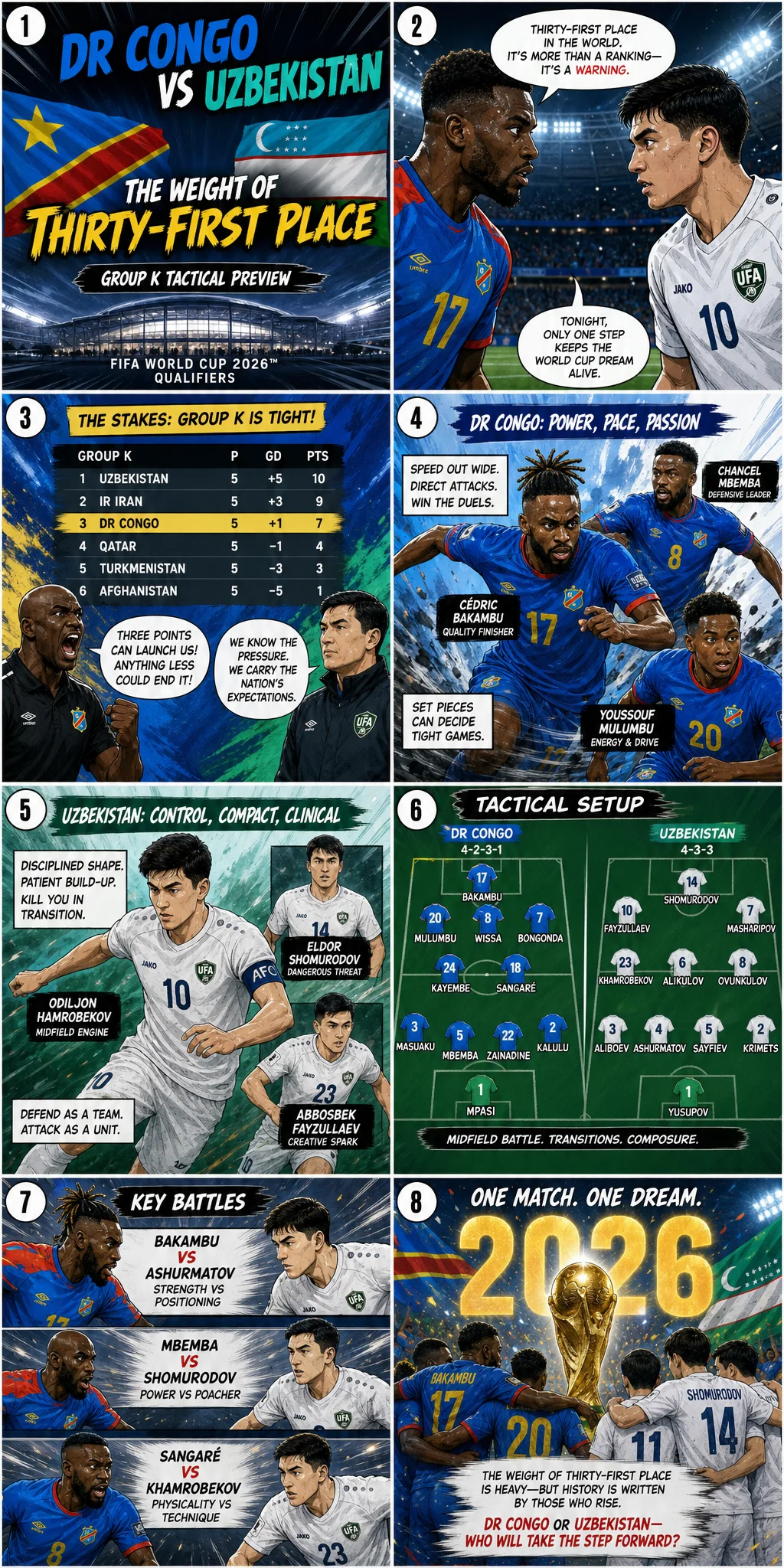
DR Congo vs Uzbekistan: The Weight of Thirty-First Place — Group K Tactical Preview
Strip away the history, the projections, the expected-group-finish tables that analytics departments produce before every major tournament, and DR Congo versus Uzbekistan becomes the most honest match of Group K. Two teams that the modeling anticipat
Published: June 6, 2026
Comic content and match statistics are for entertainment purposes only and may contain inaccuracies. For Accurate Data, please refer to the reference's official website.
# DR Congo vs Uzbekistan: The Most Winnable Match — Two Underdogs, One Shared Dream
Strip away the history, the projections, the expected-group-finish tables that analytics departments produce before every major tournament, and DR Congo versus Uzbekistan becomes the most honest match of Group K. Two teams that the modeling anticipated finishing third and fourth. Two teams that view each other as the one opponent in the group they can beat. Two nations whose World Cup stories are still being written, whose football identities are still being shaped, whose relationship with this tournament is defined by possibility rather than expectation. This is the match that both teams circled on the calendar the moment the draw was announced.
DR Congo's Leopards approach this fixture with the physical confidence of a team that believes its athletic advantages translate directly into results. The Congolese midfield is taller, faster, and more powerful than Uzbekistan's — an assertion of physical dominance that will manifest in aerial duels, second balls, and the transitional moments where raw athleticism overcomes tactical organization. Wissa, having spent the previous two matches running at elite European defenders, will find the Uzbek back line a more manageable challenge. The Brentford forward knows that his World Cup will be measured, fairly or not, by his performance in this specific match. Against Portugal, Wissa was expected to struggle. Against Uzbekistan, he is expected to deliver.
Uzbekistan's White Wolves counter with the tactical organization that carried them through eighteen months of Asian qualification. Katanec's 5-4-1 block is not designed to produce beautiful football. It is designed to produce results against opponents who expect to dominate possession but who are vulnerable to the specific frustration that organized defending creates. DR Congo, for all its physical gifts, is not Portugal. The Congolese attacking patterns are less sophisticated, the passing combinations less precise, the positional rotations less disorienting. Uzbekistan's defenders, who spent ninety minutes solving problems they had never encountered before against Portugal and Colombia, will find the Congolese problems more familiar — more like the problems they solved against Iran and South Korea. Familiarity is an underrated tactical advantage.
The midfield battle between Katanec's double pivot and Congo's physical central runners will determine the match's tempo. If Uzbekistan can control the rhythm — slowing the game when Congo wants to accelerate, compressing the spaces when the Congolese wingers look to isolate full-backs — the tactical advantage tilts toward the White Wolves. If Congo can impose its physicality, turning the match into the chaotic, transitional affair that suits its athletic gifts, the advantage tilts toward the Leopards. The first fifteen minutes will signal which team has imposed its preferred tempo.
Shomurodov versus the Congolese center-backs is the individual duel that will decide the outcome. The Uzbek forward, clever and selfless in his movement, will look to exploit the defensive lapses that Congo's aggressive approach occasionally produces. The Congolese defenders, powerful but positionally vulnerable, will look to dominate Shomurodov physically, denying him the space to receive and link play. If Shomurodov wins his duels, Uzbekistan builds attacks. If the Congolese defenders win theirs, Congo transitions quickly and Wissa gets the service he needs.
The tactical adjustments each team must make based on prior group-stage results add complexity. If DR Congo suffered a heavy defeat against Portugal, the coaching staff will have spent the intervening days managing psychological recovery as much as tactical preparation. Congo's diaspora-based squad should have the mental resources to reset. Whether the legs are willing is a separate question. Uzbekistan faces a similar challenge. If the Colombia opener resulted in defeat, Katanec must convince his players that this match — against DR Congo — was always going to define the White Wolves' tournament. Everything Uzbekistan worked for over eighteen months of qualification comes down to this.
The set-piece dimension cannot be overlooked. Both teams are tall, physical, and well-organized on dead-ball situations. DR Congo's aerial presence in the box — the center-backs, the midfield runners, the forwards who attack crosses with the aggressive intent that comes from growing up playing football in conditions where aerial dominance is a prerequisite for survival — is a genuine weapon against an Uzbek defense that, for all its organization, has not faced this specific physical challenge. Uzbekistan's response will be equally physical. Katanec's teams do not lose aerial duels without a fight.
The emotional stakes transcend the match itself. For both teams, this fixture represents the realistic ceiling of their World Cup ambitions — not winning the tournament, not reaching the semi-finals, but winning a match on the world's biggest stage, proving to themselves and to the football world that they belong. The players who take the field understand that this may be their only World Cup. The Congolese diaspora, the Uzbek diaspora, the fans who traveled across continents to witness their nation's debut — they will sing as though the tournament depends on this match, because for them, it does. The stadium will be loud, the emotions will be raw, and the ninety minutes will determine which underdog leaves the tournament with its head held high. Two teams. One victory. The most honest match of Group K.