
England vs Croatia
Luka Modrić opens his final World Cup against the opponent that defined his tournament career. England versus Croatia in Group L is a rematch of the 2018 semifinal in Moscow, where Modrić's extra-time winner sent Croatia to their first World Cup fina
Published: June 6, 2026
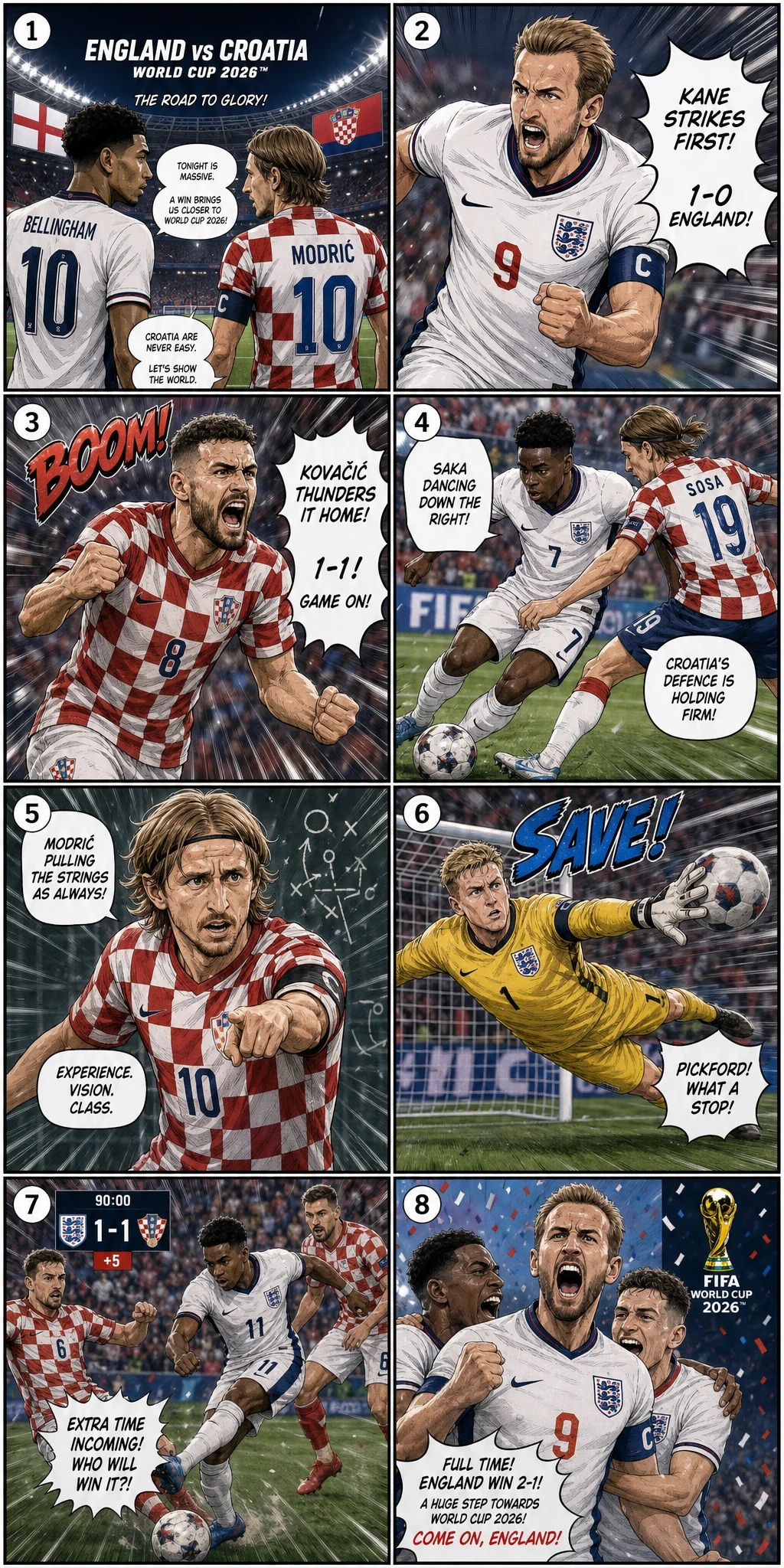
Comic content and match statistics are for entertainment purposes only and may contain inaccuracies. For Accurate Data, please refer to the reference's official website.
# England vs Croatia: Modrić's Farewell Meets Tuchel's Laboratory — Group L Opener
Luka Modrić opens his final World Cup against the opponent that defined his tournament career. England versus Croatia in Group L is a rematch of the 2018 semifinal in Moscow, where Modrić's extra-time winner sent Croatia to their first World Cup final and England into four years of what-ifs. The generational resonance of this match requires no embellishment. The present of English football — Jude Bellingham, the most complete midfielder of his generation — faces the past of Croatian genius — Modrić at forty, still conducting midfield with the economy and precision that won him the 2018 Ballon d'Or.
Tuchel's England is fundamentally different from Southgate's iteration. The tactical flexibility — shifting between 4-2-3-1 and 3-4-3 mid-match — is the quality that Southgate's emotionally stable but tactically rigid England always lacked. Bellingham operates as the creative focal point, dropping deep to collect, driving forward to destabilize, arriving in the box with timing that transforms midfielders into auxiliary strikers. Rice provides the defensive shield enabling Bellingham and Foden to take creative risks. Croatia's midfield of Modrić, Mateo Kovačić, and Marcelo Brozović — the same trio that reached the 2018 final and the 2022 semifinals — is older, slower, and more positionally intelligent than any midfield England has faced since the last time these teams met. Bellingham versus Modrić is the generational baton pass made visible on the pitch. The winner claims early control of Group L.
The weight of the 2018 semifinal hangs over this fixture in ways that neither team can escape and both should acknowledge. For England, that night in Moscow was supposed to be the breakthrough — a semifinal that the draw had gifted them, a Croatia team that had survived two consecutive penalty shootouts and 120 minutes of extra time, an opponent whose legs should have been heavier than England's but whose spirit proved lighter. Kieran Trippier's fifth-minute free kick — arcing over the wall, bending into the top corner with the specific trajectory that only the most technically perfect set-piece strikes produce — gave England the lead and the belief that the final was within reach. Then Ivan Perišić's equalizer, his outstretched leg reaching a cross that should have been cleared, his finish looping over Jordan Pickford with a defiance that seemed to come from somewhere beyond physical exhaustion. Then Mandžukić's winner in the 109th minute, a moment of predatory instinct from a striker who had spent the entire match chasing lost causes, punishing the defensive lapse that exhaustion and inexperience produced. England's players collapsed on the pitch. Modrić raised his arms. The image of Southgate consoling his young team while Croatia celebrated — the manager who had restored English dignity absorbing the pain that his players were too young to process — defined an era of English football that ended that night, even if nobody in the stadium understood it at the time.
For Croatia, the 2018 semifinal is the foundation upon which an entire generation's legacy was built. The victory over England sent Croatia to a World Cup final against France — a match they lost 4-2, a scoreline that flattered France and diminished Croatia's performance, a game in which Croatia was arguably the better team for large stretches and definitively the more heroic team throughout. The second-place finish was the greatest achievement in Croatian sporting history, surpassing the third-place finish of 1998, surpassing the basketball silver medals, surpassing every achievement that a nation of four million people has produced across every sport it has contested. Modrić's Ballon d'Or that December — the first time since 2007 that neither Messi nor Ronaldo won the award, the acknowledgment that football's greatest individual honor could recognize something other than goal-scoring statistics — was the culmination of a tournament performance that elevated Croatian football to a cultural position it had never previously occupied. The 2022 tournament reinforced the achievement: third place, a bronze medal that Croatia celebrated with more genuine joy than most nations celebrate gold, the confirmation that 2018 was not a fluke but a new standard.
The midfield battle that defined the 2018 semifinal will define this match as well, but on different terms. In 2018, Modrić and Ivan Rakitić faced Jordan Henderson, Dele Alli, and Jesse Lingard — a competent midfield, a functional midfield, a midfield that Southgate had constructed to support his attacking players rather than to dominate matches in its own right. Modrić and Rakitić dominated them, not through physical superiority but through technical precision and positional intelligence, through the specific capacity to find space in crowded central areas and to use that space to control the tempo of the match. In 2026, Modrić, Kovačić, and Brozović face Rice and Bellingham — a midfield that is younger, more athletic, and more technically complete than any midfield England has fielded since the golden generation of Lampard, Gerrard, and Scholes. The physical balance has shifted decisively toward England. The intelligence balance — the specific quality that Croatia's midfield has always possessed and that no amount of athletic development can manufacture — remains with Croatia, and the question is whether intelligence can compensate for physical decline against an opponent that combines physical superiority with technical quality in ways that previous England teams did not.
Bellingham's presence transforms this fixture in ways that are difficult to overstate. At twenty-two, he is already the most complete midfielder England has produced since Paul Gascoigne — and the comparison to Gascoigne, with its implication of genius undermined by fragility, does Bellingham a disservice. He is Gascoigne without the self-destruction, Steven Gerrard with superior tactical intelligence, Frank Lampard with superior athleticism. His season at Real Madrid — the goals, the assists, the specific quality of arriving in the penalty area at the exact moment when the cross is delivered, the capacity to play as a number eight, a number ten, or a false nine depending on what the match demands — has established him as the heir apparent to the Ballon d'Or throne that Modrić occupied in 2018. Against Croatia, Bellingham will face the midfielder who defined the position he now occupies, the player whose career established the template that Bellingham's career is extending. The personal duel between them — the older player demonstrating the positional intelligence that compensates for declining pace, the younger player demonstrating the athletic dynamism that positional intelligence cannot defend — will be the individual narrative that defines the match, regardless of whether either player scores.
Tuchel's tactical approach to this match will be scrutinized with the intensity that follows every England managerial decision. Southgate's critics — and they are legion, despite two major tournament finals — argued that his England teams were too cautious, too reactive, too willing to protect a lead rather than extend it. The 2018 semifinal is Exhibit A in their case: England scored early, then retreated, then conceded, then lost. Tuchel's England is designed to be different — designed to attack with the aggression that the available talent justifies, designed to shift formations mid-match without losing structural coherence, designed to make opponents adapt rather than adapting to opponents. Whether Tuchel can deliver on that design against a Croatia team that has never been tactically intimidated by anyone — that faced Brazil in the 2022 quarterfinal, conceded early, and simply continued playing as though the concession had not happened — is the question that will define England's tournament and, potentially, the legacy of the manager hired specifically to answer questions that previous managers could not.