

England vs Ghana
England versus Ghana carries colonial history onto the football field in a way that no pre-match ceremony can address. Ghana was the Gold Coast colony until 1957, when it became the first sub-Saharan African nation to achieve independence from Britis
Published: June 6, 2026
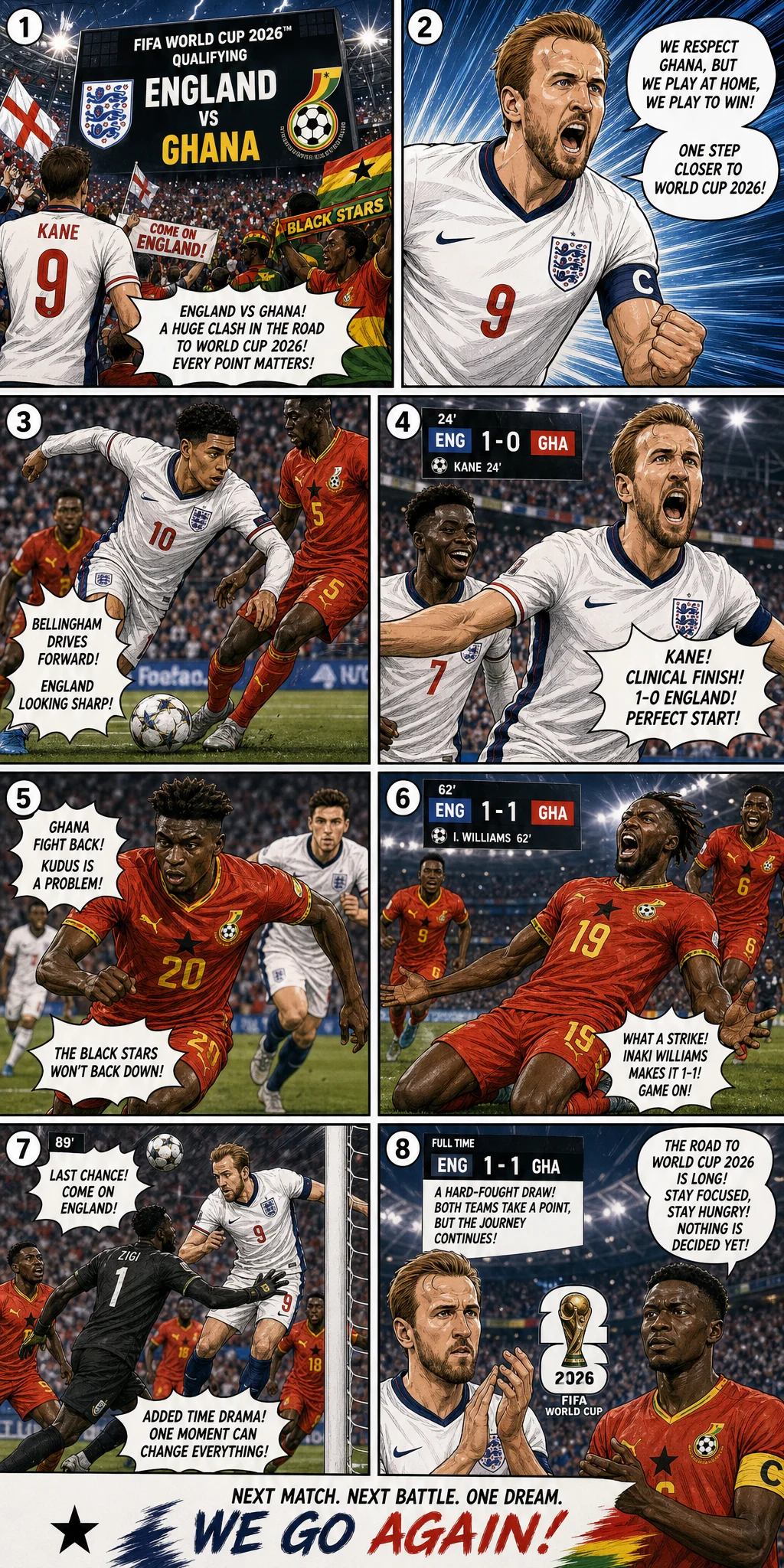
Comic content and match statistics are for entertainment purposes only and may contain inaccuracies. For Accurate Data, please refer to the reference's official website.
# England vs Ghana: Empire on the Pitch, Independence in the Stands
England versus Ghana carries colonial history onto the football field in a way that no pre-match ceremony can address. Ghana was the Gold Coast colony until 1957, when it became the first sub-Saharan African nation to achieve independence from British rule. The echoes of that relationship persist in ways both visible and invisible, and the football match that unfolds within this historical context carries weight that tactical analysis alone cannot capture.
The footballing context: England's talent advantage is significant. Bellingham, Foden, Kane, Rice — the Premier League's most accomplished players assembled in a national team system that Tuchel has made tactically flexible in ways Southgate's England never was. Ghana's physicality — Thomas Partey's midfield authority, Mohammed Kudus's explosive transitions — and refusal to be intimidated by reputation are genuine threats. Partey versus Bellingham is a Champions League-level duel transplanted to the international stage. For England, winning is expected. For Ghana, competing is a statement that transcends the scoreline. The historical resonance adds texture to a match that, on purely footballing terms, belongs to England — but World Cups do not produce purely footballing terms. They produce moments where history and sport collide, and the collision zone is where this match will be played.
Ghanaian football carries the specific weight of representing not simply a nation but a continental aspiration. The Black Stars were the first sub-Saharan African team to reach a World Cup quarterfinal — South Africa 2010, the tournament on African soil, the moment that seemed destined to produce the first African semifinalist. Luis Suarez's handball on the goal line in the final minute of extra time, the save that should have been Asamoah Gyan's winning goal, the penalty that struck the crossbar, the penalty shootout that Uruguay won — this sequence of events occupies the same position in African football mythology that the Hand of God occupies in English football mythology, except that the Suarez handball was definitively a violation, definitively punished, and definitively insufficient to produce justice. Ghana's players left the pitch in Johannesburg knowing they had been within a crossbar's width of a World Cup semifinal, knowing they had been the better team against Uruguay, knowing that the tournament of African destiny had been stolen from them by the most cynical act in World Cup history. The memory persists, and the hunger it generates — the specific desire to create a World Cup moment that replaces the Suarez handball in Ghanaian football memory — provides the emotional fuel that no tactical analysis can quantify.
The colonial history between England and Ghana is not ancient history; it is living memory that shapes the relationship between the two nations in ways that a football match both reflects and transforms. Ghana's independence in 1957 — Kwame Nkrumah's vision of a united Africa, the black star on the flag that became the team's nickname — was a repudiation of British colonial rule, and the football team that carries the Black Stars name carries that repudiation onto every pitch it occupies. England's relationship with its colonial past is more complicated, less examined, and more likely to surface in uncomfortable ways during a World Cup match against a former colony. The English players who take the field will not be thinking about colonial history — they will be thinking about the tactical instructions Tuchel has given them, the specific movements they need to make, the opponent they need to defeat. The Ghanaian players may not be thinking about it either — they are professionals focused on their jobs, not historians delivering lectures. But the supporters will be thinking about it, and the journalists will write about it, and the specific atmosphere that colonial history generates — the sense that this match means something beyond the ninety minutes it occupies — will permeate the stadium and shape the experience of everyone in it.
Thomas Partey is the player who most embodies Ghana's football identity and Ghana's competitive ambition. The Arsenal midfielder has been, at his best, one of the most complete central midfielders in the Premier League — a player who combines defensive authority with progressive passing, physical presence with technical quality, the capacity to dominate his own penalty area and to arrive in the opponent's penalty area with equal effectiveness. His partnership with Mohammed Kudus — the West Ham attacker whose explosive transitions, direct dribbling, and capacity to score from positions that do not appear threatening make him Ghana's most dangerous attacking player — defines Ghana's tactical identity: organized defense through Partey's screening, rapid transitions through Kudus's ball-carrying, and the specific chaos that African teams have historically generated against European opponents who expect to control matches and discover that control is not guaranteed. Partey versus Bellingham is, on paper, a Champions League-level midfield duel, and the specific quality of that duel — the veteran's physical authority against the prodigy's creative dynamism — will define Ghana's capacity to compete in central areas.
Kudus deserves separate and detailed attention because he represents the specific threat that England's tactical preparation must account for. His season at West Ham — the goals against elite opposition, the dribbling statistics that place him among the most effective ball-carriers in European football, the specific capacity to receive the ball in seemingly harmless positions and emerge in dangerous positions within seconds — has established him as one of the most exciting attacking players in African football. His goal against South Korea in the 2022 World Cup — receiving the ball wide on the left, cutting inside past two defenders, finishing with his right foot into the far corner — was a goal that any player in world football would have been proud to score, and it demonstrated the specific quality that England's defenders must prepare for: the capacity to create goals from situations that do not appear to be goalscoring opportunities. England's full-backs — whether Luke Shaw or Ben Chilwell on the left, whether Kyle Walker or Trent Alexander-Arnold on the right — will need to be positionally disciplined in ways that inhibit Kudus's dribbling angles. The defensive midfielders — Rice or the deeper-lying midfielder in Tuchel's system — will need to provide the cover that prevents Kudus from receiving the ball in the spaces between England's defensive lines. The preparation is straightforward; the execution, against a player of Kudus's quality, is not.
For England, this match represents a different kind of test than the Croatia opener. Croatia is a known quantity, a familiar opponent, a tactical challenge that England has been preparing for since the 2018 semifinal. Ghana is less familiar, less studied, and therefore more dangerous — the opponent that England's players know they should beat and the opponent that England's history suggests they might struggle against. The specific vulnerability of English football — the tendency to underestimate opponents from outside the traditional football powers, to assume that talent advantage translates automatically into results — has produced some of England's most painful tournament exits. The 1950 defeat to the United States, the 2010 draw with Algeria, the 2014 defeats to Italy and Uruguay, the 2016 defeat to Iceland — these results share a common thread: England expected to win because England had better players, and England discovered that better players do not guarantee better results. Tuchel's mandate is to break this pattern, to create an England team that wins the matches it should win with the professionalism that elite club football demands and international football rarely delivers. The Ghana match is a test of that mandate — not a test of whether England can compete with the world's best, but a test of whether England can dispatch the world's competitive middle class with the efficiency that championship teams require.
The atmosphere in the stadium will be distinctive in ways that favor neither team and fascinate both. Ghana's supporters — the traveling contingent from Accra and Kumasi, the diaspora communities from London and Hamburg and New York — will produce the specific sound that African supporters have brought to every World Cup they have attended: rhythmic, percussive, joyful in its noise-making, the sound of a continent that loves football with a passion that European stadium atmospheres cannot replicate. England's supporters — similarly large in number, similarly vocal in their own register, the songs and chants that have accompanied English football through decades of tournament disappointment and occasional transcendence — will respond in kind. The collision of these two supporter cultures, in a neutral venue at a World Cup, will produce an atmosphere that elevates the match beyond its competitive context. The players will feel it. The television audience will see it. And the specific quality of World Cup football — the capacity to transform a group-stage fixture between a European favorite and an African contender into an event that feels significant beyond its competitive stakes — will be on full display.