
Panama vs Croatia
Luka Modric will play his final World Cup group-stage match against Panama, and the weight of that sentence deserves a moment of silence. The Croatian midfielder, thirty-nine years old and still operating at a level that defies biological probability
Published: June 6, 2026
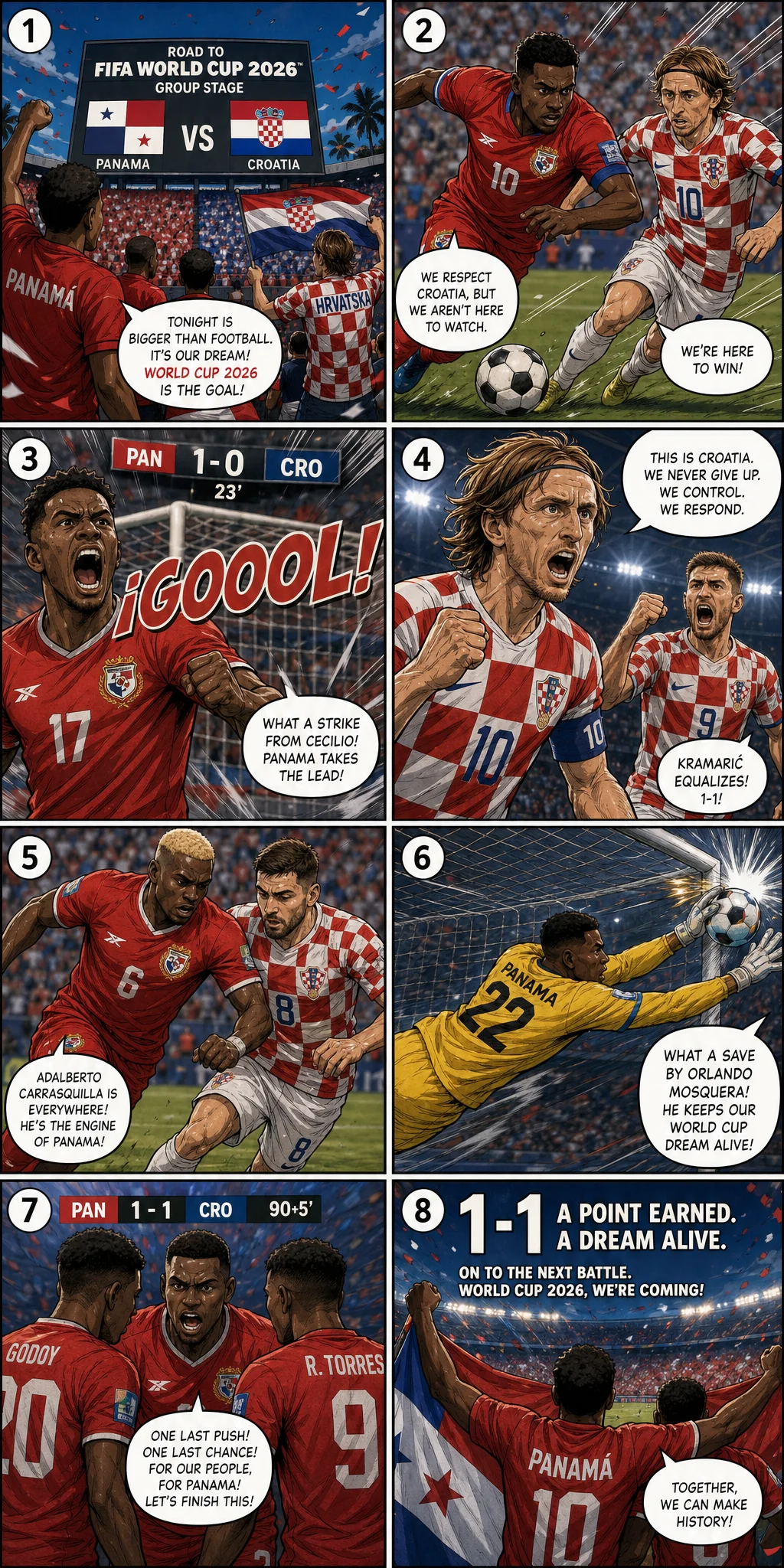
Comic content and match statistics are for entertainment purposes only and may contain inaccuracies. For Accurate Data, please refer to the reference's official website.
# Panama vs Croatia: The Final Lesson — Modric's Group Stage Farewell
Luka Modric will play his final World Cup group-stage match against Panama, and the weight of that sentence deserves a moment of silence. The Croatian midfielder, thirty-nine years old and still operating at a level that defies biological probability, has been the defining figure of Croatian football for nearly two decades. The 2018 World Cup final, the Golden Ball, the tears and the ovation at Luzhniki Stadium. The 2022 third-place finish, the penalty shootout victories, the refusal to accept that a nation of four million people cannot compete with football's superpowers. Modric's career is an argument against limits, and the match against Panama is the final piece of evidence in the group-stage portion of that argument.
Croatia enters this match likely needing a result to secure qualification, depending on the outcomes of the earlier group fixtures. The Zlatko Dalic system — the 4-3-3 that morphs into a 4-1-4-1 in possession, built around Modric's metronomic control of tempo — has been refined over three major tournaments and eight years of sustained excellence. Marcelo Brozovic provides the defensive coverage that allows Modric to operate in the spaces between the opposition's midfield and defensive lines. Mateo Kovacic provides the dribbling penetration that breaks lines and creates numerical advantages. The midfield three — Modric, Brozovic, Kovacic — has been playing together so long that their movements have become instinctive. It is the best midfield unit in Group L, and one of the best in the entire tournament.
Panama's task against this midfield is, on paper, impossible. The Canaleros' 4-4-2 block will attempt to compress the spaces Modric wants to occupy, denying him the time to lift his head and find the pass that breaks the defensive structure. The plan will work for periods — Panama's defensive organization under Thomas Christiansen has been the foundation of their qualification campaign — but Modric has spent his career solving precisely this problem. The body feint that creates half a yard. The outside-of-the-foot pass that no opponent expects. The decision-making speed that means by the time the defender has identified the danger, the danger has already passed. Modric does not overwhelm defenses with physical power. He overwhelms them with the accumulated intelligence of a thousand professional matches.
The emotional resonance of this match extends beyond the tactical details. Modric's farewell to the World Cup group stage is not yet a farewell to the tournament — Croatia expects to advance, expects to compete in the knockout rounds, expects to extend the Modric era for as long as the bracket allows — but it is a milestone. The player who debuted at World Cup 2006 in Germany, who was twenty years old and anonymous outside Croatian football circles, has become one of the defining footballers of his generation. The 2018 Golden Ball, breaking the Messi-Ronaldo duopoly, was the moment the football world acknowledged what those who watched Real Madrid weekly already knew. Modric is not merely great. Modric is essential. The game has changed around him — faster, more physical, more systematized — and he has adapted without losing the qualities that made him exceptional.
Panama will not be a passive participant in this farewell. The Canaleros arrived at World Cup 2026 to compete, not to serve as ceremonial opposition. The 2018 experience in Russia — three defeats, eighteen goals conceded, the brutal education of a World Cup debutant — has been the foundation for everything Panama has built since. The defensive organization is tighter. The transitions are sharper. The belief, the essential belief that Panama belongs at this level, is stronger. The players who take the field against Modric's Croatia will not be overawed. They will be ready.
The most likely scenario is a Croatian victory built on midfield control, a goal from a set piece or a moment of Modric magic, and a professional performance that secures qualification. But the story of this match is not the result. The story is the final lesson: a generation of Panamanian footballers, watching Modric operate at thirty-nine with the grace and intelligence of a player a decade younger, learning what it means to build a career on technical excellence rather than physical dominance. Modric's final group-stage match is not just a farewell. It is an education. Panama will be grateful for the lesson, even as it hopes to disrupt the curriculum.