
Croatia vs Ghana
The final matchday of Group L likely arrives with Croatia and Ghana contesting the second qualification spot behind an England team that should have already secured passage to the knockout stage. The precise arithmetic will depend on the earlier resu
Published: June 6, 2026
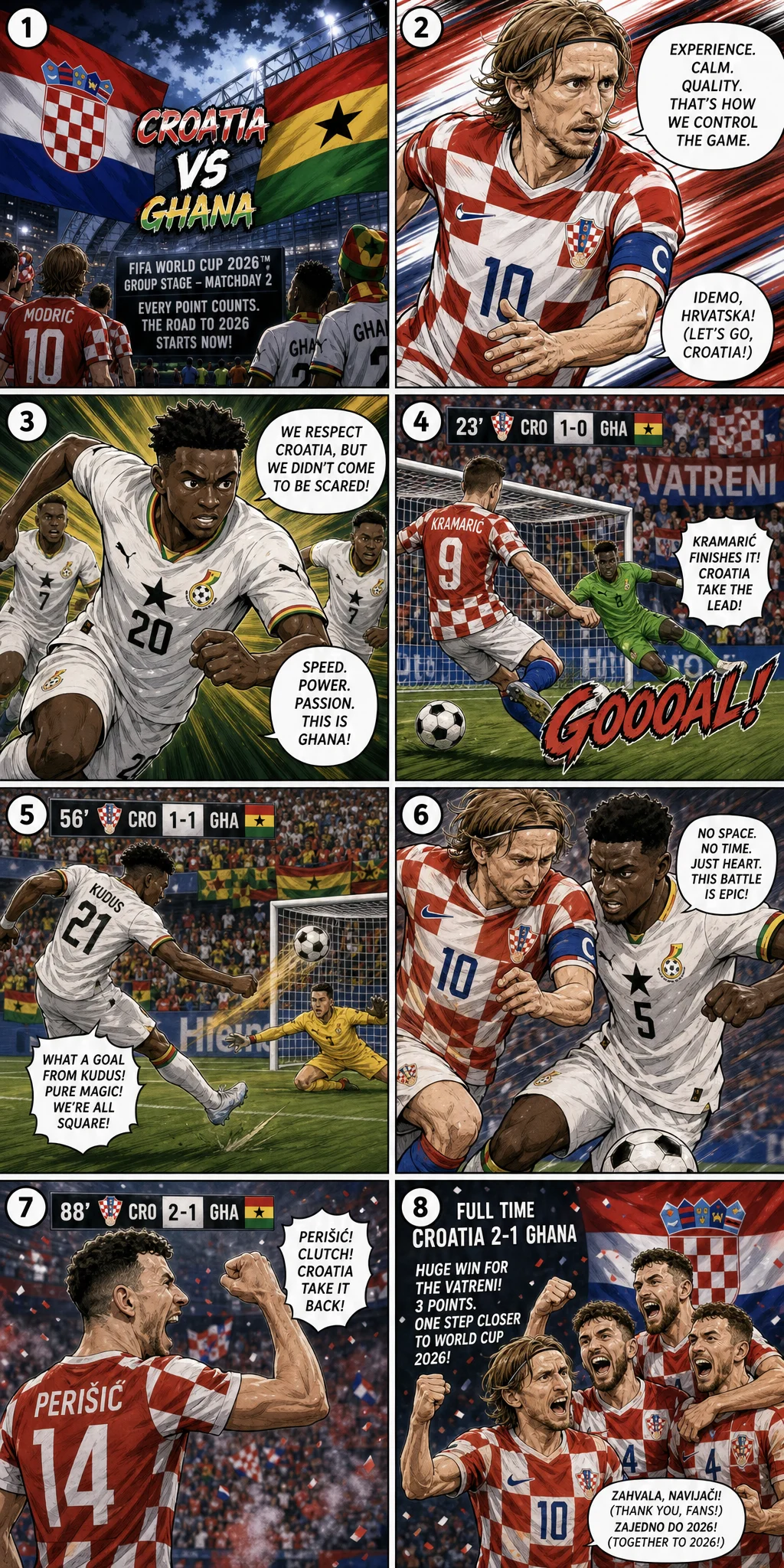
Comic content and match statistics are for entertainment purposes only and may contain inaccuracies. For Accurate Data, please refer to the reference's official website.
# Croatia vs Ghana: The Modric Group Finale — Knockout Qualification on the Line
The final matchday of Group L likely arrives with Croatia and Ghana contesting the second qualification spot behind an England team that should have already secured passage to the knockout stage. The precise arithmetic will depend on the earlier results, on goal differences and head-to-head records and the specific mathematics of group-stage resolution, but the essential scenario is clear: Croatia versus Ghana, Modric versus Kudus, the 2018 finalist against the 2010 quarter-finalist, with a place in the round of thirty-two hanging in the balance. Ninety minutes to determine whose World Cup continues and whose ends.
Croatia's experience in these situations is unmatched in this group. The 2018 World Cup, where Dalic's team navigated three consecutive knockout matches that went to extra time — Denmark, Russia, England — before falling to France in the final. The 2022 World Cup, where Croatia eliminated Japan and Brazil in penalty shootouts before losing to Argentina in the semi-final. The Croatian national team has played more knockout football in the last eight years than almost any nation in the world, and that accumulated experience — the specific knowledge of how to manage the emotional intensity of win-or-go-home matches — is the most valuable asset Croatia possesses.
Modric, in his final World Cup group-stage match, will be asked to do what he has always done: control the tempo, find the passes that break defensive lines, and provide the leadership that transforms a collection of talented players into a team that believes it cannot lose in the moments that matter most. At thirty-nine, his legs cannot cover the ground they once covered. His mind, however, remains the sharpest on the pitch. The passes arrive earlier than the opponent expects because Modric sees the play developing before the opponent has recognized the danger. The body feints create space because Modric knows where the defender will move before the defender has decided. This is the wisdom of a thousand professional matches, and it is the weapon that Croatia will deploy against a Ghana team that will attempt to overwhelm Modric physically — pressing him, kicking him, denying him the time that his game requires.
Ghana's Black Stars counter with youth and physicality. Mohammed Kudus, twenty-five years old and entering his prime, carries the creative burden that Modric carried for Croatia at the same age. Thomas Partey, the Arsenal midfielder who has spent his career competing against the best players in the Premier League, provides the defensive platform that allows Kudus to operate with creative freedom. The plan is not subtle: press Croatia's midfield relentlessly, deny Modric the time to dictate tempo, and trust that the physical advantage Ghana's athletic squad possesses can overcome Croatia's technical superiority. It is the plan that has worked, on occasion, against technically superior opponents. The question is whether it can work against the most technically gifted midfielder of his generation.
The psychological dimension of this match is the factor that tactical analysis struggles to capture. Ghana has not reached the World Cup knockout stage since 2010 — the Suarez handball quarter-final, the moment that has defined Ghanaian football for sixteen years. The current generation of Black Stars players grew up watching that match, internalizing the injustice, carrying the burden of a nation that believes it was denied its rightful place in World Cup history. The opportunity to reach the knockout stage — not as underdog participants but as legitimate contenders — is the opportunity to rewrite that history. The weight of that opportunity is simultaneously motivating and immobilizing. Which it becomes depends on what happens in the first fifteen minutes.
Croatia has its own psychological history, and it is the opposite of Ghana's. Croatia has won the matches that Ghana has lost. The penalty shootout victories are a testament to a national character that has been forged in the crucible of tournament football — the resilience, the refusal to panic, the specific confidence of a team that has been here before and emerged victorious. When the match reaches its decisive moments — and it will, because matches of this magnitude always do — Croatia will draw on the accumulated memory of 2018 and 2022. Ghana will draw on the memory of 2010. One memory is a foundation. The other is a wound.
The match will be decided by which midfield imposes its will. If Modric finds his rhythm, if Brozovic and Kovacic provide the platform, if the Croatian passing carousel begins to turn and Ghana's press cannot disrupt it, Croatia will control the match and create the chances that secure qualification. If Partey and the Ghanaian midfield can disrupt Croatia's rhythm, if Kudus can find the spaces between Croatia's defensive lines, if the physical battle tilts toward the African side, Ghana can produce the result that would represent the nation's most significant World Cup achievement since 2010. Modric's group-stage farewell. Ghana's redemption. Group L has built toward this match. The stage belongs to whoever claims it.