
Panama vs England
England's final group match against Panama concludes what should be a straightforward group-stage campaign and provides Thomas Tuchel his last opportunity to calibrate before knockout football begins. Panama faced England in 2018 and lost 6-1 — a def
Published: June 6, 2026
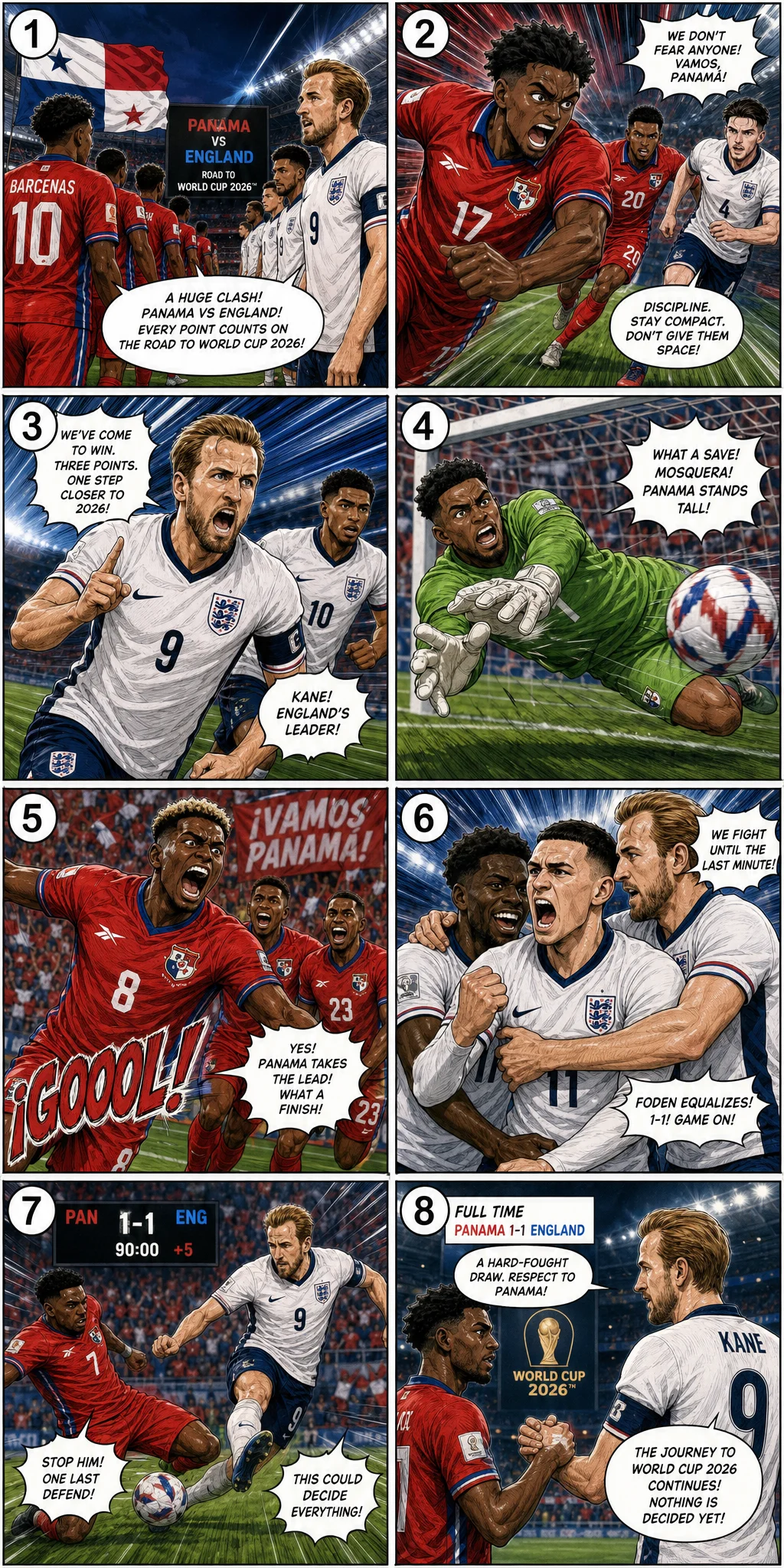
Comic content and match statistics are for entertainment purposes only and may contain inaccuracies. For Accurate Data, please refer to the reference's official website.
# Panama vs England: The Final Examination — Tuchel's Tactical Fine-Tuning
England's final group match against Panama concludes what should be a straightforward group-stage campaign and provides Thomas Tuchel his last opportunity to calibrate before knockout football begins. Panama faced England in 2018 and lost 6-1 — a defeat so comprehensive that the Panamanian players reportedly asked for English shirts after the final whistle, treating the match as a pilgrimage rather than a competition. The 2026 Panama squad arrives with harder-earned tournament knowledge, a more organized defensive structure, and the specific pride of a nation that refuses to be anyone's group-stage appetizer. The narrative has shifted. England knows it. The question is whether the result will shift as well.
Tuchel's England is a project that exists in the strange space between expectation and uncertainty. The squad is among the deepest in the tournament — Bellingham, Kane, Rice, Foden, Saka, Alexander-Arnold, a collection of talent that rivals any nation's — but the performances in the group stage have been, by Tuchel's own demanding standards, incomplete. The patterns are there. The pressing triggers are there. The positional rotations are there. What has been missing is the fluidity, the seamless execution that Tuchel's best teams — the Chelsea that won the Champions League in 2021, the Paris Saint-Germain that reached the final in 2020 — produced as a matter of course. England is still learning Tuchel's system. The match against Panama is the final lecture before the final examination begins.
England's priorities are clear: win convincingly, manage squad rotation to preserve legs for the knockout stage, and use the match to fine-tune the tactical details that will determine the tournament's outcome. Tuchel will test formations — perhaps the 3-4-3 that worked so effectively at Chelsea, perhaps the 4-2-3-1 that maximizes Bellingham's creative influence — and evaluate which squad players can be trusted against knockout opposition. The match is simultaneously meaningless for England's group-stage ambitions and essential for their tournament preparation. The contradiction is not lost on Tuchel, a manager who treats every training session as though a Champions League trophy depends on it.
The individual decisions Tuchel must make in this match reveal the depth of England's squad — and the complexity of managing it. Does Harry Kane start, maintaining his rhythm and pursuing the goals that could secure a second consecutive World Cup Golden Boot, or does he rest, preserving his thirty-three-year-old legs for the knockout rounds? Does Jude Bellingham play sixty minutes to maintain his connection with Kane and Saka, or does Tuchel use the match to build chemistry with the alternative midfield combinations he may need later in the tournament? Does Trent Alexander-Arnold start at right-back, testing his defensive reliability against a Panama side that will target his flank, or does Kyle Walker's pace provide a safer option? These are the decisions that keep Tuchel awake at night, and they are the decisions that separate tournament-winning managers from the rest.
Panama's objective is simpler: make England work. The Canaleros' 4-5-1 low block, honed through CONCACAF qualifying against opponents far more talented on paper, is designed to compress space, deny central passing lanes, and frustrate teams that expect to dominate. The plan will not work for ninety minutes — Panama's squad, largely built from MLS and Central American leagues, cannot match England's Premier League talent over a full match — but it will work long enough to send a message. Panama arrived at this World Cup to compete, not to serve as a training exercise for bigger nations.
The 2018 match casts a long shadow over this fixture. Panama versus England, in Nizhny Novgorod, was the day Panama scored its first World Cup goal — Felipe Baloy's diving header, a moment of pure joy that the Panamanian bench celebrated as though they had won the tournament. The 6-1 scoreline was secondary to that moment, to the tears in the stands, to the knowledge that a nation of four million people had announced its presence on the world stage. The 2026 Panama squad wants more than a goal. It wants a performance that demonstrates the progress of eight years — the tactical education, the physical preparation, the mental resilience that transforms hopeful participants into credible competitors.
Tuchel's England needs three points and zero injuries. Panama needs a performance that demands respect. The objectives are compatible only if England treats the match as seriously as Panama will. Tuchel understands this. His team talks before group-stage finales are not about the opposition — they are about the standards that champions impose on themselves regardless of the circumstances. The match against Panama is not about Panama. It is about England, about the system, about the fine-tuning that determines whether this generation of English talent can finally deliver the trophy that has eluded them since 1966.