

The Referee Had a Few Drinks After Work
At the 2026 World Cup, every offside decision will be rendered as a 3D skeletal animation displayed simultaneously on stadium screens worldwide. The technology is remarkable. The implications run deeper than most football administrators are prepared
Published: June 6, 2026
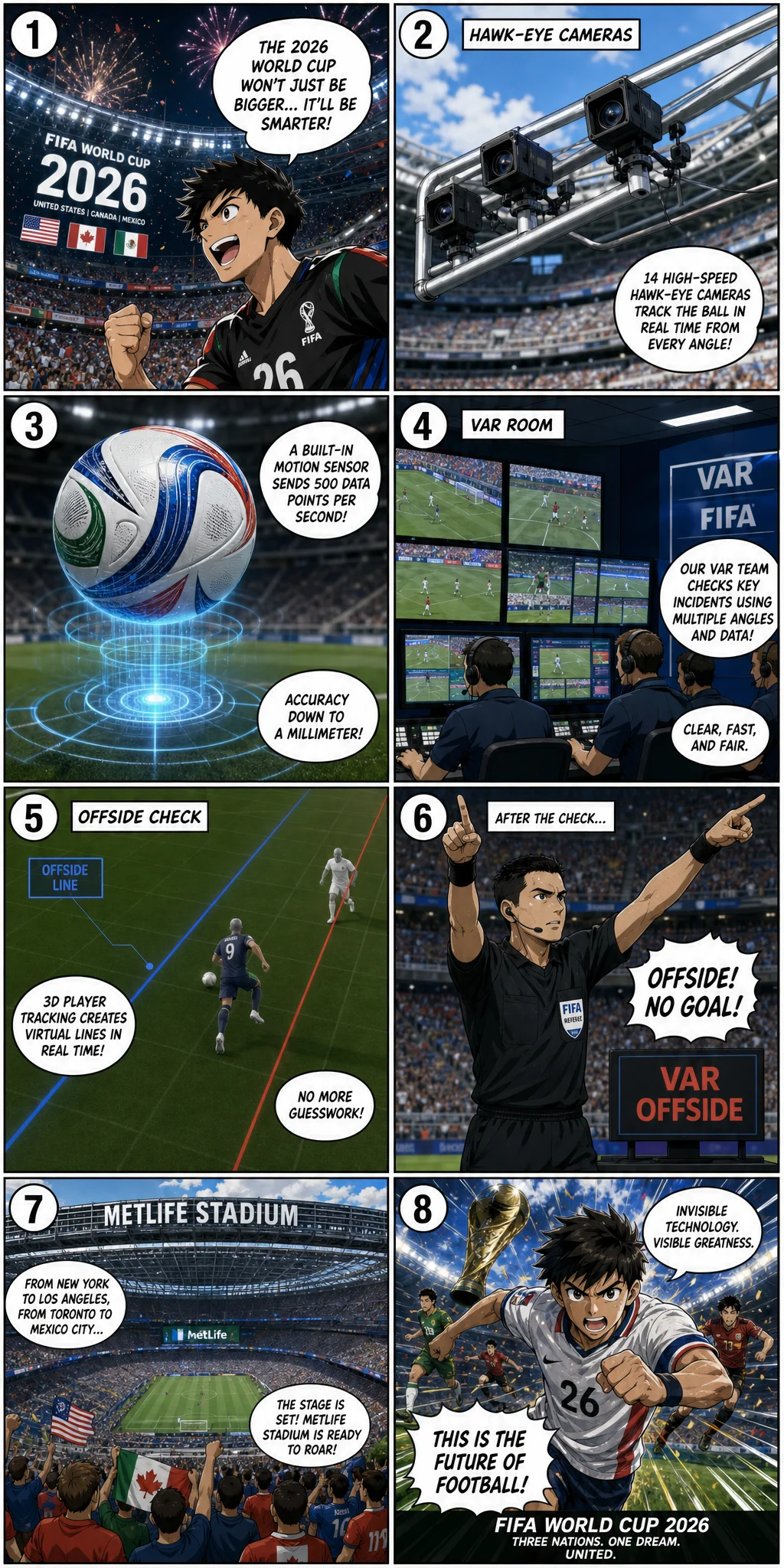
Comic content and match statistics are for entertainment purposes only and may contain inaccuracies. For Accurate Data, please refer to the reference's official website.
# Semi-Automated Offside Technology and the Question of Who Decides Football
At the 2026 World Cup, every offside decision will be rendered as a 3D skeletal animation displayed simultaneously on stadium screens worldwide. The technology is remarkable. The implications run deeper than most football administrators are prepared to discuss. Because the real question Semi-Automated Offside Technology raises is not whether it works — it demonstrably does, with accuracy rates approaching perfection and decision times dropping from seventy seconds to twenty-five. The real question is what kind of game football becomes when measurement replaces judgment. To understand that question, we need to go back to the afternoon it became unavoidable.
November 22, 2022. Qatar. Argentina versus Saudi Arabia. The moment Lautaro Martinez put the ball in the net, he turned and ran. His teammates swarmed him. The Lusail Stadium shook — the Argentine end, at least. Then, nothing happened. Referee Slavko Vincic did not blow his whistle. He did not run to the VAR monitor. He just stood there, right hand pressed gently to his earpiece, looking like a man listening to a very long voice message. The stadium screen lit up with the iconic image of the 2022 World Cup: a 3D skeletal animation, twenty-nine glowing data points mapped along Martinez's body, the offside line slicing through his shoulder. The margin: "millimeters."
Two years later, I found myself in a London pub with a retired Premier League linesman. I asked what he thought about Semi-Automated Offside Technology. He took a sip of his beer. "When we raised the flag, it came from a feeling. You're watching the midfielder play the pass, tracking the last defender's foot out of the corner of your eye, and reading the moment the striker starts his run. You don't see it frame by frame. You see the whole thing. Sometimes you put the flag up because you know he was off. SAOT doesn't do that. SAOT doesn't know anything. SAOT just measures. So my question is — is football a measuring game, or a judging game?"
Let me explain how the 2026 system actually works. Twelve tracking cameras hang under the stadium roof, tracking 29 skeletal points on 22 players simultaneously, 50 times per second — wrist, ankle, tip of shoulder, center of knee. Meanwhile, inside the Adidas match ball sits a 14-gram inertial measurement unit with a three-axis accelerometer and gyroscope, suspended at the exact center of the ball on elastic MEMS filaments. It pings the system 500 times per second. A human blink takes about 100 milliseconds. In that same window, the sensor has collected 50 data points and concluded the tip of a striker's right toe was three millimeters ahead of the defender's shoulder.
The AI sends its verdict to the VAR operations room — a darkened space resembling a nuclear submarine control center. Behind the screens sits a human being, looking at the red line, judging whether it is drawn correctly. Only when they nod does the message reach the referee's earpiece. The AI measures. The human believes.
For the 2026 tournament, FIFA introduced something genuinely confrontational to the relationship between humans and technology in sport: stadium display of the offside decision. The stadium screen shows the 3D graphic. Every person in the building sees the skeleton, the red line, exactly what the VAR official sees. No hiding behind "VAR check complete." It is an interaction, not a pronouncement. The crowd becomes participant rather than recipient. You might think this makes everything feel cold and algorithmic. But the opposite is happening. Because when the stadium shares the evidence, and the evidence is good, people believe it.
Here is the uncomfortable truth no one wants to discuss: technology does not end arguments. It changes them. Before SAOT, we argued about whether the linesman was corrupt or blind. Now we argue about whether the calibration was correct, whether the frame chosen for "moment of contact" was the right frame, whether a shoulder measured three millimeters ahead constitutes a "clear and obvious" advantage anyone should care about. We have not stopped arguing. We have just gotten more sophisticated about what we argue about.
The real question about SAOT is not whether it works. It does work. The data shows average offside decision time dropped from 70 seconds to 25 seconds, accuracy improved to near-perfect, the cascade of errors that human perception introduces into tight decisions has been virtually eliminated. The real question is whether football wants to be a game of measurement or a game of judgment. The technology is ready for 2026. The question is whether we are.
The 2026 World Cup marks a inflection point in the relationship between technology and football officiating. The ball sensor and skeletal tracking system deployed at Qatar 2022 proved the concept. The stadium display protocols introduced for 2026 transform the spectator experience from passive reception to active participation in the decision-making process. But the deeper question — the one the retired linesman raised in that London pub — remains unanswered. Is football a measuring game or a judging game? The technology measures beautifully. It calculates limb positions to millimeter precision, detects ball contact to half-millisecond accuracy, and renders the results in 3D graphics that would have seemed like science fiction to the linesmen who flagged Pele offside in 1966. But measurement is not judgment. The AI does not know whether a three-millimeter offside shoulder constitutes a meaningful advantage. It does not know whether the spirit of the offside law — preventing attackers from gaining unfair positional advantage — is violated by a toe ahead of a knee. It simply measures. Humans judge. The partnership between the two — the algorithm that calculates and the VAR official who decides, the data that informs and the referee who rules — is the specific tension that defines modern football officiating. The 2026 World Cup will not resolve this tension. It will make it more visible, more transparent, and more debated. Which is, in its own way, exactly what the sport needs. We have not stopped arguing about offside. We have just gotten better at arguing. And the evidence, at least, is now available to everyone.
The retired linesman finished his beer that afternoon in the London pub and said one more thing before he left. "The technology is good. I mean it. It's better than I was. But here's what worries me — when you take the flag away and replace it with a sensor, you take away the human being who knows that this is a game. A game played by people, watched by people, judged by people. The sensor doesn't know it's a game. The sensor just measures. And measurement, without judgment, eventually stops being sport and starts being something else." He walked out into the London rain. The pub TV was still showing Champions League highlights. I sat there thinking about what he'd said. The 2026 World Cup will feature the most sophisticated officiating technology in the history of team sports. The decisions will be faster, more accurate, and more transparent than at any previous tournament. But the question the retired linesman raised — is football a measuring game or a judging game? — will not be answered by the technology. It will be answered by what we decide the technology is for. Measurement, or judgment. Precision, or wisdom. The AI, or the human. The World Cup will give us the answer. We just have to decide which answer we are willing to accept.