

I Wore a Down Jacket in a Texas Stadium
The World Cup in North America will be played in June and July — summer in the Northern Hemisphere, when temperatures in Arlington, Texas routinely exceed forty degrees Celsius. The matches will be played in comfort. The players will sprint for ninet
Published: June 6, 2026
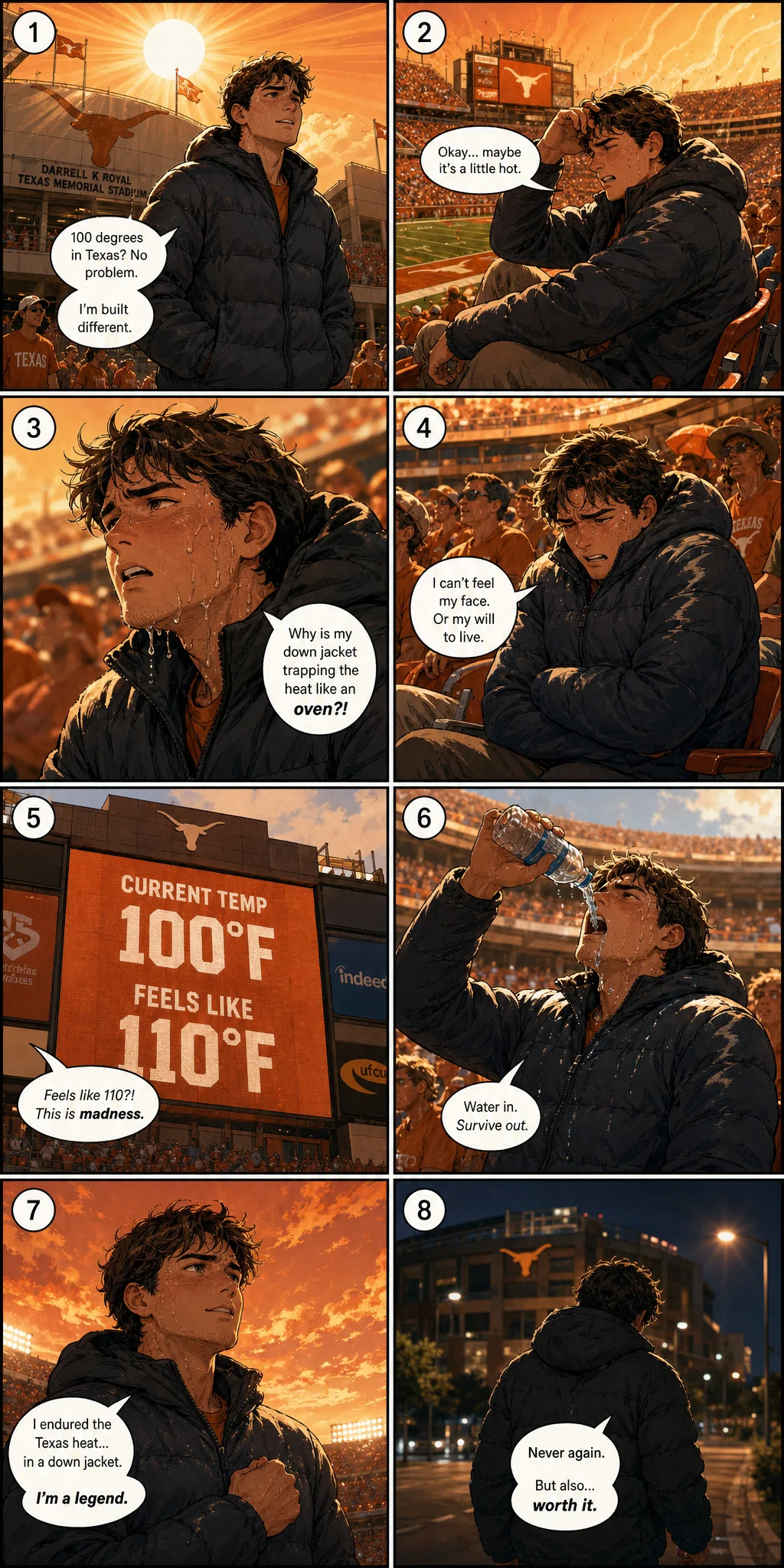
Comic content and match statistics are for entertainment purposes only and may contain inaccuracies. For Accurate Data, please refer to the reference's official website.
# The Invisible Technology Cooling World Cup 2026
The World Cup in North America will be played in June and July — summer in the Northern Hemisphere, when temperatures in Arlington, Texas routinely exceed forty degrees Celsius. The matches will be played in comfort. The players will sprint for ninety minutes without heat exhaustion. The spectators will sit in air-conditioned stands while the outside world bakes. This is not luck or meteorology. This is engineering — the invisible achievement of a cooling technology first developed for the Qatar desert and now exported to American football stadiums never designed for summer soccer. To understand how it works, I went to Arlington.
June 23, 2026. Two in the afternoon. Arlington, Texas. Outside: 41 degrees Celsius, the heat shimmering off the asphalt. The second I climbed out of my rental car, my skin felt like a sheet of baking paper sliding into a hot oven. I walked through the doors of AT&T Stadium. Five seconds. My t-shirt went from "appropriate clothing choice" to "regrettable mistake" to "completely irrelevant." The air wrapped around my body in a way that made the 41-degree world outside disappear like a bad dream. An old man in cowboy boots buying a hot dog glanced over and grinned. "First time?" "First time in summer." "You hang tight. Second half gets colder. They're worried about the grass."
Before the 2022 World Cup kicked off, the entire planet was laughing. "A World Cup in the desert? Air-conditioned stadiums? Sounds like pointing a desk fan at the Sahara." Then the tournament started. Then everyone shut up. Qatar's AC was not flawless — some stadiums got so cold spectators bought jackets at gift shops, others had weird temperature layers — but a country where summer temperatures hit fifty degrees Celsius successfully kept eight stadiums between 21 and 24 degrees. Twenty years ago, this sentence would have been science fiction.
The key figure is a Sudanese-born engineer named Saud Abdulaziz Abdul Ghani. Everyone calls him "Dr. Cool." He spent thirteen years at Qatar University working on one question: how do you create a microclimate suitable for extreme human exertion inside an environment aggressively unsuitable for any human exertion? The answer was not "add more air conditioning." The answer was rethinking how air itself moves.
The standard logic for cooling a stadium: big ducts in the roof, blow cold air downward. Problem: cold air is heavier than warm air. Blow cold air from above, it sinks. Warm air rises. Net result: stands freezing, pitch an oven, technical area a sauna. Also, a stadium is not a sealed box. Chilled air leaks out through every gap. Qatar's solution — "spot cooling" — is a completely different philosophy. Don't blow from the roof. Blow from under the seats. A small vent beneath every seat. Cold air rises from your ankles, but because it's heavier than the surrounding air, it stays pooled around your body. As it warms up and becomes lighter, it drifts upward, where a recirculation system under the stands pulls it back, cools it, and sends it back to your feet. This is "stratified cooling" — you are only cooling the bottom two meters. The twenty meters of empty air above the stands? Let it boil. Nobody's sitting up there.
What about the pitch? Along the sidelines, nozzles blast cold air at a precisely calculated angle across the turf — not downward, which would interfere with ball flight, but horizontally. A carpet of cold air gliding above the grass. The ball rolls normally. The players sprint normally. The grass stays at 22 degrees.
For the 2026 World Cup, the technology has been exported to North America with adaptations for each venue. AT&T Stadium in Arlington poses a unique challenge: a retractable roof stadium in a climate where 40-plus degree days are common in June. The solution borrows from Qatar but with Texas-sized modifications. The air handling units are larger. The cooling load calculations account for the specific humidity profile of North Texas summers. The pitch-level cooling system works in conjunction with the stadium's existing HVAC to maintain the 22-degree grass temperature that FIFA mandates.
The technology creates a paradox. A World Cup played in American summer heat, in stadiums originally built for American football, cooled by technology developed in the Qatari desert — this is globalization as infrastructure, not as abstraction. The Qatar World Cup proved that cooling technology worked at tournament scale. The 2026 World Cup is the proof that the technology is portable, that it can work across different climates, different stadium architectures, and different cultural contexts. The invisible achievement of World Cup 2026 will be the temperature. Engineers solved the desert. Now they are solving Texas, Los Angeles, and every other venue where summer heat would make elite football impossible. Nobody will notice unless it fails — which is, in engineering terms, the highest possible compliment.
The old man in cowboy boots was right about one thing: the second half got colder. By the seventy-fifth minute, I was genuinely grateful for the down jacket I had brought as a joke. The cooling system had been calibrated, as he predicted, to account for the additional body heat generated by twenty-two athletes sprinting for an hour and a half. The engineering was invisible. The experience was seamless. Nobody in the stadium thought about the temperature except to note, in passing, that it was remarkably comfortable for a June afternoon in Texas. That is the definition of successful engineering: the solution that disappears into the background, that becomes so natural you stop noticing it exists. The 2026 World Cup will be played in climate-controlled comfort across a continent that spans Arctic to tropical. The achievement will be invisible. The football will be visible. And the engineers who made it possible — Dr. Cool and his counterparts across Qatar and North America — will have done their job so well that nobody will remember they were ever needed. Which is, in engineering terms, the highest possible compliment.
There is a philosophical dimension to the cooling technology that deserves acknowledgment. A World Cup played in June and July across North America — from the Mexican plateau to the Texas plains to the Northeastern seaboard — confronts climate conditions that, fifty years ago, would have made the tournament impossible in these locations. The 1994 World Cup in the United States was played in stadiums without climate control, and the midday matches in Florida and Texas became notorious for their physical toll on players. The 2026 tournament, by contrast, deploys technology developed in the Qatari desert to create microclimates that maintain optimal playing and spectating conditions regardless of external temperature. This is progress in the most literal sense — the application of engineering knowledge to a problem that previously limited where and when the world's most popular sport could be played. But it also raises questions about what kind of sport football becomes when it detaches itself from environmental conditions that have historically shaped its character. The World Cup has always been as much about context as competition — the altitude of Mexico City, the heat of Guadalajara, the monsoon of some Asian venues. When every stadium is cooled to an optimal 22 degrees, when every pitch is maintained at perfect grass temperature regardless of the climate outside, the tournament gains in consistency what it loses in character. The tradeoff is real. The technology is remarkable. And the invisible achievement of World Cup 2026 — the achievement nobody will notice unless it fails — is the one that made the entire tournament possible in the first place.